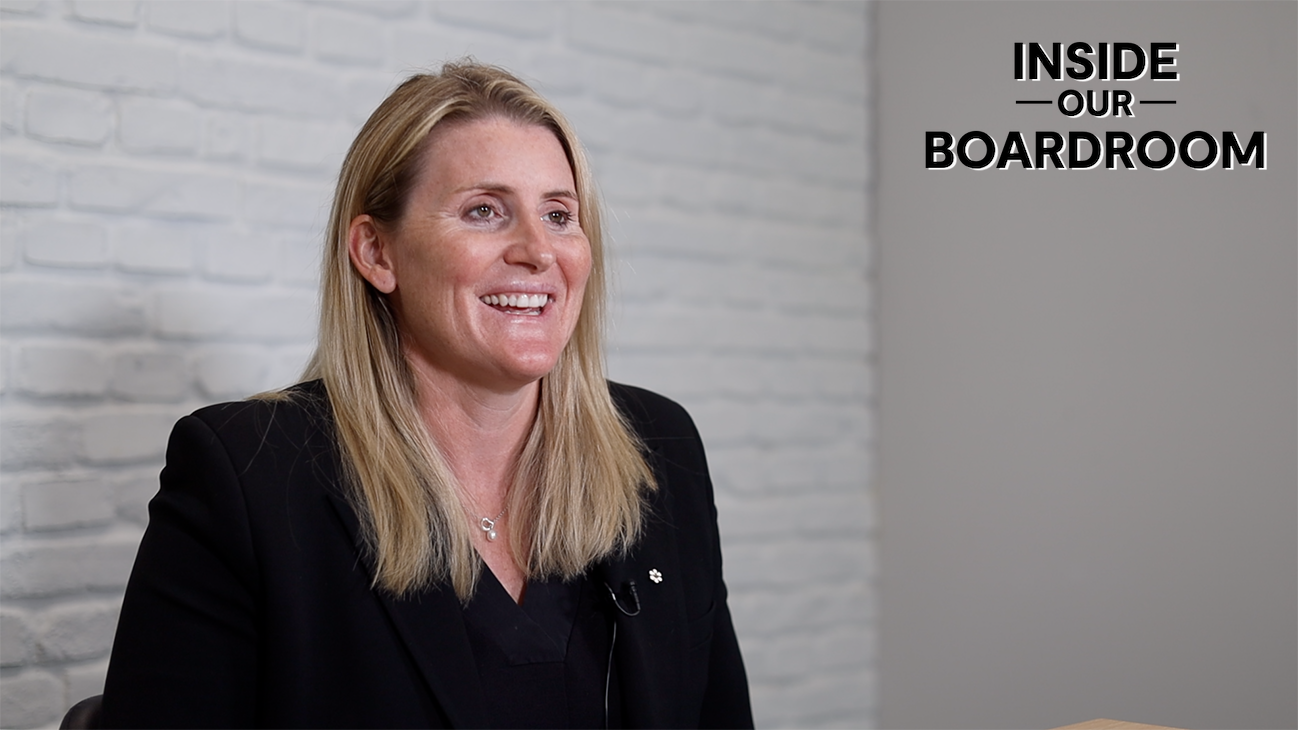
Dr. Hayley Wickenheiser, widely regarded as one of the greatest female hockey players of all time, has mastered the art of performing under extreme pressure. Canada’s all-time leading scorer with four Olympic gold medals and seven world championships, she made history as the first woman to score in a men’s professional hockey game.
But Hayley’s achievements extend far beyond the rink. After retiring from international competition in 2017, she traded her skates for a stethoscope, fulfilling a lifelong dream of becoming a physician, while simultaneously taking on the role of assistant general manager of player development for the Toronto Maple Leafs.
Now a practicing family and emergency medicine doctor, Hockey Hall of Fame inductee, and bestselling author, Hayley brings a unique perspective to sustainable high performance, leadership and teambuilding, cultivating a growth mindset, and more. She recently joined us as part of our “Inside Our Boardroom” series to share insights and lessons learned from Olympic podiums to emergency rooms on pressure, failure, and the pursuit of excellence.
Answers have been edited for length and clarity.
From Olympian to Medical Doctor
Speakers Spotlight: Was there a pivotal moment that sent you down a path leading first to sports then to medicine?
Dr. Hayley Wickenheiser: You know, since I was a kid, I had two simultaneous dreams. One was to win a Stanley Cup with the Edmonton Oilers and the other was to become a doctor. The small rural community that I came from, Shaunovan, Saskatchewan, there were some amazing family physicians that were our friends and they really inspired me. So, from a young age, I have always wanted to be a doctor.
As I was getting to the end of my career in hockey — I grew up with two teacher parents who said, “you better have a life-after-hockey plan” — so I spent a lot of time thinking about what that was. I started shadowing in the emergency department after games to make sure medicine was what I wanted as my next plan in life and it became very clear to me early on that I enjoyed it. It’s very similar to hockey, never the same thing twice, adapting under pressure, teamwork, quick decisions, so, it felt like a great next step. And it’s worked out really well. It was a pretty natural transition for me.
Performance Under Pressure
SpSp: How do you handle the intense pressure you’ve faced both in sport and now medicine?
HW: People ask me all the time, what’s more pressure — playing for a gold medal at the Olympics or working in the emergency department? And honestly, nothing will ever come close to the pressure I felt competing for Canada, trying to win an Olympic gold medal. I can’t explain why. It was probably the pressure I put on myself to perform and maybe because I felt like I had more to do with the outcome. Whereas in the world of medicine, I’m kind of resigned to the fact that there’s only so much I can do and I can’t save or fix everyone. So that that gives me more to fall back on. At the same time though, the stakes are much higher in that you’ve got a lot of responsibility.
So, I came from a world of performance on demand as an athlete and now that continues as a physician. And really what it comes down to is preparation and just doing the things every day so that, when the world is watching or that patient needs you, you’ve already been there, done that, and you’re ready to perform.
Getting Comfortable with Being Uncomfortable
SpSp: How do you balance instinctive training and complacency?
HW: I’m a big believer that you have to be comfortable with being uncomfortable in life. And one of the things I know is that to elevate myself or to challenge myself, I needed to put myself in uncomfortable situations. So whether that was playing professional men’s hockey overseas, starting medical school at the age of 38, or working in an all-male environment in the NHL, these are things that are not easy, but they keep me on my toes. And this is likely tied to the fact that in the game of hockey, nothing is the same twice. When you go out on the ice for a shift, it’s always different, which is what I love about the game.
What I love about life is you don’t have to live in a box. You can break through the box. You can create different boxes for yourself or paths for yourself, and I think that helps with staying fresh and not feeling stale or complacent.
Healthy High Performance
SpSp: What does it take to change an unhealthy work culture?
HW: I think we’re going to see a shift, and we are slowly seeing that shift due to the pandemic, in the way we work and live. With AI, and the speed of which we can process information, everything is changing and it’s impacting our health, so if we’re smart, we’ll take advantage of that to be efficient and work in non-traditional ways that allow for more enjoyment in life, more leisure, more recovery time.
For me, the other part of that is movement is medicine. From my lens being an athlete and being inside healthcare, I’ve really seen that you only get one chance at your health and where you choose to spend your time and money is very important. This hits us really hard inside the world of medicine. It’s very evident that our time is short and how we choose to use it is all we have.
Reframing Failure as Your Greatest Teacher
SpSp: Failure is a part of life. How can we handle it better?
HW: One of the amazing things about being an athlete and now being in the world of medicine is just how much failure I’ve experienced. And I say that in a very grateful way.
When I look back on my athletic career, I realize that something athletes are good at is handling and managing failure. From a young age, you get told to skate faster, lift more weights, run faster, do this, do that better, and you get very resilient through listening to the critical opinion of others. You understand that that’s just part of the job.
And those protective mechanisms that we get from those little moments of failure, they build resiliency and character. You learn that you can get knocked down and get back up again. At my first Olympics, I thought we were going to win, but at the end I was standing on the blue line staring at the Americans with the gold medal. This was a hard lesson to learn about perspective and overcoming failure.
One of my coaches at the time gave me a quote that said, “A gold medal is a wonderful thing, but if you’re not enough without it, you’ll never be enough with it.” I’ve kept that piece of paper in my wallet for 20 years. It’s a reminder that we’re not what we do. I learned that lesson the hard way over many years, and I think failure is just as important as success if you use it properly.
Hire Dr. Hayley Wickenheiser to Speak at Your Event
Drawing on her unique perspective as an Olympic champion, NHL executive, and practicing physician, Dr. Hayley Wickenheiser delivers powerful lessons on peak performance, strategic resilience, leading through adversity, and more, sharing actionable strategies that drive real results.
Contact us to learn more about Hayley and how she can help your audience achieve sustained excellence.