
Chief Perry Bellegarde has dedicated his life to championing the rights and well-being of First Nations. He served two terms as the National Chief of the Assembly of First Nations, where he campaigned tirelessly to close the quality-of-life gap between First Nations and other families in Canada. Under his leadership, Canada passed its first national legislation protecting Indigenous languages, reformed funding for First Nations communities, and became the first nation in the world to make the UN Declaration on the Rights of Indigenous Peoples domestic law.
A member of Little Black Bear First Nation who describes himself as an oskâpêwis (helper in Cree), Perry continues his advocacy work today as a special advisor to Fasken, an international law firm; chair of the First Nations Bank of Canada; and special advisor to His Majesty King Charles III’s Sustainable Markets Initiative.
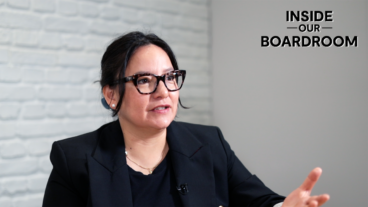
Perry recently joined us “Inside Our Boardroom” to discuss the breakthroughs and ongoing challenges in Indigenous-Crown relations, the vital role traditional knowledge plays in addressing climate change, and where Canada stands 10 years after the Truth and Reconciliation Commission’s final report.
Answers have been edited for length and clarity.
Legal Breakthroughs and Legislative Wins
Speakers Spotlight: Throughout your 35 years in politics, what stands out as breakthroughs for Indigenous priorities in Canada?
Chief Perry Bellegarde: Well, one of the biggest is the legal court cases that we’ve been winning since 1982 when Canada patriated the constitution. Before that, we were a colony of Great Britain, governed by the British North America Act of 1867. When they patriated the constitution, there was a very important section added — section 35 where existing aboriginal treaty rights were recognized and affirmed. Was it a full box of rights or empty box of rights? The debate still goes on, but we’ve been using section 35, the Supreme Court system, and the legal justice system to fill up that box. And we’ve been winning.
Other breakthrough issues in Canada are some of the pieces of legislation developed while I was national chief from 2014 to 2021. One was Bill C91, which is the Indigenous Languages Act. That was important because we didn’t want the residential school system to win. It was a genocide of our people, it tried to kill our languages, which is one of the key identifiable items for self-determination to be recognized.
The next was C92, child welfare. We have 40,000 First Nations kids in in the welfare system. That’s not acceptable. So C92 said, First Nations develop your own laws, exert your jurisdiction, and look after your kids. Make sure they’re immersed in their culture and language in healthy, safe, and loving homes.
Then the big one, the United Nations Declaration on the Rights of Indigenous Peoples. This was passed by the UN in 2007. Unfortunately, four countries put caveats on it: Canada, Australia, New Zealand, and the US. It took up until 2016 for Canada to remove their caveats. Then, through strong advocacy, Canada put in place a law in 2021 to give legal effect to the UN declaration. So, it’s a federal piece of legislation now with an action plan. That was huge because all the policies and legislation in Canada have to be brought in line with the UN declaration, and that’s a monumental piece because no other country in the world has done what Canada has done.
Global Leadership on Indigenous Rights
SpSp: How do Canadian Indigenous relations compare to those of other nations?
PB: I think globally Canada is further ahead. What other country has domestic legislation to implement the United Nations Declaration on the Rights of Indigenous Peoples? Many have a statement but there is no other country in the world that has it to the same level as Canada, plus a two-year action plan. What good is a UN declaration if you’re not implementing it in your nation state?
Paragraph number nine is very important because it says the doctrine of discovery and the doctrine of terra nullius are illegal racist doctrines. That’s huge, because how did the crown take title to First Nations land and territory? By planting a flag and all of a sudden claiming it. Now, there’s domestic law and legislation that says it’s illegal. So, what impact does that have on all current policies and legislation? They all now have to get in line with that UN declaration. We now have the UN declaration as a roadmap for reconciliation to build a better country.
So comparatively, Canada is ahead of the game. But even when I say that — yes, we’re ahead, yes, there’s momentum — we’re not done yet. We still have a gap to close. We still have a lot of work to do, but it’s on the right trajectory. So let’s not stop that momentum.
Traditional Knowledge and Climate Change
SpSp: What role does traditional knowledge have in tackling the increasingly dire climate situation?
PB: The public, private, and philanthropic sector all have to work together in order to fight climate change. And it’s important to incorporate traditional knowledge because it’s our worldview. We’re all connected. We’re not in isolation. And what I mean by our worldview is that we recognize mother earth is all of our mother as human beings, along with father sky, grandmother moon, and grandfather sun, and our relatives, the four-leggeds, the animals, the birds, and the swimmers. We’re all connected. That’s our worldview. What you do to one impacts the other and we have to stop doing damage. We see the fires, the floods, and the big winds. Our elders have said this is going to happen because we, as two-leggeds, are not respecting creator’s laws and the water and the lands and our relatives are crying out.
Incorporating traditional knowledge in our worldview is necessary because in order to develop strategies and plans to combat this, we need to embrace that we’re connected and start thinking long term. We need to embrace the view that the economy is 100% a subsidiary of the environment.
So, basically the bottom line is we’re all related. We’re all connected. Let’s embrace that concept and bring that forward through policy and legislation when dealing with climate change and think seven generations down the road.
Environmental Reconciliation in Practice
SpSp: What does environmental reconciliation look like in practice?
PB: There’s a couple practices in Canada right now to draw on. Indigenous protected conservation areas is very powerful in Canada. That’s a good example of how Indigenous peoples, our elders and traditional knowledge, are involved.
The other one is the land guardianship program. It’s very powerful involving Indigenous peoples in their specific territories to walk the land and the waters, and keep an eye on it to make sure that it’s healthy and report back if it’s not. So, those are examples of environmental reconciliation happening right now in Canada.
Reflecting on 10 Years since TRC
SpSp: Having been 10 years since the Truth and Reconciliation Commission final report, have we done enough?
PB: In 2015, the Truth and Reconciliation Commission came out with a report and their 94 calls to action. Have we done enough? Yes and no. Has the socioeconomic gap closed between First Nations and the rest of Canadian society? It’s starting to move. We’re sixth vs. 63rd in the United Nations human development index now. But has it closed? Have there been key strategic investments in everything that makes up the social determinants of health? We got rid of the 2% funding cap within the federal government as it relates to First Nations people and there have been billions in terms of investment, so, it has moved. The gap is closing, but we’re not there yet. We still have communities that have boil water advisories. We still have a large number of children in foster care. We still have too many of our people in jail. We still have a high youth suicide rate.
So, yes, it’s getting better, but we’re still not at the same starting line. We have to keep those investments going. I go to a lot of meetings where people get up and do land acknowledgements, and sometimes I just roll my eyes. Oh, there’s a check mark. TRC, land acknowledgement, check. To that I say, “Keep doing it, but why don’t you and your organization review the 94 calls to action and pick two or three to focus on?” Go beyond basic land acknowledgement and embrace something and actually implement it.
For example, the papal apology. It was one of the calls to action. I was national chief at the time and our team lobbied to make that happen. We had to develop a relationship with the Council on Catholic Bishops and that resulted in the pope’s visit to Canada, where he made an apology.
Part of truth and reconciliation is telling the truth. The Catholic Church was one of the churches involved heavily in the genocidal policy of the residential school system. So, to have the head of that church make an apology was very moving and monumental. It was part of the healing of our people, and we have to build on that now. We have to build on that and how we go forward together to respect ourselves as peoples and build a better country for all.
Hire Chief Perry Bellegarde to Speak at Your Event
As a keynote speaker, Chief Perry Bellegarde shares powerful insights from three decades of Indigenous leadership, offering audiences practical wisdom on reconciliation, sustainable development, and building stronger, more inclusive organizations for the future.
Contact us to learn more about Perry and our roster of Indigenous leaders, and how they can inspire meaningful change at your next event.