
93 musicians. One stage. Zero room for error. When the Toronto Symphony Orchestra (TSO) performs, audiences witness something extraordinary — nearly 100 individual talents delivering a single, unified sound. What they don’t see is the months of rehearsal, the precision of timing, the extraordinary degree of trust required to make it work.
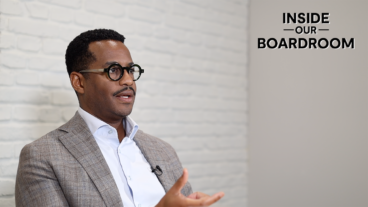
As the CEO of the TSO, Mark Williams doesn’t just manage a $32 million organization — he’s mastered the art of orchestrating human excellence. He is one of the few Black executives leading a major orchestra worldwide and the first to do so in North America.
Calling himself the ultimate “insider outsider”, Mark has used that position to shape a world-class institution around a genuine, lived commitment to equity, inclusion, and access. Under his leadership, inclusion has become the connective tissue of everything the TSO does — how it builds trust with its musicians, how it reaches new communities, how it leads change that resonates both inside the organization and beyond. As a result, the TSO has seen record-breaking philanthropy, deeper community ties, and restored financial and organizational stability in the wake of the pandemic.
From Musician to Leader
Mark didn’t set out to make history as a “first.” He was a trained musician who felt his skills and expertise could better serve the artform on the business side of things. Over the course of his 20-year career, he has held senior leadership roles at some of the most respected orchestras in North America, including The Cleveland Orchestra and the San Francisco Symphony.
What led Mark to the TSO was an unrelenting willingness to say yes. “I was a sponge,” he says of those early days in his career. “I put myself out there — listening, reading, travelling. That effort was noticed by people.” At Cleveland alone, he held four different titles in nine years, consistently taking on more than his role required. It was that accumulation of experience — mentorship, curiosity, and a readiness to take a leap — that prepared him for the role of CEO.
And while he doesn’t often think about being a first, it has influenced the way he leads. “I care about access, diversity, and inclusion and wanting people to feel welcome,” Mark said, “and in many ways that has seeped into my leadership and decision making.”
The Lonely Only
Being a “first” is complicated, Mark said. At an institutional level, he calls it the “lonely only” syndrome: the tendency for organizations to celebrate the arrival of one trailblazer and quietly consider the work done. “Just because one person got through doesn’t mean your organization or industry doesn’t have a problem,” he says.
Mark doesn’t think of himself as special. His career has been a conventional one, but he walks into rooms carrying something his predecessors could not: the lived credibility of someone for whom the words classical music is for everyone are not a marketing line, but a personal truth. “When I say classical music is for everyone — that it’s a space for everyone to come and feel comfortable — that’s more believable, because it’s real for me,” he said.
That duality — insider and outsider at once — has become one of his most powerful leadership tools.
Inclusion Is Not a Program. It’s a Practice.
When Mark arrived at the TSO in 2022, its centennial year, he found an orchestra that was artistically punching above its weight but still tethered to an old-school institutional mindset. His mandate, signalled by the board that hired him, was change. And his instrument for that change has been inclusion: not as a values statement, but as an operational discipline.
Mark’s focus from the start was on visibility — spreading the word about the orchestra’s artistic quality, deepening its work in the community, and building internal confidence to match. That meant getting curious about who the TSO was and wasn’t reaching.
For example, new to the city, Mark immersed himself in learning about the communities that surrounded it. He was surprised to discover that TSO had not once in its 100-year history visited Brampton, one of the Greater Toronto Area’s largest, fastest-growing, and most diverse communities.
“That seemed wrong,” Mark said. So, he made it happen, not by making Brampton fit the TSO’s needs, but by asking how the TSO could fit into Brampton’s. He started conversations with local orchestras, found ways to offer free programming, and brought young Brampton musicians to perform at Roy Thomson Hall. “We have to bend for others,” Mark said.
That willingness to bend is inclusion in action. “At the end of the day, inclusion leads to trust. And trust shows itself in speedy decision-making and high output.”
Trust as the Foundation of Excellence
In an orchestra, that trust is not a metaphor. It is a technical necessity. The TSO’s stage is 80 feet wide, Mark said. Musicians at one end of the stage can’t hear their counterparts at the other end. Sound travels at a different speed depending on where you sit — a musician must play ahead of the beat to land in time with someone 60 feet away. There is no margin for doubt. “You can only do that if you trust that everyone is doing what they should be doing,” Mark said.
Nowhere is that trust tested more than on tour. Asking musicians to break their routine, travel to different cities, and perform in unfamiliar venues night after night while still delivering at the highest level is no small thing, Mark said. “That doesn’t happen if you don’t build deep trust.”
For Mark, building that trust is daily work. It shows up in how he communicates — not just yes or no, but yes, and here’s why. That transparency, practiced consistently over time, is what brings people in and builds a culture where people feel safe to do their best work.
Building a Legacy
The TSO recently returned from a European Tour. The story that ran in the Globe and Mail wasn’t about the music. It was about the impact of a Canadian orchestra showing up on the world stage at a particular moment in time — cultural diplomacy in action, culture as a force that moves people forward and brings them together. That’s the legacy Mark hopes to leave at TSO, but it begins at home.
“I want the people of the GTA to feel that the TSO is for them. That Toronto without the Symphony is like Toronto without the CN tower, it’s integral to who we are. The goal here is if you are lover of music, there’s something here for you.” That sense of belonging, he believes, is what the TSOs future success is built on.
Mark is also deliberate about using his platform to open doors for others. He has served as a mentor for Sphinx LEAD, a program dedicated to developing the next generation of Black and Latinx executive arts leaders, and as a Trustee of College Now Greater Cleveland, supporting access to higher education for young people. For Mark, opening doors for others isn’t separate from his leadership — it’s an expression of it. It’s what happens when inclusion stops being a policy and starts being a practice.
That is what Mark is building at the TSO — and beyond. A place where people feel they belong, where trust is the infrastructure, and where, every season, extraordinary things follow. Inclusion is not a values statement. It is what sustained excellence is built on.
Book Mark Williams for Your Next Event
In Greek, “symphony” means “harmony”. Seasoned cultural leader Mark Williams will show you how to orchestrate it in your organization. He has helped guide the TSO through real change and draws parallels between orchestral and business leadership to share lessons on building trust, leading with transparency, and navigating complexity drawn not from theory, but from real experience managing creative people under pressure.
Discover how to transform your team from a collection of soloists into a powerhouse ensemble that delivers extraordinary results. Contact us to learn more about Mark and how to book him for your next event.