When the Toronto Symphony Orchestra (TSO) performs, the audience experiences something remarkable — almost 100 individual talents masterfully performing as a single, unified force. What they don’t see is the work that went into executing that perfect moment.
As the Chief Executive Officer of the TSO, Mark Williams bridges the worlds of music, leadership, and organizational transformation. The TSO is one of Canada’s largest performing arts institutions — a complex, high-performing organization where collaboration, adaptability, and purpose are essential to success. Since joining the TSO in 2022 — after holding senior leadership roles at The Cleveland Orchestra and the San Francisco Symphony — Mark has guided the organization through real change. As a keynote speaker, he draws parallels between orchestral and business leadership to share lessons on building trust, leading with transparency, and navigating complexity.
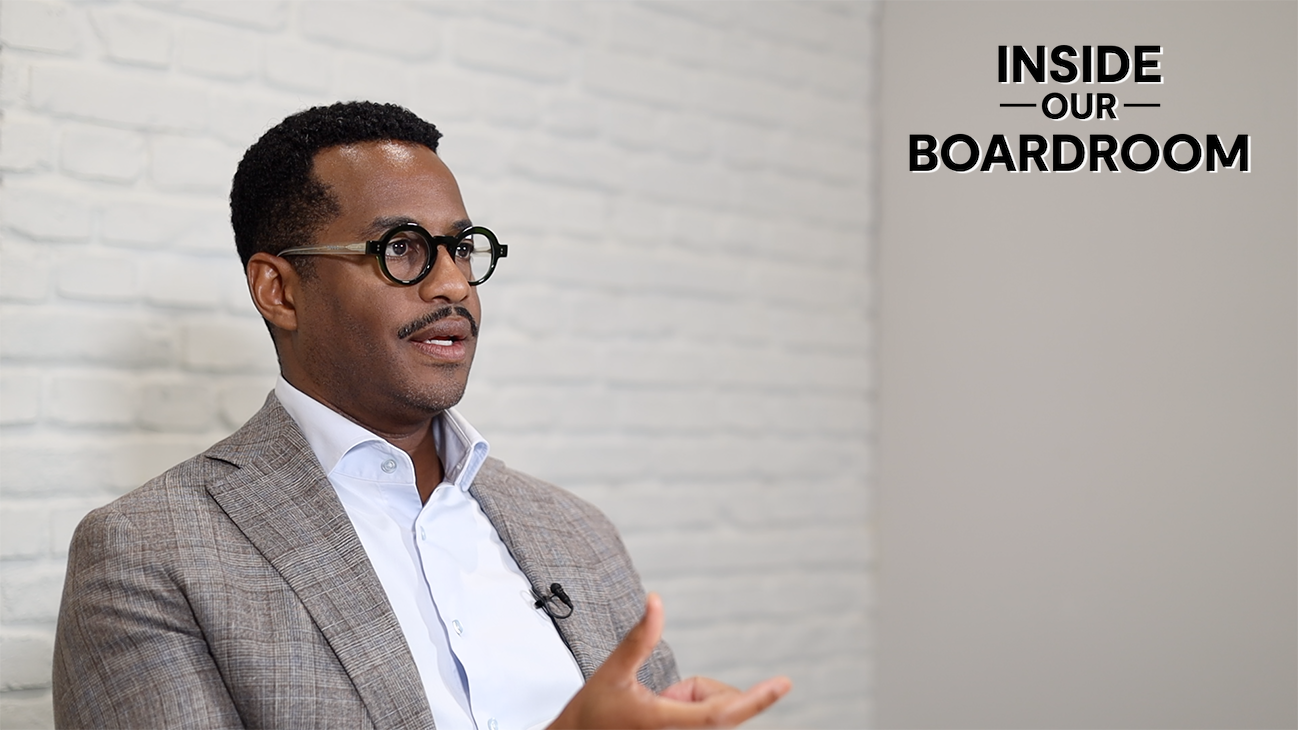
Mark recently joined us “Inside Our Boardroom” to explore what orchestras reveal about leading diverse teams, why great products require constant repackaging, how understanding your audience — and reflecting them in your workforce — is essential to staying relevant, and more.
Answers have been edited for length and clarity.
What Orchestras Can Teach Us About Leadership
Speakers Spotlight: In your keynote, you draw parallels between leading an orchestra and leading an organization. How do the two mirror each other?
Mark Williams: Orchestras and corporations are very similar. They are workplaces. They have hierarchy. They have departments. An orchestra is a collection of individual musicians, but of course, they’re sorted by instrument, where some, like the violins, may all play the same part, while others, like the clarinets, may all have individual roles. That’s similar to any other workplace — you have a call centre where everyone is doing the same job. Then you have another department with a director, manager, and coordinator working together within a hierarchy that’s within an overarching hierarchy that leads up to a CEO.
They’re also similar in that you’re bringing together individuals with individual aspirations, talent, and challenges and you need them to pull in the same direction to reach a common goal. I think the big difficulty in an orchestra, and in any corporate environment, is that balance of nurturing individual skill, imagination, creativity, and drive and harnessing it to fulfill an overarching vision. It’s driven by the individual but only achievable with collective buy-in.
Also, both, at the end of the day are businesses. We create products and services and need an audience to have interest in buying those products and services. In our case, that’s donors and people who purchase tickets. So, we’re always thinking about what’s in the box, what’s the shape of the box, and how is it decorated? Take Mozart for example. We have to be very mindful whether Mozart continues to have relevance. I think he does. I think it’s art that has a timelessness about it because it speaks to the human condition. But how are we programming it? What’s the context that we’re putting it in? How are we making sure that the audiences of today understand what Mozart is, who he was, what he did, why this music matters, and how are we delivering it in a way that is meaningful to our audience?
That’s the same strategy whether you’re selling paper, hotel rooms, widgets, etc. The most important thing is understanding what you produce and making sure that it’s done with integrity. How you package it is what’s up for reinvention.
The symphony orchestra is the perfect model for modern leadership. The months of preparation, the coordination of diverse team members, the pressure of delivering excellence when every note matters. It’s the same challenges leaders face today — transforming individual talent into collective success under pressure. Mark speaks more to this in his keynote “The Symphony of Leadership: Orchestrating Outstanding Performances and Team Harmony” and in the video below:
Why Diversity Is Essential to Excellence
SpSp: What is the value that diversity brings to the TSO and how is it essential to any organization pursuing excellence?
MW: We can’t deny that classical orchestral music is an artform that comes out of Western Europe, written by mostly white men for a white audience. But I think we have to think about in the larger sense of what great art means.
Great art comes from and speaks to a human experience. I don’t believe you have to have been alive in 1750 and been white, male, and upper class to understand the pain, sorrow, joy, or curiosity of a Mozart or Beethoven symphony. So, we have a role in translating those messages for a contemporary audience, and we have to understand that the contemporary audience is diverse. The TSO has the great fortune of operating in Toronto, one of the world’s most diverse cities, and if you don’t have your eye on how to translate that message to the people who live here, you’re going to out of business.
This works in any corporate context. Are you making products that audiences want? I think there’s always going to be that balance between legacy product, what you became known for, and that modern product. In my business that might be playing a sitar concerto of Ravi Shankar in connection with a piece by Philip Glass in connection with a Beethoven symphony. So we’re looking at orchestral music with unexpected instruments over a period of a couple hundred years. I think many organizations are doing exactly that, holding on to that core but also building out with an idea of creating products that a new or contemporary audience might be interested in.
Of course, the other piece is how do you have a workforce that represents the audience you want to have? We have to understand that, as open as we might be, we’ve never walked in someone else’s shoes. So, how do you have the people making those important decisions and executing that work as diverse as the audience or customer that you’re trying to attract?
Adapting Leadership Across Cultures
SpSp: Prior to the TSO, you held senior leadership roles at The Cleveland Orchestra and the San Francisco Symphony. What are some things you’ve learned about Canadians since moving here?
MW: There is so much I did not expect. Someone said to me recently when Canadians look south, they see America. When Americans look north, they see America. And in a way, it’s very true. Our cultures on the surface are so similar, but once you move here and are actually working and building a life here, one finds, or at least I found, that the cultures are very different.
I didn’t fully appreciate the extent to which Canadians are collectivist and Americans are individualist. I sort of knew it intellectually, but then when I came here, especially in a leadership role, I found it quite fascinating managing a team of people and realizing that mentally I was on a different page and would need to motivate them in a very different way. This isn’t to say that either collectivist or individualist is necessarily better or worse, but I found that speaking about the overall benefit of certain decisions to get a consensus was far more important here than it was in the United States. It’s fascinating. They’re very different cultures.
The Role of Art in Times of Crisis
SpSp: What place does the arts have in times of global stress?
MW: Art is a human need. We don’t make art because we need to or want to, we make art because we have to. Just like breathing, human beings create art. They always have from cave drawings to handmaking instruments all the way up to today and well into the future. I can’t overstate the importance of art in our lives.
Look at the pandemic, when we were all locked away, what did we do? We listened to music. We watched film, we sang, we created. So, I never question the value of what we’re doing. In a business context though, we have to wear two hats. We have to think about how we support great art — art with a capital “A” — that audiences will enjoy or find meaningful but might not be so financially successful, with a program that would be more financially successful. There’s not exactly a right or wrong way to do that, and that’s where trust comes. That, as a leader, you’re surrounded by a team of people who understand your vision and trust that you have the best interests of the institution at heart.
AI and the Future of the Arts
SpSp: Where does AI fit into the arts?
MW: That’s a big topic. I’ll start by saying that I’m fascinated by AI and I’m not afraid of it. I think that AI is yet another tool we have to make workflows better and ideally give us more time to do those things that only human beings can do.
I obviously work in an artistic organization, but we’re also a business. And I would say that AI is going to be useful to us in similar ways it will be useful to other businesses. I was playing around with it the other day and built an app in five minutes that helps people choose which concert they should attend based on a couple of questions, and I’m not a developer.
So, all of that stuff is great. But when it touches on the art, that’s where AI has the potential to be dangerous, if there is not an understanding of the difference between sound that is produced by humans and sound that’s produced by computers. One of the things that’s so incredible about hearing an orchestra is that those people are bowing across a string or blowing into an instrument and creating soundwaves that physically interact with our body. Losing that because we are listening to digitized music would be a shame. I think AI can be a useful tool in writing music, but ultimately, I believe that art is about our ability as humans to see and connect with something human in others.
Hire Mark Williams to Speak at Your Event
Mark Williams brings a rare perspective on leadership, team performance, and organizational transformation, drawn from decades of experience leading some of North America’s most prestigious orchestras. Through his keynote “The Symphony of Leadership,” he delivers actionable insights on leading diverse teams, building organizational trust, and cultivating cultures where people can perform at their best even under intense pressure.
Contact us to learn more about Mark and discover what can happen when your organization finds its rhythm.