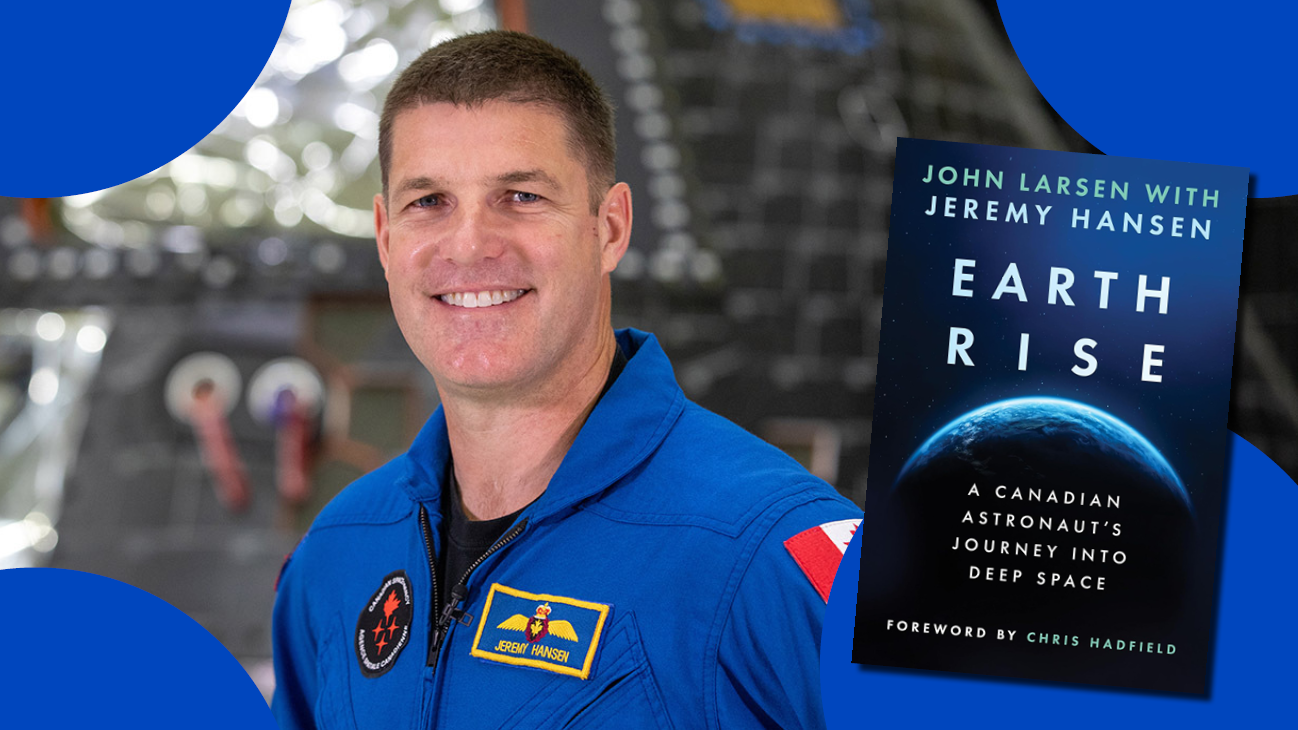
From a small-town kid staring up at the stars on his family farm to becoming the first Canadian to travel into deep space, Colonel Jeremy Hansen is recounting his historic journey to the Moon in the new book Earthrise, written by John Lawson, a former senior military public affairs officer, with the Artemis II astronaut himself.
“We wrote it together by him interviewing me,” Jeremy said in an interview with CTV’s Your Morning. “I edited it in the end to make sure it was accurate, but he did a lot of the work to bring this thing to life. His goal was to share this tremendous story, a Canadian success — it’s not a Jeremy Hansen success, it’s a Canadian success — and credit to John for bringing it to the pages so people can read it.”
A Historic Mission
The Artemis II mission was a defining moment for space exploration, marking the first time in more than 50 years that humans flew to the Moon and breaking the record for the farthest distance humans have ever travelled from Earth.
Alongside crewmates Reid Wiseman, Victor Glover, and Christina Koch, Jeremy travelled more than 1.1 million kilometres, viewing parts of the Moon never before seen by human eyes. During the 10-day mission the astronauts tested various systems, including communications through NASA’s Deep Space Network (DSN), and conducted tests on how the human body reacts in space. With this journey, Jeremy became the first Canadian, and the first non-American, to travel to the Moon.
Earthrise gives readers a passenger-seat view into this daring deep-space journey and the long years of intense training, grit, and perseverance Jeremy needed to prepare for lift-off and to fulfill his lifelong dream of becoming an astronaut.
Achieving Your Moonshot
This is a story Jeremy also shares on stage as an in-demand keynote speaker. His presentations are equal parts awe-inspiring and actionable as he translates one of humanity’s greatest achievements into lessons for leaders and teams chasing their own moonshots.
Jeremy challenges audiences to realize that dreaming alone won’t get you to the finish line. Achieving a moonshot requires relentless daily action. To underline his point, he brings audiences behind the scenes of Artemis II to explore the intense planning, rigorous training, and teamwork required to pursue and achieve audacious goals, equipping them with a practical framework to identify their goals and leverage inspiration to execute them.
That framework rests on three ideas, each grounded in his own experience.
1. Set and share your vision
For the Artemis team, their vision was clear: get people back to the Moon. The vision is easily said, as Jeremy is quick to point out, it’s the execution that’s the tough part.
For example, when it came time to test the carbon dioxide removal system on the Orion capsule, the team was confident it would perform after years of work. They put the capsule in a vacuum chamber to test it, and three small valves leaked the cabin’s entire pressure into space. The failure hit everyone hard.
Moments like that, Jeremy says, are when accountability matters most. But for him, accountability has nothing to do with blame. Everyone on the team is doing their best, so who made the mistake or how they got to that point doesn’t matter. What matters is finding the right answer and getting to the finish line. The team took the system apart, rebuilt it, and tested it again. Just as they thought they had it solved it, another problem surfaced, and they did it all over again.
Setbacks are inevitable on the way to any moonshot, and Jeremy believes the teams that navigate them best are the ones that build a culture where people are rewarded for reporting their own mistakes.
2. Navigate the Unknown
Artemis II took Jeremy farther from Earth than any human had ever travelled. With so much uncertainty and unknown around the mission, he’s often asked how he dealt with fear.
For the challenges you can identify, Jeremy says, there’s no need to be afraid. You know they’re there and you’re working on them. Fear is reserved for the moments that surprise you. Its job is to get your attention, and once it has, you acknowledge it and set it aside. That’s what allows you to get into the creative, problem-solving space you need to work through it.
During the 10-day mission, a fire alarm went off aboard Orion. In the end, it was a false alarm, but for those first few minutes, no one knew that. Jeremy had to push the fear aside so he could figure out what was going on. It’s something years of aviation and spaceflight taught him: you have to compartmentalize to get yourself back into a space where you can find a solution. Often, he says, it’s intuition that gets you through the tough parts, and you can’t reach your intuition if you’re trapped in the emotion. The brain and body are incredible machines, he says. They can do extraordinary things if you let them.
3. Harness the Power of Collaboration
Jeremy believes collaboration is the foundation of success not only for a team but across all humanity. And he often finds that what resonated the most with people after he returned to Earth was the team’s camaraderie and their ability to work together so cohesively.
That cohesion didn’t come naturally — put four highly experienced Type A personalities in a room, Jeremy says, and you’re going to get four different opinions — so the crew made it a priority. They set aside half a day every month to work on it, bringing in experts like psychologists and taking team trips together. Jeremy also commends Reid Wiseman for his leadership. As commander of Artemis II, he made sure each crew member had the time and space to contribute meaningfully to the mission.
But with hundreds of people involved in Artemis II, that same principle extended far beyond the crew. This is where accountability comes in again. For Jeremy, it’s built on proximity and trust. Whenever the crew was asked for their opinion or a decision, they would often respond with a question of their own: what would you recommend? People assume leaders have the answers, he says, but the best answers usually come from those closest to the problem. Trusting those people meant giving them full ownership of their work and empowering them to act on what they believed was right.
Life After Artemis II
Following his mission, Jeremy announced he would step back from his full-time role at the Canadian Space Agency. Prime Minister Mark Carney has since named him a special adviser on space, a role in which he’ll advise Carney and Industry Minister Mélanie Joly.
“I’m just super excited to serve Canada in that role,” Jeremy said in a video he posted on social media. “There’s so much opportunity to leverage this position that we’re already in, to do more to provide for our sovereignty, our security, our quality of life on the planet, and at the same time make significant contributions on the global stage.”
Watch him speak about the new book plus his new role in the clip below:
Hire Jeremy Hansen to Speak at Your Event
Colonel Jeremy Hansen knows firsthand what it takes to turn an impossible dream into a reality. In his visually stunning and deeply personal keynotes, featuring breathtaking video and imagery, he brings audiences behind the scenes of his journey while sharing actionable insights they can carry into their own work and lives. It’s an experience that leaves people inspired, energized and ready to aim higher.
Contact us today to learn more.