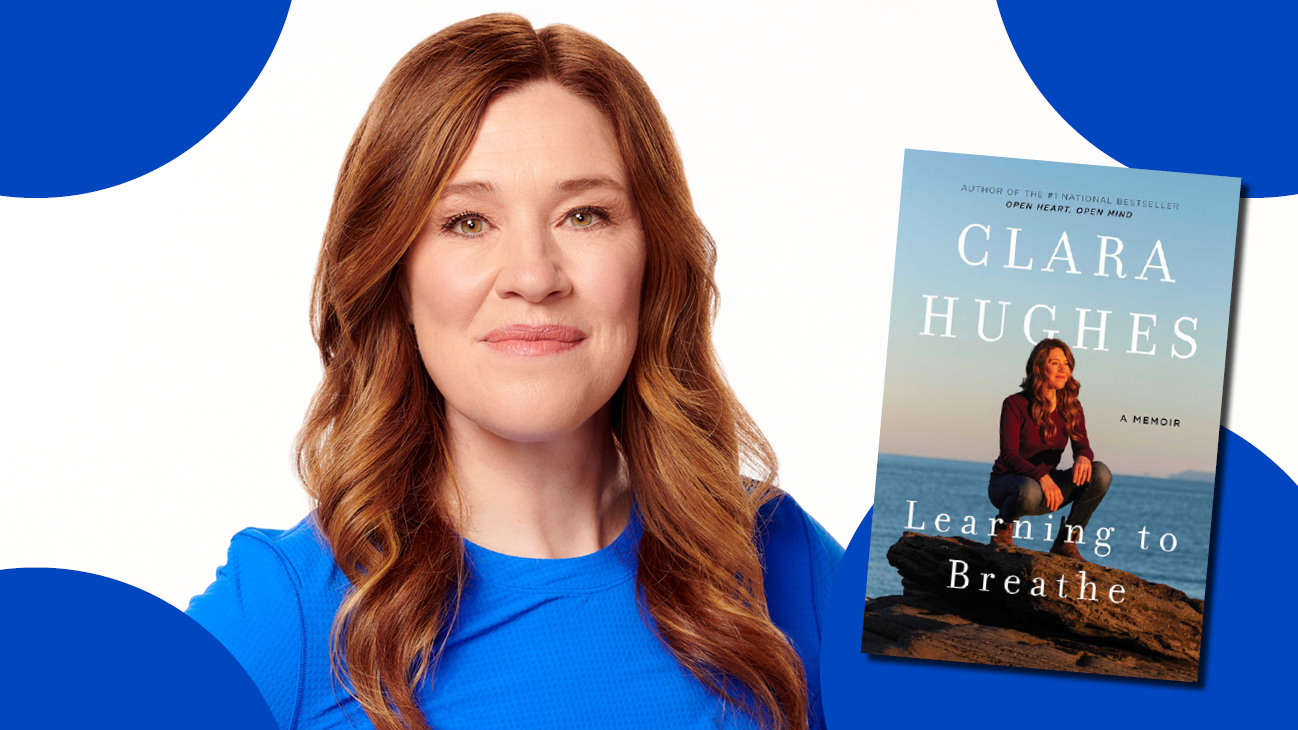
Clara Hughes has spent her life in constant motion. She is the only person to win multiple medals at both the Summer and Winter Olympic Games. Since retiring from sport, she has become one of Canada’s most committed mental health advocates.
For years, she thrived on powering through pain, but her body and mind paid the price. Even after retiring from sport, her pull toward extremes never faded. Then in 2021, a catastrophic knee injury collided with menopause and forced her into stillness just as her depression loomed larger than ever.
In her new memoir, Learning to Breathe, she explores what happens when the body you’ve always relied on finally says stop. Through guided psychedelic-assisted therapy, she began a winding trip back to herself, facing long-held fears and tracing her inner pain to its roots. The result is a vulnerable, funny, and wise look at midlife change and the possibility of new beginnings at any stage.
We recently sat down with Clara to talk about her new book and what she learned along the way.
The Importance of Stillness
Speakers Spotlight: There’s a fascinating tension in the book between “movement as medicine” and learning that sometimes you actually have to stop. What did stillness teach you that movement couldn’t?
Clara Hughes: Stillness taught me that I didn’t have to be constantly moving away from things. That I could sit with myself and actually be in fluidity. That I did not need to be going anywhere to allow for the shifts and changes that were trying to emerge to take shape. In ways, taking away the destination that movement often provided allowed me to learn to be present in the changes that were happening inside. That I did not have to rely on physical strength and output to feel alive. Stillness taught me that I don’t have to move, I can choose to move.
A Changing Identity
SpSp: You describe feeling like a stranger to yourself during the combination of injury, menopause and depression. Was there a particular moment when you realized this wasn’t simply your body failing you, but that your sense of identity was changing too?
CH: I think many people can relate to the very real feeling of achieving and outputting so much in life and still not feeling like they are enough. Or that something is lacking, missing or wrong with them. I lived with this deep-rooted belief all of my life. Even with an Olympic gold medal around my neck, it was not enough. So, in a greater sense, my identity was what I tried to fill this void of “never enough” with.
When I got injured and lost this identity of achievement I had the chance, as incredibly challenging as it was, to take a deep dive into this void and see for the first time what was really going on, and where these beliefs were formed.
Menopause was the ultimate catalyst to this point of radical change and capacity to stop running and start looking. I think many women reach this season of life no longer able to push things down and perform a version of themselves that no longer serves them. It certainly was for me.
Rethinking Menopause
SpSp: Your experience with menopause seems to have been a major turning point, particularly because you were looking for help and found that there was so little understanding or support available. What do you think we fundamentally misunderstand about menopause, especially when it comes to mental health?
CH: I think menopause is treated as something to fix. Something that is broken and needs a solution. Women’s health is vastly underserved, under-researched and misunderstood.
As a Gen Xer, I feel like women of my vintage are shaking things up because we’ve had a whole lifetime of experiences of having to figure things out for ourselves. It’s pretty cool to see the narrative shifting and the pushback to this idea in Western culture that you’re past your prime or to be disposed of challenged in powerful ways.
What’s most deeply misunderstood and underestimated is the capacity of women in this menopausal season of life. We can truly do anything with the right supports.
Healing Through Psychedelic Therapy
SpSp: The book takes you into psychedelic-assisted therapy, which is a very different approach from the “movement as medicine” philosophy that has shaped so much of your life. What did that experience teach you about healing?
CH: The experience with psychedelic-assisted therapy for me was both a great disruptor and a great connector. I had little clue as to what I was carrying all these 50 years of my life. The level of protection I had built inside of me that both kept me safe from the traumas and experiences of early childhood trauma and sexual assault was seemingly insurmountable.
It took the supports of skilled practitioners and the love of community to help me through a really rough few years of both upheaval and remembering, then processing and integrating all that I carry. Some remembered and some buried so deep I had no intellectual recollection of, but my body always knew. Realizing along the way that these wounds of trauma did not make me a broken person, but instead a person who had injuries of life that needed to be tended to.
Tending to these wounds with the right relational holding brought me to the beautiful place of knowing clearly all wounds can heal but they will leave a scar. And that scar is the growth around the wound that keeps it protected. Life happens in that protection and you no longer need to live from the wound.
It’s been an incredible experience to learn about not just who and why I am, but to ask myself who I really want to be without needing to prove anything, or achieve more to fill a void that is no longer empty. That void is and was always my heart, that is a beautiful place to be in, to allow love into, and to give love to this world.
A Healthier Relationship with Movement
SpSp: You’ve spent your life pushing yourself to your limits. What does a healthier relationship with your body and with movement look like for you now?
CH: A healthier relationship with my body means not always coming from a place of force, but finding a place of gentleness and compassion as well. Of course, I still have trails I want to hike and mountains I wish to climb, but I get to choose my steps instead of muscling through. I can choose to be strong in my body but not desperately need to be strong.
It’s coming from a place of love, respect, compassion and deep gratitude now. I don’t need to reach the end of the trail needing another path to follow. I get to wonder, with awe and possibility, what I want that step to be. And that’s a gift to think about when moving through this blink of a lifetime.
Hire Clara Hughes to Speak at Your Event
Clara Hughes explores mental health, human connection, and what we gain when we slow down. Drawing on her Olympic career and close to 20,000 kilometres on long-distance trails, she shares practical lessons on listening to yourself, letting go of the fear of failing, and building a deeper bond with the people and places around you.
Contact us to learn more about Clara and how to bring her to your next event.