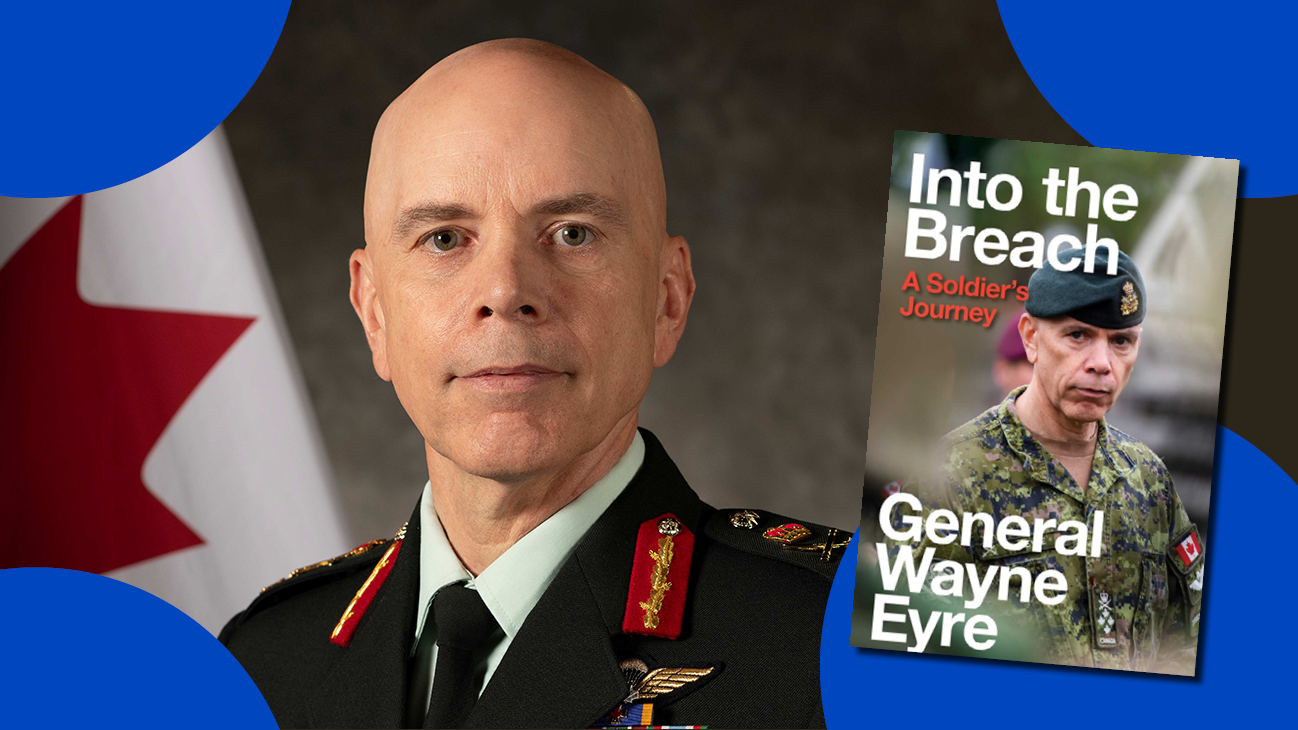
General Wayne Eyre has spent his career stepping into the breach. As Canada’s most recent Chief of the Defence Staff, he led the Canadian Armed Forces through one of its most demanding periods in generations — from floods, fires, and a pandemic at home, to wars in Europe, Africa, and the Middle East, to increased threats in the Arctic and Asia-Pacific.
In his new memoir, Into the Breach, Wayne reflects on his four decades of service at home and abroad and makes a compelling case that Canada can no longer take its security for granted. We recently spoke with him about leading through a “polycrisis,” why the Arctic is becoming a flashpoint, Canada’s place in a changed world, and more.
Leadership Under Pressure
Speakers Spotlight: You led the Canadian Armed Forces through an extraordinary convergence of crises. What did leading through those challenges teach you about leadership under pressure?
General Wayne Eyre: I call that period the polycrisis, where one crisis is stacked on top of another. True character comes out under pressure. I realized the role of a leader is to provide stability and a modicum of clarity in order to provide teams with as much unity of thought, effort, and purpose as possible.
During crisis, a leader has to radiate calm regardless of the turmoil. The two most infectious emotions are panic and calm. If a leader can represent calm, it has an outsized effect on an organization.
At the same time, they must encourage conflicting advice. You need diverse opinions that reflect how different members of the team see the situation. And you have to make decisions with less than perfect information, because a decision that waits for perfect information will come too late. But those decisions must be made for the right reasons: for the good of the institution, the mission, and the nation, not for yourself and not because they’re popular. And as more information comes in, you need the humility to revisit your decisions. It’s not about being right; it’s about getting it right.
Building Defence Literacy
SpSp: You write about the challenges of getting the resources needed to defend Canada. What do you think Canadians most misunderstand about the state of our military and what is required to keep the country secure?
WE: What we lack in Canada is widespread defence and security literacy amongst our population. We’ve lost our sense of history, of where we came from, and of the fact that conflict and real threats have always been part of our story. We have to realize that our country is under threat, and not just from a belligerent US administration. It goes well beyond that. Those threats manifested long before January 2025.
We also have to understand that security and defence institutions can’t be built overnight. The investments the government is making now will require sustained effort. Canadians need to realize that the international order has changed. As beneficiaries of that order, we were able to invest heavily in social spending. But history has returned, and we now face a far more threat-laden environment.
Canada is worth it. It is worth defending. Having seen the alternatives around the world, I believe in this country. What we need is a renewed sense of confidence, and part of that will come with renewed investment.
Defending Canada’s North
SpSp: Arctic sovereignty is one of the major issues you raise in the book. Why is the Arctic becoming increasingly important to Canada’s security, and what do you believe Canada needs to do to protect its interests there?
WE: We’re seeing a confluence of pressures that bear directly on Arctic security: climate change, technological advancement, and shifting geopolitics.
The global security environment is changing. The war in Ukraine is not constrained to Europe; its effects will be felt in the Arctic and the North Pacific as well. While climate change is increasing access to the Arctic, and with it, interest in resource exploitation and transit routes. That growing interest translates into more opportunities for confrontation, and maybe even conflict.
Around the world, we’re seeing long-standing norms of sovereignty being challenged. The invasion of Ukraine showed how norms of territorial sovereignty can be disregarded. We need to recognize that our Arctic borders are relatively new constructs. Throughout the long arc of history, borders have been temporary; they come and go. If we are unable to assure our sovereignty, it opens us up to being challenged. Not just threat of invasion, that’s relatively low, but economic violation, search and rescue gaps, ships transiting the Northwest Passage without permission, treaty violations, etc. There are multiple ways for sovereignty to be violated. We also have overlapping territorial claims with Russia.
We need to have an awareness of what’s going on, from space to seabed, through a network of sensors in space, in cyberspace, at sea, and undersea, so we understand what’s happening on our territory and in our approaches. Secondly, we need infrastructure that allows us to project capabilities from the south to the north, with northern infrastructure serving as bases we can operate from.
Thirdly, we need capacities relevant to the arctic that can operate in vast, harsh conditions: advance warning through sensors, an integrated control system to make sense of it, and the ability to project from southern bases to Arctic infrastructure nodes to deal with it.
Routinely exercising these capabilities is a demonstration of sovereignty. It changes the decision calculus of anyone who wants to question our sovereignty. That is the definition of deterrence.
Why Hard Power Is the Currency of Influence
SpSp: You’ve served in conflicts and missions from the Balkans and Afghanistan to Korea and the Indo-Pacific. How has Canada’s place in the world — and the nature of the threats we face — changed over the course of your career?
WE: If there was one word that would characterize my service, it would be change. I started at the end of the cold war, an era of great power and confrontation. Then it went to fragmentations, which we saw with the former Yugoslavia, alongside the rise of democracy. After that, the focus shifted to global terrorism, and now there’s a move back to great power and confrontation in a multi-polar world that is far more complex.
The threat has changed because we are seeing a confluence of stressors in the international security environment, the likes of which we have not seen in human history. Every era says it’s different and more complex. I think it’s true now for four reasons. First, geopolitics. Second, the international order has come and gone. We’re in a period of international reorder, the disorder before the reorder. Third, climate change, the pace of which is unprecedented in recorded history. Four, the acceleration of tech change. And this is all against the backdrop of significant societal change across Western democracies. We’ve seen more change in the past 10 years than in the last 50 in terms of demographics, generational expectations and norms, identities, and how we consume information.
So put those four together, add the fragmentation of global trade, and the different permutations and combinations make for a very uncertain security environment with multiple plausible scenarios. We need to hedge by diversifying our alliances, friends, and partners, and by having hard power. At the end of the day, a nation’s insurance policy is its military.
As for Canada’s place in the world, it has declined from where we were in 1945 and during the Cold War. Through the 2010s, our influence dropped off. We still held a respected place, but we didn’t show the kind of international leadership we’re capable of. My sense is that this is changing. International leadership will be required to shape the emerging international order, but the currency of international affairs is hard power. Without it, it’s just hot air.
A Country Worth Defending
SpSp: After everything you experienced in your military career, what is the biggest lesson you hope readers take away from Into the Breach?
WE: The biggest lesson I hope readers take away in the face of all these challenges is that we have great people who serve our country, people willing to go into harms way for a greater good. They need the tools though, and the nation needs to provide those tools, as well as the capabilities and the readiness to ensure people can do their job. We are a country of great potential. Having seen the alternatives in various hot spots, we have it really good here. Let’s continue to make our country a great place.
Hire General Wayne Eyre to Speak at Your Event
General Wayne Eyre (Ret’d) is a distinguished Canadian military leader who served a highly eventful and consequential 40 years in the Canadian Armed Forces. Asked to serve as the Chief of the Defence Staff in a period of intense crises, he guided Canada’s military through an era he describes as a “turning point in history,” marked by unprecedented global and domestic challenges. He now speaks on the pressing issues facing Canada — from the global polycrisis to Arctic sovereignty — and the leadership required to navigate them.
Contact us to learn more about Wayne and how to book him to speak at your next event.