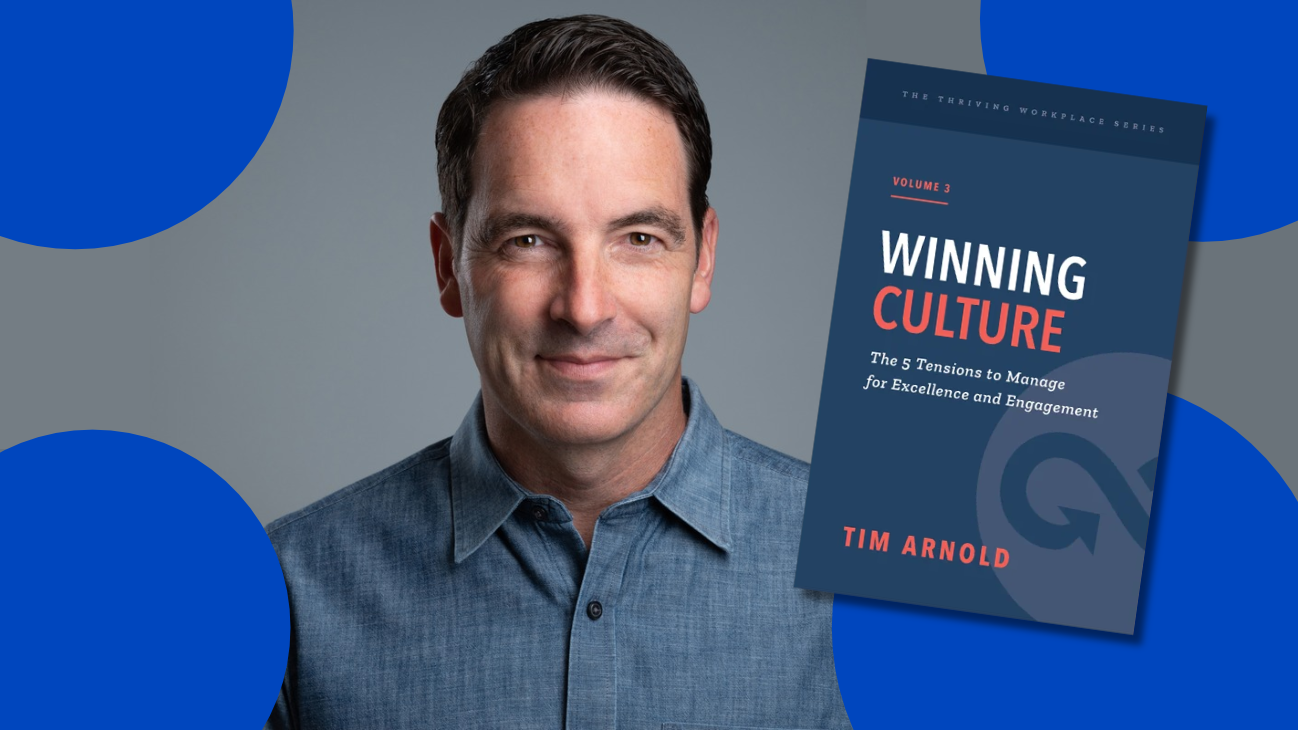
Tim Arnold has spent two decades working alongside leaders at the United Nations, global financial institutions, healthcare systems, and high-growth companies, and he has seen the same pattern everywhere: culture is always being shaped, but very few leaders are shaping it intentionally.
In his new book, Winning Culture: The 5 Tensions to Manage for Excellence and Engagement, Tim offers a clear, practical framework for shaping culture on purpose. It’s built around five tensions every leader faces: focusing on people AND results; respecting rules AND risk; fostering challenge AND encouragement; celebrating commonalities AND differences; and valuing work AND home.
We recently sat down with Tim to explore why so many organizations struggle to turn their values into lived behaviours, and the practical step any leader can take today to start changing that.
From Values to Behaviours
Speakers Spotlight: You mention that culture is always being built, and that it’s easier to put values on a wall than to implement them. Why do so many organizations struggle to turn stated values into lived behaviours?
Tim Arnold: Culture has very little to do with what we say — it’s all about what we do and experience. We can talk a good game and use words like respect, integrity, teamwork, and innovation, but if the behaviours we reward and tolerate don’t align with them, the words on the wall mean little. Culture comes down to what people experience every day.
One classic mistake is basing your culture on what I call, in the book, an absolute value: one whose opposite is plainly negative. Respect, for example, is the opposite of disrespect, and integrity is the opposite of being untrustworthy. These are really hiring expectations. If people don’t live them out, that’s a performance management issue, not a cultural distinctive. They’re simply the expectations for working here.
Culture is shaped far more by interdependent values: values that come in pairs, where the opposite is also good. We want to be all about results and all about people. We want to be all about risk taking, and respecting rules. The moment that you just choose one and neglect the other, you’re in trouble. If it’s all about risk, you’re vulnerable and will make unnecessary mistakes. If it’s all about rules, you stop innovating and stay within your limited beliefs. Same with people and results. If it’s all results and we neglect the people, we create a culture where nobody wants to show up. If it’s all about people and we neglect results, we’re feeling good, we’re just not getting stuff done.
So the big idea is this: instead of posters of absolute values that are really just expectations, pin your culture to a few interdependent ones.
Balancing Tension
SpSp: What are some of the tensions leaders need to navigate when trying to build a strong culture, and why is finding the right balance often more complicated than it first appears?
TA: In my work over the last 20 years, the organizations with a healthy, or even thriving, workplace culture were not perfect, because perfect doesn’t exist. But whether they stated it or not, they managed the five tensions well. No matter where I am in the world, those are the ones that are always critical to understand and manage well.
What’s interesting is that there’s no perfect formula for balance. The way Speakers Spotlight balances people and results is different from the way Loblaws manages it, which is different again from CIBC. Each organization has to find what I call healthy tension between those value pairs. The question is not what’s right or wrong, but what balance means for us. Sometimes we’ll lean more towards one side, but the tension never goes away.
The moment we culturally pick one side and ignore the other, we’re done. If it’s all results and no people, we’re in trouble. If it’s all about people and we neglect results, we’re in trouble. They only work when they’re working together.
Creating Engaged Cultures
SpSp: In your experience working with organizations across such different industries, what separates a workplace where people genuinely feel engaged and supported from one where culture exists mostly as a set of words on a wall?
TA: It really rises and falls on leadership. It’s been said that your culture is shaped by the worst behaviour leaders are willing to tolerate. You can say all day long that you’re about talking to people, not about them, and having crucial conversations. But if you lead meetings where people smile and nod, you know they’re having meetings afterwards where they’re talking about the issue, and you do nothing about it, that’s your culture. You can say you’re an innovative culture, but if someone takes a risk that doesn’t go quite as planned and you correct them for it, you shut down future attempts. That’s your culture.
So culture is shaped by the worst behaviours leaders tolerate, and just as much by what leaders model. If the posters say you’re all about work-life balance, but the leader hasn’t taken a vacation in five years, that’s your culture. If at the end of the day, what really gets rewarded is showing up two hours early and working weekends, that’s your culture.
You can have beautifully crafted mission, vision, values, and you can have incredible posters on every wall. But what matters are the behaviours leaders reward and tolerate, and model.
Navigating Differences
SpSp: How should leaders think about culture when their employees have different personalities, perspectives, priorities, and expectations about what a workplace should look like?
TA: One of the tensions in the book is celebrating both commonalities and differences, and a thriving workplace culture does both. It embraces and celebrates uniqueness and differences, in work style and in strengths. And at the same time, it celebrates what we have in common.
This is something people need to know as they explore working for an organization. There are certain things we simply do as a company. These are cultural distinctives that may or may not be a great fit for you, based on how you’re wired and the work environment that works for you. How we manage work and home is one example. These are conversations we expect to have with each other, and that’s okay, because they’re really what we rally around as a community. We can’t be about everything, so we choose to be about some things. The culture may be an absolute bullseye for you, or it may not. Either way, we’re still going to celebrate uniqueness, diversity, and differences. And there are certain things we’re confident about, because they’re how we work as one organization.
Practical Next Steps
SpSp: After two decades working with organizations ranging from the United Nations to financial institutions and high-growth companies, what is one practical step a leader can take today to start shaping their workplace culture more intentionally?
TA: The first thing is to recognize that no one has totally figured this out, from small start-ups to the United Nations. There is no perfect workplace culture. It is always a work in progress.
What leaders need to do is ask: in the culture that I am responsible for shaping, which one of the tensions am I going to keep front and centre in the season ahead? I can’t focus on everything, so what is the one thing I will talk about, keep us aligned around, reward when I see, and have difficult conversations when people fall outside it?
Don’t worry about all five tensions. Pick the one that would make or break us in the season ahead.
If leaders do that, they’re no longer leaving culture to chance. Your culture exists either way, so the question is whether you are being deliberate about the one you want. Then you can say: this is how we’re moving forward to have a culture that’s healthy and constantly getting better.
Hire Tim Arnold to Speak at Your Event
A leading voice on navigating complexity, Tim Arnold has helped more than 300,000 leaders, from Fortune 500 CEOs to frontline managers, turn competing demands into a leadership advantage. Drawing on his experience as an entrepreneur and nonprofit leader, his keynotes on workplace culture, teamwork, and leading change show audiences how to manage tension instead of trying to eliminate it. Practical, accessible, and often funny, they leave leaders with tools they can put to work right away.
Contact us to learn more about Tim and how to bring him to your next event.