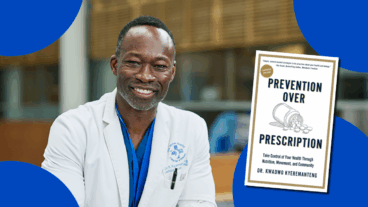
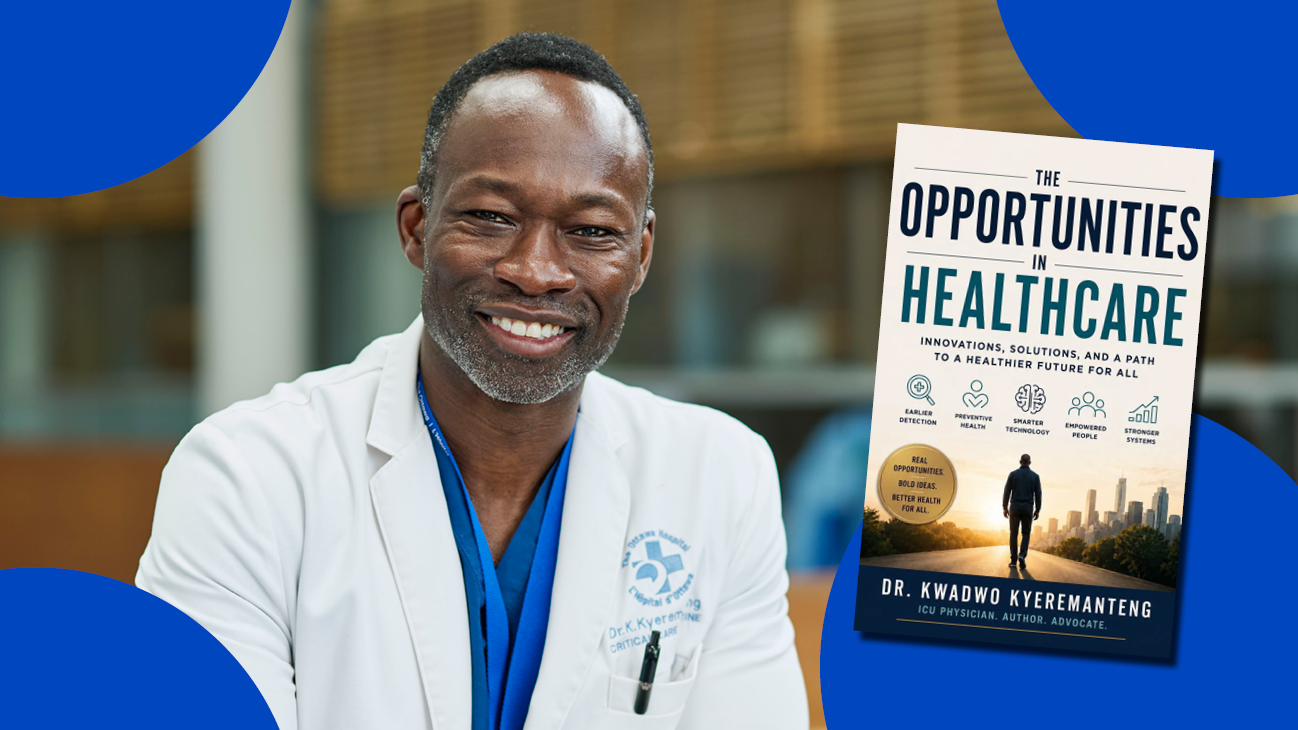
Dr. Kwadwo Kyeremanteng is an ICU and palliative care physician, healthcare innovator, and bestselling author whose work sits at the intersection of leadership, proactive wellness, and the future of healthcare. In his latest book, The Opportunities in Healthcare, Dr. K challenges the conventional narrative that healthcare is defined by crisis, burnout, and unsustainable costs.
Instead, he presents a bold vision for reimagining healthcare through innovation, prevention, technology, and human-centered solutions that improve outcomes while reducing suffering and system strain. Drawing from years on the frontlines of critical care, Dr. K shares practical strategies for leaders, organizations, and communities to build a healthier future — one focused not simply on treating disease, but on creating systems that help people thrive.
We recently sat down with Dr. K to dig deeper into his new book and how he hopes to inspire readers and audiences alike to think differently about the future of healthcare and embrace the extraordinary opportunities available to transform how we care for ourselves, our communities, and the systems we depend on.
From the ICU to Preventive Care
Speakers Spotlight: You’ve spent years working on the frontlines of critical care. How has that experience shaped the way you think about prevention and what healthcare could look like?
Dr. Kwadwo Kyeremanteng: Working in the ICU — especially through the pandemic — completely changed the way I think about healthcare.
An ICU admission is an incredibly difficult experience. Patients are critically ill, often separated from their families, unable to communicate, and experiencing significant physical and emotional distress. Even for those who survive, recovery can be long. We know that ICU survivors can experience anxiety, depression, PTSD, weakness, and loss of function. And unfortunately, not everyone survives.
The turning point for me was realizing how many of the conditions that ultimately bring people to the ICU are influenced by preventable risk factors.
Metabolic health is a great example. Improving how we eat, move, sleep, manage stress, and maintain muscle can reduce the risk of cardiovascular disease, stroke, infection, certain cancers, and many other chronic conditions.
There is also a tremendous economic argument. During COVID, an ICU admission could cost the healthcare system more than $50,000. Imagine if we invested even a fraction of that upstream — before people became critically ill.
That realization changed the direction of my career. I still believe deeply in excellent critical care, but I have become equally passionate about preventing people from needing my ICU in the first place.
The Opportunity in Healthcare
SpSp: What are some of the biggest opportunities in healthcare right now that you think aren’t getting enough attention?
Dr. K: One of the biggest opportunities is strengthening access to primary care.
Primary care is the cornerstone of the healthcare system, yet millions of Canadians struggle to access it. We need to think much more creatively about how we deliver care. For example, national medical licensure combined with high-quality virtual care could allow a patient in one part of Canada to access a physician elsewhere in the country. That could improve screening and prevention while reducing unnecessary pressure on emergency departments.
The second enormous opportunity is technology and AI. Used properly, AI can make healthcare more efficient, improve the patient experience, help clinicians make better use of their time, and potentially create more objective and equitable approaches to triage and access.
It can also help people navigate healthcare. Patients increasingly want to know: Do I need to see my family doctor? Should I go to emergency? What screening should I be getting? What can I do to improve my health?
Technology can help democratize access to reliable health information and give people more agency over their own health.
Prevention over Prescription
SpSp: You make a strong case for prevention. What would it actually take to move healthcare from a system that primarily treats illness to one that helps people stay healthier in the first place?
Dr. K: We have to change the incentives.
Right now, healthcare systems are primarily designed and funded to respond once someone becomes sick. If we genuinely want prevention, we need to create the time, resources, and infrastructure for clinicians to deliver it.
That could mean giving primary-care teams more time to discuss nutrition, exercise, sleep, stress, and metabolic health. It could also mean expanding the healthcare team to include dietitians, physiotherapists, mental health professionals, and health coaches.
Technology can help us scale this. Not every preventive intervention needs to happen during a physician appointment. Digital tools can provide education, track progress, personalize recommendations, and support people between visits.
I also think employers and the private sector have an important role to play. There is a tremendous opportunity for organizations to invest in keeping their workforce healthier rather than simply paying for the consequences of illness.
The encouraging part is that people increasingly want this. They want more ownership of their health, and they are looking for tools that allow them to act earlier.
AI and Healthcare: Opportunities and Challenges Ahead
SpSp: Technology and AI are often presented as solutions to healthcare’s biggest challenges. Where do you see the greatest potential — and where do we need to be more cautious?
Dr. K: One of the most immediate opportunities is improving the interaction between clinicians and patients.
AI scribes are a great example. Instead of spending much of an appointment looking at a computer and typing notes, clinicians can focus on the person in front of them. The technology can help generate the documentation, which the clinician then reviews and edits.
That sounds simple, but it can fundamentally change the experience of care. It gives us an opportunity to make healthcare more efficient while actually making it more human.
Beyond documentation, AI can help with navigation, screening, clinical decision support, and identifying patients who may need attention earlier.
The major caution is misinformation. AI is only as useful as the information behind it. We need clinicians, healthcare organizations, and trusted institutions actively involved in developing these tools and ensuring they are grounded in high-quality evidence.
The goal should never be to replace the relationship between a clinician and a patient. It should be to use technology to make that relationship stronger.
Finding Your Agency
SpSp: For people who feel overwhelmed by the state of healthcare, what is one shift in thinking you hope they take away from the book?
Dr. K: The biggest shift is recognizing that we have more agency than we think.
Healthcare is facing enormous challenges, and no individual can fix the entire system. But that doesn’t mean we are powerless. As individuals, we can take greater ownership of our health and focus on the behaviours that reduce our risk of disease.
For example, healthcare professionals can challenge inefficient practices and advocate for better models of care. Leaders and organizations can invest in prevention, innovation, and healthier workplaces. Entrepreneurs and technology companies can build tools that make care more accessible and easier to navigate. Governments can rethink incentives and regulation.
The message of Opportunities in Healthcare is ultimately optimistic: there is no single solution and no single person coming to rescue healthcare. We all have a role to play.
If enough of us start identifying the opportunities in front of us — and acting on them — we can begin moving healthcare in a very different direction.
Hire Dr. Kwadwo Kyeremanteng to Speak at Your Event
Having spent his career caring for the sickest of the sick patients, Dr. Kwadwo Kyeremanteng is a mission to shift the conversation on healthcare from reactive to proactive. His work emphasizes the power of simple, sustainable habits to protect health and reduce burnout with his practical keynotes on leadership, healthcare innovation, and health and wellness offering a rare blend of clinical wisdom, storytelling, and down-to-earth strategies that audiences can immediately apply.
Contact us to learn more about Dr. K and how to book him to speak at your next event.