
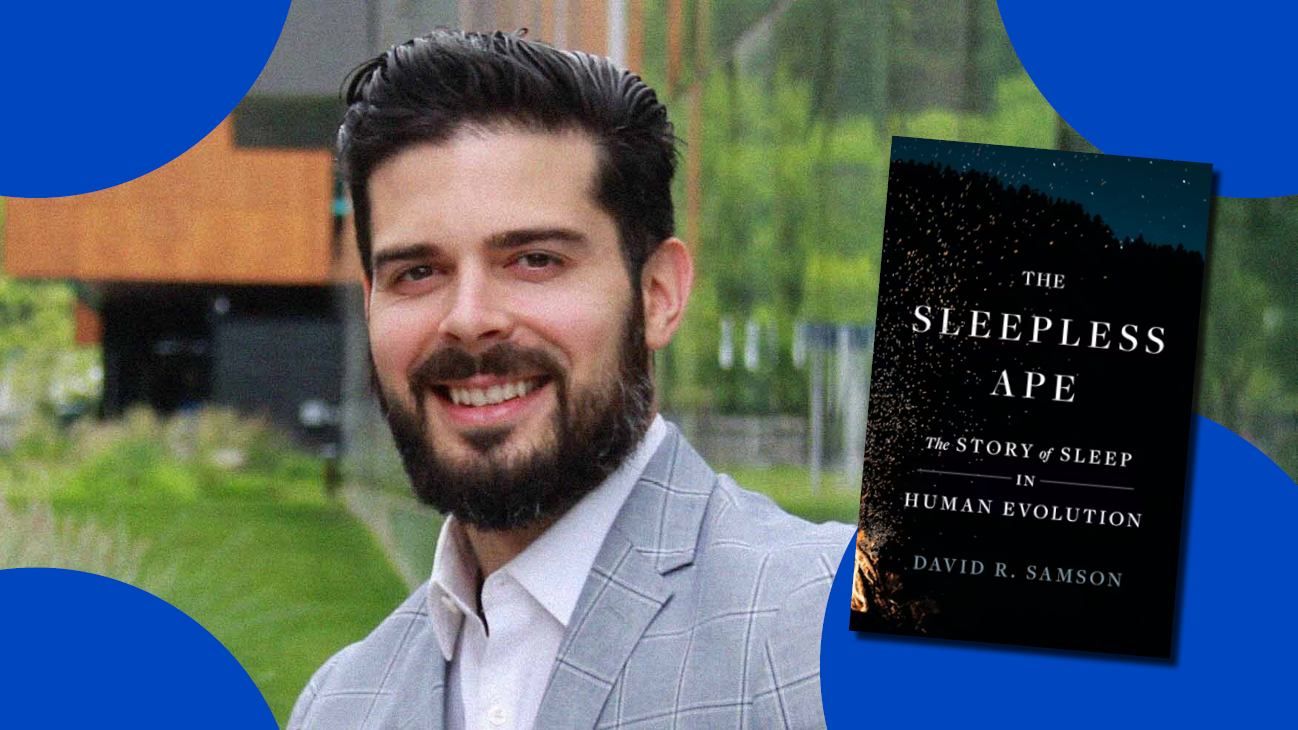
You sleep every night — but do you know why you sleep the way you do? For evolutionary anthropologist David R. Samson, that question unlocks something far bigger: the hidden biological forces still shaping how we think, connect, and perform.
An associate professor at the University of Toronto and award-winning author of Our Tribal Future, David has spent his career bridging our ancient past and modern lives — translating cutting-edge science into insights that help organizations optimize wellness, strengthen teams, and lead more effectively. His new book, The Sleepless Ape, tackles one of evolution’s most fascinating paradoxes: why humans sleep less than any other primate, and what that means for our health and potential.
We sat down with David to learn more about his new book release and explore the science of sleep and what it reveals about being human.
Less Sleep: The Human Advantage
Speakers Spotlight: Humans sleep less than any other primate — why did evolution favour shorter, more efficient sleep instead of more of it?
David R. Samson: Sleep is essential, but it is also costly. When you’re asleep, you’re offline: you cannot forage, defend yourself, care for others, or respond quickly to threats. My argument is that humans evolved a remarkable solution to this problem. By sleeping in socially protected groups, using fire, shelter, and eventually more stable sleeping environments, our ancestors reduced the dangers of sleep and compressed more restorative sleep into fewer hours. We did not simply lose sleep; we evolved a shorter, more flexible, and more efficient form of sleep. Therefore, we can flip the modern intuition that group sleep is poor sleep on its head — we’re such efficient sleepers because of — not in spite of — being group sleepers!
A Turning Point in Human Evolution
SpSp: How did the shift from sleeping in trees to sleeping on the ground fundamentally change human biology and behaviour?
DS: The move from the trees to the ground was one of the great turning points in human evolution. Other apes sleep in arboreal nests, which help protect them from predators and environmental exposure. But as our ancestors increasingly slept on the ground, they entered a more dangerous sleep niche. That likely intensified the importance of social sleep: sleeping near others, maintaining vigilance across the group, using fire, and building safer sleep sites. In this sense, ground sleep did not just change where we slept; it helped shape human cooperation, social bonding, and the architecture of the human night.
The Hidden Engine of Human Ingenuity
SpSp: You argue that deeper, more efficient sleep helped fuel cognitive advancement. What’s the link between our sleep patterns and the evolution of creativity and memory?
DS: Sleep is not passive. It is an active neurobiological state that supports memory consolidation, emotional processing, learning, and insight. Humans appear to have evolved a sleep profile with a relatively high proportion of deep, restorative sleep and REM sleep packed into a shorter night. That may have helped support the cognitive demands of a highly social, tool-using, symbol-making primate. Creativity does not come from sleep alone, of course, but sleep gives the brain time to reorganize experience, and strengthen important memories, and make new associations. In that sense, the sleeping brain may have been one of the hidden engines of human imagination, creativity, and ultimately our stunning evolutionary success.
Are We Really in a Sleep Crisis?
SpSp: There’s a lot of talk about a modern “sleep crisis.” Are we actually sleep-deprived or misunderstanding what healthy sleep looks like?
DS: I think we are misunderstanding the story. Our cross-comparative work with small-scale societies suggests that people in large-scale industrial societies are, in some respects, sleeping better than any group on the planet: sleep is often longer, more consolidated, and more efficient. So the issue may not be a simple sleep-deprivation crisis. The deeper problem is circadian disruption. Circadian rhythms are among the most ancient sleep-related adaptations, and sleep is downstream of those rhythms. If we want true sleep enlightenment, the goal should not be to chase an abstract eight-hour ideal, but to rebuild strong daily rhythms: bright days, dark nights, regular timing, social consistency, and environments that tell the body when to be awake and when to sleep.
The Simple Shift That Could Transform Your Sleep
SpSp: Based on your research, what’s one common modern sleep habit we should rethink if we want to align better with how humans evolved to sleep?
DS: I would rethink the way we treat the evening as an extension of the workday. Humans evolved with powerful environmental signals: daylight, darkness, temperature shifts, social rhythms, and the gradual transition from activity to rest. Today, many of us move from bright screens, work emails, artificial light, and cognitive stimulation directly into bed, then wonder why sleep feels fragile. If I had to choose one habit, it would be to protect the transition between sunrise and sunset. Anchor wake ups to morning lights, and at all costs protect yourself from blue wave light after sunset!
Bring David R. Samson to Your Next Event
What could your team achieve with a deeper understanding of their own biology? David R. Samson doesn’t just explore human nature, he shows audiences how to use it. Drawing on decades of fieldwork and cutting-edge interdisciplinary research, his keynotes translate evolutionary science into practical tools for optimizing performance, building stronger teams, and becoming smarter leaders.
Whether he’s unpacking the ancient roots of peak performance or exploring how our paleolithic instincts can help us navigate modern uncertainty, David leaves audiences with insights they can act on immediately.
Contact us to learn more about David and how he can give your team the tools to thrive.