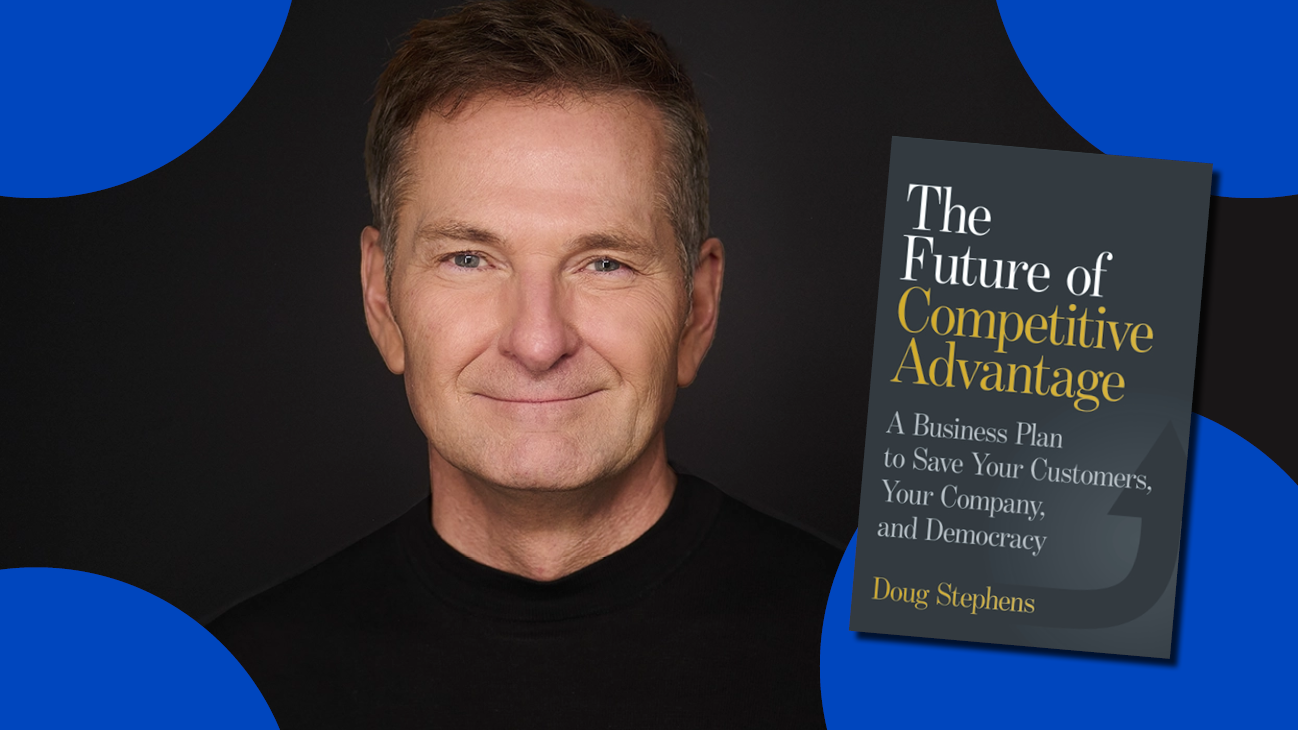
What if the greatest competitive advantage available to businesses today isn’t a new technology or a smarter supply chain — but a healthier society? That’s the provocative and timely argument at the heart of Doug Stephens’ new book The Future of Competitive Advantage.
Called “the futurist that futurists follow”, Doug is one of the world’s foremost business futurists and retail industry experts, renowned for his ability as a keynote speaker to decode the forces reshaping commerce and translate them into strategic advantage. In his fourth book exploring the future of consumerism, he draws on decades of research into consumer behaviour and global commerce to illustrate why trust, fairness, and collective intelligence are the next generation of business superpowers.
We recently sat down with Doug to explore what it means to build a business that’s good — and why, in today’s world, that might just be the smartest competitive move a company can make.
The Tipping Point
Speakers Spotlight: In your new book, you argue that businesses can no longer separate their success from the health of society itself. What signals convinced you we’ve reached that turning point?
Doug Stephens: There were a few things that collided around 2024. The first had to do with the business world at large. To hear the retail industry tell it, everything was business as usual. Beyond the obligatory AI chatter, the same kinds of conversations that dominated a decade ago were still dominating.
Meanwhile, the world our industry depends on was being transformed beyond recognition. Democracy — the very foundation of the free market — was hanging by a thread, particularly in the United States where 65 percent of Americans had lost faith in democracy. But even in Canada, one-third of Canadians had similarly little conviction to democracy.
Income and wealth polarization had reached an inflection point across North America and AI was setting up to make that divide even wider. An entire generation of young consumers had been priced out of the life their parents took for granted. And on top of it all, social media was driving an epidemic of social division and declining happiness. So, Rome was burning, and the business sector was still debating minutia. Worse yet — business leaders weren’t stepping up to defend democracy.
I wanted to understand how we, as a society, got here. And it became clear that the business sector – enabled by governments across the political spectrum — was chiefly culpable for what has been a persistent march toward a society of haves and have-nots. A 45-year extraction of value from society that caused an entire segment to fall out of the middle class and into a brutal underclass. To put a point on it, a mere 10 percent of Americans today are responsible for 50 percent of all consumption. The bottom 80 percent account for roughly 30 percent. And in that environment, the bedrock of society — our trust in institutions, our belief in the fairness of capitalist systems, and our commitment to education and the expansion of human intelligence — had cracked and, in places, shattered entirely.
It seemed to me that ultimately no company can thrive long term in a society that is failing. At some point, capitalism itself implodes. That connection launched me on a journey to map the next frontier of competitive advantage.
The New Competitive Currency
SpSp: You describe trust, fairness, and collective intelligence as the next generation of business superpowers. Why are these becoming more valuable than traditional advantages?
DS: Any good business plan is predicated on one fundamental question: what are the needs in the market that are underserved?
It seemed to me that in a world of product and service proliferation, what consumers around the world need most right now isn’t faster delivery, cheaper offshored products, or an iPhone with two more cameras. They need trust in business and societal institutions. They need a renewed sense of economic fairness. And they need corporations willing to make real investments in human intelligence and growth.
What I discovered is that those three things, in combination — fairness, trust, and intelligence — are the engines of far superior business performance, robust societal prosperity, and stable democracy. All of which serve the economic interests of businesses and government. Everybody wins.
So, my book is an attempt to explain how we arrived at this moment — and the role business played in getting us here — and then draw a clear roadmap toward the next frontier of competitive advantage where being a “good” business is no longer seen as a sacrifice but as a competitive superpower.
The Business Case for Democracy
SpSp: Many leaders still see social responsibility as separate from profitability. How do you make the case that defending democracy and investing in societal well-being are actually competitive advantages?
DS: Well, you’ve hit on an important point and one that I very deliberately based my concept of this book on. If you’re trying to convince CEOs and boards to act, moral appeals will fall on deaf ears. That’s not meant as an insult to business leaders. It’s simply the reality. Business leaders are in the business of generating revenue, profitability, and shareholder returns.
So, it was clear to me that the book had to present a clear and cogent business argument for why these competitive pillars are essential but also offer a tactical plan to manifest them. It had to be provable and doable. In essence, making the financial case for why democracy was good for business and good business was essential to a strong democracy.
What I discovered is that the three pillars of fairness, trust and intelligence are not only essential ingredients in a healthy, functioning democracy but they are also rocket fuel for companies. In the book, I provide examples of companies that understand this — all of whom dramatically outperform their competitors.
What Consumers Really Want
SpSp: You’ve spent decades studying consumer behaviour and the future of retail. How are customer expectations changing when it comes to the role brands should play in society?
DS: I won’t lie and suggest to you that there aren’t plenty of consumers out there who don’t care about much beyond price. That’s just the reality that 45 years of income polarization creates. That said, my research found that there are also billions of consumers in the world today that are distrusting of large corporations. In fact, in Canada, just 27 percent of those surveyed trust businesses. For perspective, 30 percent of Canadians believe groundhogs can predict spring. The numbers are the similar in the US.
So, businesses lack trust. And a lack of trust has significant financial impact. It lowers consumer purchase intent, reduces customer loyalty, raises staff turnover, quashes supplier collaboration, and tanks investor premiums and confidence. In other words, trust is capital on steroids and fairness is the price to acquire it.
Consumers want to shop where people earn living wages, with companies that pay their fair share of taxes and don’t attempt to price gouge. They want to buy from companies that respect and maintain the environment. And they want to invest in companies that have a public reputation for being trustworthy. So being radically trusted is a breakout competitive opportunity.
The Opportunity Hidden in the Crisis
SpSp: While the book addresses serious societal challenges, it’s also deeply optimistic. Where do you see the greatest opportunities for companies willing to rethink how they lead and compete?
DS: The overriding goal of most CEOs today is delivering returns to shareholders. This is incredibly short-termist, transactional, and frankly self-serving, considering most executive compensation includes stock. What my research suggested was that the real goal of every CEO should be to operate their company in such a way as to promote conditions for mass prosperity. Mass prosperity — like that between 1945 and 1975 — was the most remarkable growth period in history. Thousands of brands that are household names today were born in that era. Supply couldn’t keep up with demand. Consumers wanted more of everything.
If not for the post-war increase in social and economic fairness, deep trust in government and business, and the leaps in intelligence due to expanded access to education, we may never have heard the names Sam Walton, Steve Jobs, or Jeff Bezos.
So, the goal cannot be to serve the short-term needs of shareholders at the expense of society. That’s a road to extinction. The goal should be to serve society in the long-term interests of their shareholders.
What gives me hope is that more CEOs and business owners will begin to embrace this business plan. Not as a sacrifice but because they can see that being a good business is good for business — and the democracy they depend on. That’s a future we can be proud to leave to future generations.
Hire Doug Stephens to Speak at Your Next Event
The founder and CEO of Retail Prophet, Doug Stephens is one of the world’s most sought-after business speakers and a go-to authority for global brands like IKEA, Nike, Coca Cola, and Louis Vuitton. His dynamic keynotes don’t just explore business transformation; they reveal the surprising competitive advantages waiting for organizations bold enough to reimagine their future in this era of unprecedented disruption.
Contact us to learn more about Doug and how he can give your audience a roadmap for turning today’s challenges into tomorrow’s competitive advantage.