Change is no longer a phase organizations pass through but a permanent condition of modern business with $2.6 trillion spent on transformation each year. Yet despite this astounding investment, two in three organizations fail at change initiatives — a stat that hasn’t moved in three decades. Even with AI thrown in the mix, the problem isn’t getting easier with 74% of organizations failing to scale value from it.
If change is so constant, it begs the question why are we so bad at it? Or, even better, why do some succeed where so many others fail?
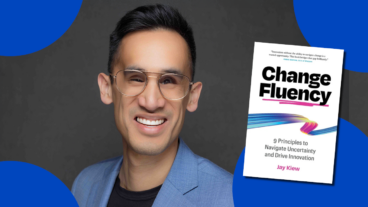
That’s the question Jay Kiew has dedicated his career to answering. An innovation and change navigation strategist, he has created more than $2B of impact for 400+ executives by designing, developing, and delivering organizational transformation. But his relationship with change extends far beyond the professional arena. Jay is a half-blind cancer survivor who moved eight times across three countries before the age of 13. Navigating change has been the defining constant of his life.
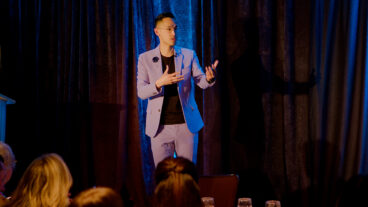
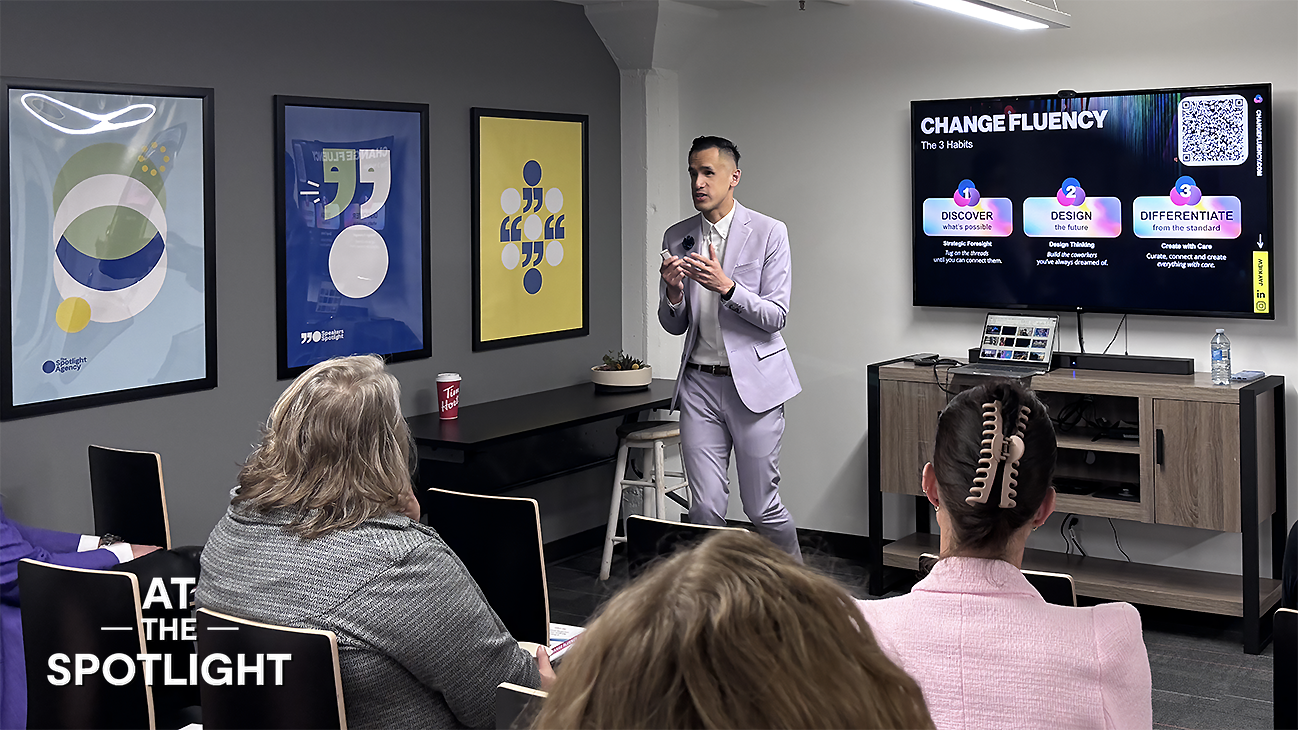
Jay recently joined us at our client-exclusive event, At The Spotlight, where he unpacked what it takes to develop change fluency — an individual’s adaptive capacity to translate challenges into opportunities. He broke down the change mindsets that shape our relationship with disruption, the three core skills required to build a change fluent mindset, and the practical tactics leaders need to make it stick.
The Four Change Mindsets
The organizations that figure out change aren’t necessarily working with better technology or bigger budgets. The difference lies in mindset, Jay said, and specifically how we interpret change and respond to it. Do we see change as a threat or an opportunity? And when it hits, are we frozen and resistant or proactive and adaptive?
Together, those two responses form what Jay calls the Change Mindset Matrix — four mindsets that explain why people can face the exact same disruption and respond in completely different ways.
Mindset 1: The Observer
If someone sees change as an opportunity but stays frozen or resistant, they fall into the observer mindset —optimistic about what’s coming but they hang back, waiting to see how it plays out before committing to it.
Mindset 2: The Defender
If someone sees change as a threat and responds by staying frozen or resistant, they fall into the defender mindset. Having built something they’re proud of, their instinct is to protect it from disruption rather than change or evolve alongside it.
Mindset 3: The Saboteur
If someone sees change as a threat but responds proactively, they fall into the saboteur mindset. On the surface, they can look like a champion of the initiative: nodding along in meetings, saying the right things. But underneath, they may be actively working to slow it down or kill it altogether.
Mindset 4: The Change Fluent
If someone sees change as an opportunity and responds proactively, this is what we call change fluency, Jay said — the Mr. Miyagi of the group, referencing the famous Karate Kid character. These are the people who are thrown punches of disruption all the time and able to take it and transition it into forward momentum.
None of us live permanently in one quadrant, Jay added. We move across all four depending on the change and how it makes us feel. The real leadership challenge isn’t where you fall as an individual, but where your teams fall and how you can help them shift back or enter into a change fluent state.
The Three Practices of Change Fluency
Jay shared three core practices leaders can use to move themselves and their teams toward change fluency.
1. Discover What’s Possible
This is the practice of strategic foresight, Jay said. Most of us operate inside our own organizational bubble — one company, one industry. Strategic foresight means learning to zoom out so you can zoom in on what matters. Be curious about what’s happening outside of your work or role so you can zoom back in on what’s important to it.
There’s a lot of noise out there, Jay said, and often when we are hit by it our instinct is to hide or push away from it. But navigating the noise is what gets us the signals we need to move forward.
Jay pointed to four signals worth watching right now:
- AI demand is surging. Anthropic’s valuation went from $14 billion in February 2026 to $30 billion the following month.
- Consumer expectations are evolving just as fast. People are shifting from searching for information to expecting personalized insight delivered in seconds.
- AI is fragmenting trust while augmenting reality. That makes human expertise and experience more valuable than ever.
- AI agents are reshaping the workforce. They’re increasingly taking on the entry-level work — research, writing, analysis — that used to build foundational skills, with real implications for how organizations approach succession planning and talent development.
So how can you put strategic foresight into practice? Ask yourself these questions regularly, Jay said:
- How do you scan for signals with your head on a swivel?
- How do you synthesize the insight underneath the noise?
- And how do you spot the opportunity that follows?
2. Design the Future
Once we’ve uncovered what’s possible, we can move into the practice of design thinking, Jay said — building solutions for the future you’ve just discovered. This is where AI can come in. We can build AI co-workers to helps us find these solutions.
For example, from an event perspective, if your attendees find forms tedious and ROI is hard to capture, an AI agent can do the heavy lifting instead, Jay said. Using Claude Cowork, he gave a live example to show how, by giving it the correct prompt, it can help collect useful data to shape your programming and enhance your attendees’ event experience.
Claude Cowork can collect and review all event registrants from a certain time period and draft personalized outreach emails to check in on what those attendees hope to learn and surface what business outcomes they’re actually after. From there, it can pull together that data in a spreadsheet and use it to suggest agenda/programming adjustments for the planner and/or share recommended sessions to the registrants to help them achieve their desired learning outcomes.
While this is just one example, design thinking is what turns AI’s potential into real, actionable leverage, Jay said.
3. Differentiate Through Care
The third practice, Jay said, is about how you show up in the work — not just what you do, but the care you bring to doing it.
As an example, Jay introduced us to Roger Cool, a radio DJ in Singapore where Jay was born. Roger was blind and one day got the opportunity to interview Stevie Wonder. He was excited to welcome another blind person into the booth for the first time. “There are many things impossible for a blind person,” Roger said to him. “We can’t drive, we can’t perform surgery. How does that make you feel?”
In response, Stevie pulled out a harmonica and blew a few notes. “You’re right,” he said. “Many things are impossible for blind people. But I believe everything else is possible. If I didn’t do what I do with my instruments, and you didn’t do what you do with your microphone, we wouldn’t have blind DJs or blind musicians.”
Roger was Jay’s father — and a big reason why Jay applies the same principle to his own life. Whether the instrument is a harmonica, a microphone, or an AI platform, he said, the goal is learning how to leverage what’s in front of you to bring your best work to life.
Hire Jay Kiew to Speak at Your Event
Most people think change happens to them, Jay said. The shift leaders need to make is recognizing that change happens through them.
As a keynote speaker, Jay helps audiences make that shift — moving from reacting to change to actively shaping it by building a change fluent mindset. He tailors every keynote to the industry and organization in the room, drawing on relevant examples and signals specific to that audience. The result is a session that speaks directly to the challenges your team is facing.
Learn how to navigate disruption with confidence. Contact us to learn more about Jay Kiew and how to book him for your next event.