
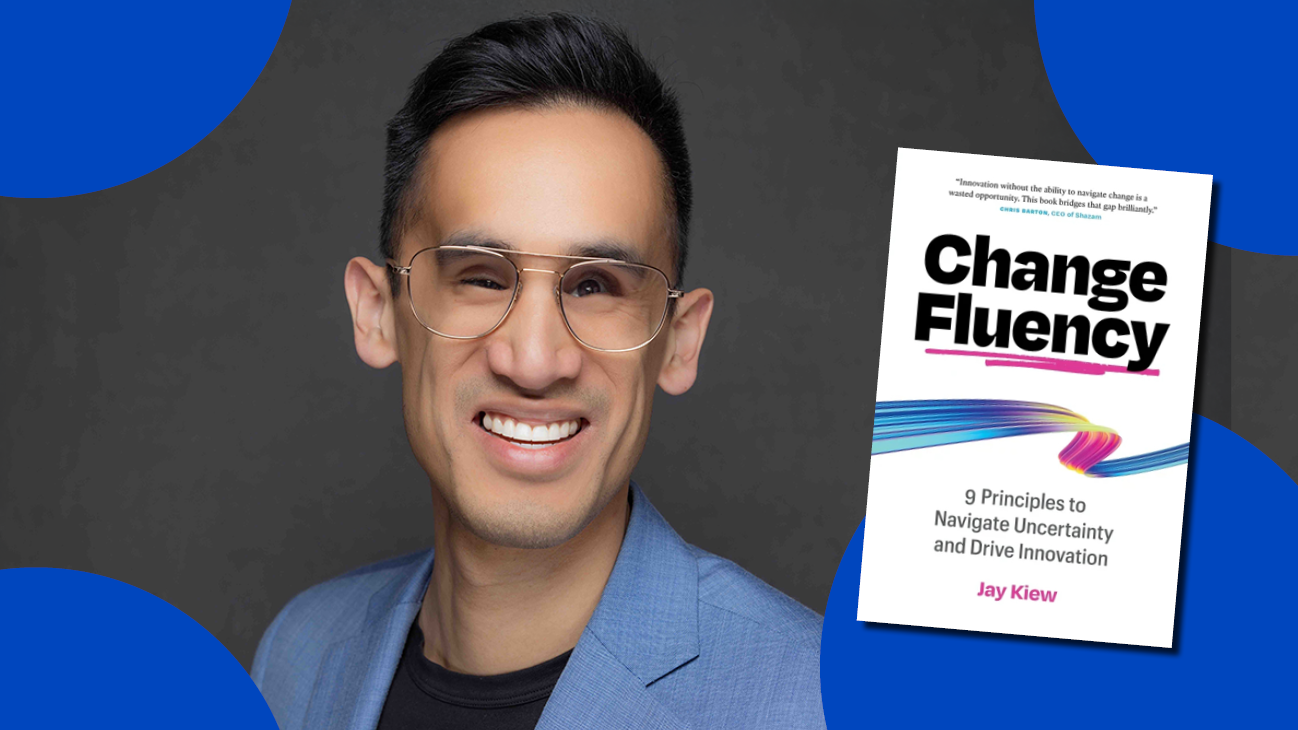
When disruption strikes, most leaders freeze. The best ones become fluent. An innovation and change navigation strategist, Jay Kiew’s new book Change Fluency, draws from real-world examples — from over $2 billion in transformation impact from more than 400 organizations — to share nine leadership principles to better navigate uncertainty and drive innovation.
Part parable, part playbook, Change Fluency equips managers, executives, and leaders to discover what’s possible, design the future, and differentiate from the standard when everything feels the same. We spoke to Jay about his new book and why, in a world where change is the only constant, change fluency is critical and how leaders can develop this essential skill in themselves and their teams.
Change Management vs. Change Fluency
Speaker Spotlight: In your book, you argue that leaders shouldn’t just manage change but become fluent in it. What’s the difference between managing change vs. change fluency?
Jay Kiew: When I think about managing change and change management as a practice or function, you have all these initiatives, these transformation efforts that you’re doing within your organization that are very project or program based. But the truth is, most change is dynamic. It’s complex. So, what we found is that most people manage change, but leaders manage mindset.
What I mean by this is that you can project manage change from an initiative point of view, but leaders who are change fluent speak the language of change. They know it’s complex, dynamic, and ever evolving, that it can’t be managed because it’s constantly iterating. So those who are change fluent maintain a mindset where they see change as an opportunity, and something they can be proactive about.
Leveraging Limits: The Overlooked Principle
SpSp: Through examining several case studies, you outline nine principles to becoming change fluent. In your research, was there one that surprised you or is often overlooked?
JK: Probably the one about leveraging your limits. With this principle, we dug into a Costco case study. Costco doesn’t try to create a future where they’re winning all the time. In fact, most of their focus is actually on leveraging their limits, meaning they work within the constraints of their business and how they can play around with those constraints to find market differentiation.
Businesses like Amazon and Walmart, they believe that the more SKUs you have the better. Costco only has 3000 SKUs vs. the 300,000 SKUs at Amazon and Walmart. They also limit things like profit, which is such a surprising thing. They don’t try to make more money. They don’t try to make more than 15% on every dollar they sell. Anything beyond 15%, they actually give back to their members, which is why so many people love Costco.
The third thing that they limit is marketing. They don’t do ads or anything like that. Most of it is based on their membership. They’ve relied on word-of-mouth marketing throughout all the different iterations of their brand, from when it was Price Club to today.
Nintendo’s Masterclass in Change Fluency
SpSp: Speaking of those case studies, was there one you found particularly fascinating that captures your change fluency model in action?
JK: There were so many case studies to choose from. The one that I saw the most was Nintendo. Nintendo reached a few points throughout 80s, 90s, and 2000s where they were at risk of extinction. Each time, they double downed on not sticking to what they’re really good at but discovering what’s possible — they zoomed out to zoom in. They took a look at designing the future by working in wonder, and then they looked at differentiating from the standard by creating with care.
Nintendo started off as a playing card company and evolved into a console company. Then, over time, they saw each console as a chance to redefine who they were. From Super Nintendo to N64, then they shifted to the Wii, which was much more active, all the way to the Switch. Handheld gaming devices were not something they were good at doing but they wanted to see how they could build a console that was multimodal. How could they build something that was accessible on your TV and on the go? And they did it.
Combating Change Fatigue
SpSp: With teams experiencing change fatigue right now, how can leaders create momentum and drive experimentation and innovation without burning people out?
JK: There are a lot of different strategies to choose from, but one of the principles from the book that really speak to this is cultivating contribution over participation. Most change initiatives measure participation as a success rate, how many people are adopting new technologies, how many people are doing the training, etc. These are participatory scores. Where the nuance gets in, where change fatigue decreases, is when we enrol people in making a contribution. When we see people as part of the change and ask ourselves as leaders, how do we bring them along the journey so that they are co-creating the future with us?
This begins by rewarding and recognizing those who are building and those who are experimenting. Usually within every organization about 10-15% of employees would be described as the innovators. They’re the ones constantly tweaking around with your processes, suggesting new ways of making things better, etc. They can be really helpful, or they can be perceived as thorns, and sometimes they’re both. But to combat change fatigue to encourage a culture of innovation, you need to start by recognizing and rewarding the innovators and the changes they are making. When you do this, you are increasing visibility for the innovator’s work, making them feel good and valued.
AI as a Partner
SpSp: Your book comes with an AI companion coach. How do you see AI reshaping the way leaders approach innovation and transformation?
JK: AI agents are going to become the centrepiece of most organizations. Our work will continuously surround or lean into AI partners to do our work with us. So how does that shift us? We, as leaders, are in the active process of learning how to partner with AI better. And what we found is that the l skills necessary for leaders today are critical thinking, storytelling, influencing, and design thinking all of which develop naturally when working in wonder. If they can do that consistently, if they can adopt this kind of mindset, they’re actually able to adapt to the future of work a lot better. It becomes less about what AI does and more about how we can integrate it seamlessly into our workflows and shift our mindset around our roles.
We get so attached to our functions, we work in HR or finance or marketing or operations. And really, the truth is, most of what we do on a daily basis is actually multifunctional. For instance, you might sit in marketing, but you actually do so much more than that every single day. You’re writing, creating, generating ideas, looking at brand design, etc. But then you’re also project managing. You’re looking at budgets or ROI and metrics. So, I think our roles as leaders is to take on more of an orchestrator role now, where we’re orchestrating work, reviewing it, guiding it, elevating it, and providing oversight.
One of the quotes from the book that really resonates for me is “the depth of your connection determines the height of your collaboration,” which really captures the notion that to reach new heights together depends on how deeply connected we are with our teams.
Strategy Is Sacrifice
SpSp: If leaders walk away with just one mindset shift after reading Change Fluency, what should it be?
JK: It’s the notion that strategy is sacrifice. Oftentimes, we hear people are burnt out, and yet the solution is to add more onto people’s plate. New initiatives, more growth, more head count, etc. But the more we are willing to let go of the things that no longer support us, that’s when we’re able to home in on what we’re great at. So get comfortable with the notion of sacrificing one area so that we can double down and focus in on what we can become really great at.
Hire Jay Kiew to Speak at Your Next Event
Jay Kiew is a world-leading expert on change fluency and a renowned keynote speaker with more than 13 years of strategy and human capital experience. But his story extends far beyond the professional arena. Jay is a half-blind cancer survivor, whose life is a testament to resilience in the face of adversity. His remarkable blend of professional expertise and personal resilience equips leaders to hack through the thick of change and disruption.
Contact us to learn more about Jay and how he can help your organization better navigate ongoing disruption and turbulence.