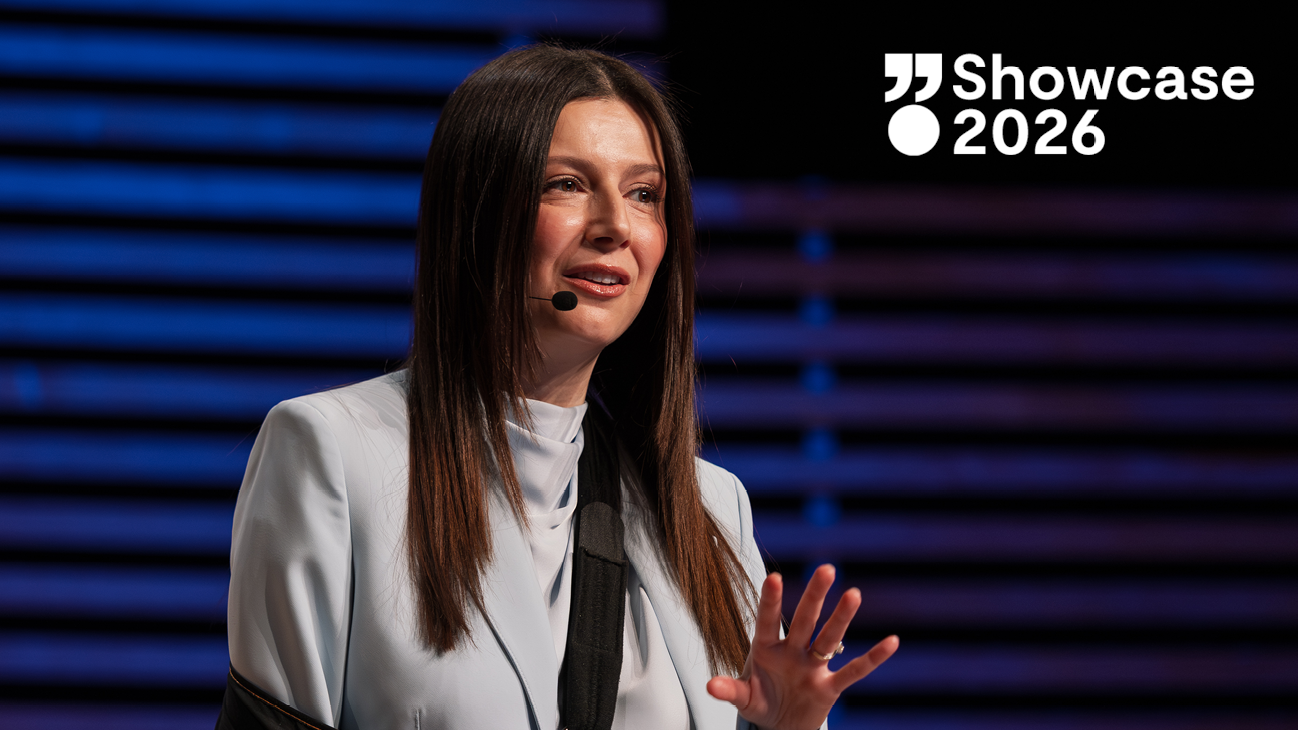
There was an elephant in the room at Showcase 2026. It’s the same one in every boardroom, workplace, and industry right now — and its name is artificial intelligence.
Reality is beginning to blur. AI is moving off screens and into the world around us, and the line between what’s real and what’s simulated is eroding faster than most leaders realize. At Showcase 2026 — Speakers Spotlight’s annual client-exclusive, TED-style event — Dr. Helen Papagiannis challenged the room to stop asking what’s next and start asking a bolder question: what comes after what’s next?
A globally recognized authority on AI and a pioneer in immersive technologies, Helen has spent more than two decades designing the very systems now reshaping our world. She is the bestselling author of Augmented Human: How Technology Is Shaping the New Reality and uses her signature AfterNext lens to help business leaders see the future before it arrives and understand what they need to do now to stay ahead of it.
Dr. Helen Papagiannis had clear messaging about the projects of the future… The immersive examples and business cases were excellent.
Showcase 2026 attendee
The AI Shift: From Screen to World
For years, AI has lived behind a screen. You typed a question, it gave you an answer. Now, it’s moving into the physical world — into glasses, wearables, and environments that respond to us in real time. This evolution marks a shift from large language models to world models, meaning AI can now simulate environments, explore possibilities, and let us step inside different futures before they happen.
“When you step inside something,” Helen said, “it stops being information. It becomes experience.”
This AI shift from tool to influencer represents a world of opportunity for leaders. For the first time, organizations and consumers alike can test ideas in real time — a real estate buyer can walk through a building before it’s built, a retailer can test a store layout before committing to it. This changes how leaders should and can plan, communicate, and act.
The Authenticity Premium
While this shift represents an exciting opportunity, it’s a fine line to walk. As AI-generated content floods every channel, what feels genuinely human is becoming more valuable. Helen calls this the “authenticity premium”, a term explored in a recent special report on the future of marketing published by the Financial Times. In a world where almost anything can be fabricated, she said, authenticity commands a premium in trust, attention, and brand loyalty.
We’re already seeing this play out in real time. Vogue came under fire for using AI-generated models, accused of perpetuating unrealistic beauty standards, Helen said. While other brands are being applauded for making the opposite choice — committing to no AI and only using real people and real bodies.
“We’re beginning to map out what parts of the online world we’re willing to let be synthetic,” she continued, “and where we still want things to be real.”
It’s a tension that gets to something deeper. “AI is a mirror,” Helen said. “It reflects back to us our hopes, our dreams, and our fears. And our job is to keep that reflection distinctly human.” It’s our ability to do that that will define the next decade. Not the technology itself, but how we choose to engage with it.
“The real measure of progress,” Helen said, “isn’t what technology can do. It’s what it enables us to become.”
The Rise of the Augmented Human
AI isn’t just changing what we create. It’s changing what we’re capable of. Helen calls this the rise of the augmented human — AI amplifying human capability, expanding how we perceive, decide, and act. But with that amplification comes a responsibility that she argued most leaders haven’t fully embraced.
We are crossing a threshold — not just a technological one, but a human one. Now that the real can be fabricated, trust has become the new axis, the foundation upon which every human interaction in an AI-shaped world now rests. This is the AfterNext, Helen said. Not simply what’s coming next in technology, but the deeper recalibration already underway — of what feels real, what feels credible, and what it means to be human in a world where experience itself is becoming programmable.
Helen’s challenge to the room was clear: the leaders who thrive in this future won’t be those who adopt AI the fastest. They’ll be the ones who stay acutely aware of the systems shaping them, and who choose — deliberately — who they want to become in the worlds they’re building.
AfterNext in Action
Organizations across industries are already putting this into practice. For example, in financial services, Helen said AI and immersive technologies are helping to tackle one of the oldest challenges in advising: helping clients picture a future that feels distant or difficult to imagine. MIT’s Future You project offers a glimpse of where this is heading — a conversational interface that lets you speak with an AI-rendered older version of yourself, built from your own values, goals, and life choices. Research shows that people who interact with their future self make better long-term decisions and experience reduced anxiety.
AI is taking a similar role in health and wellness, Helen said. MIT’s experimental wearable Rewind uses the same principle — creating a virtual version of you to guide you through moments of stress and anxiety. The device plays back your own recorded voice, calm and deliberate, to help you slow down, reconsider, and make better decisions in real time.
Another example is retail, where brands are using tech to further immerse customers into their products. Helen worked with Louis Vuitton to reimagine their iconic trunk using augmented reality in celebration of their founder’s 200th birthday. Appearing in stores globally, her AR artwork allowed customers to go deeper into the brand’s world and story.
These examples are early signals of where every industry should be heading.
Book Dr. Helen Papagiannis for Your Next Event
In a world where reality itself can now be engineered, Dr. Helen Papagiannis’ keynotes — grounded in two decades of firsthand experience at the frontier of AI and immersive technology — leave audiences with a deeper understanding of the forces reshaping human experience, and what it means to lead with clarity, intention, and humanity in the age of AI.
With the ability to tailor content and case studies, Helen’s signature AfterNext lens helps leaders step out of reactive mode and see the world before it arrives. She translates complex technological change into clear, actionable insights that leave audiences energized, confident, and equipped to lead ahead of what’s coming. Contact us to learn more about Helen and how to bring the Afternext to your organization.