Every leader is being asked to bring AI into their organization. Few know where to start. Welcome to Ask the Expert, where we put the questions keeping business leaders up at night to the people best positioned to answer them.
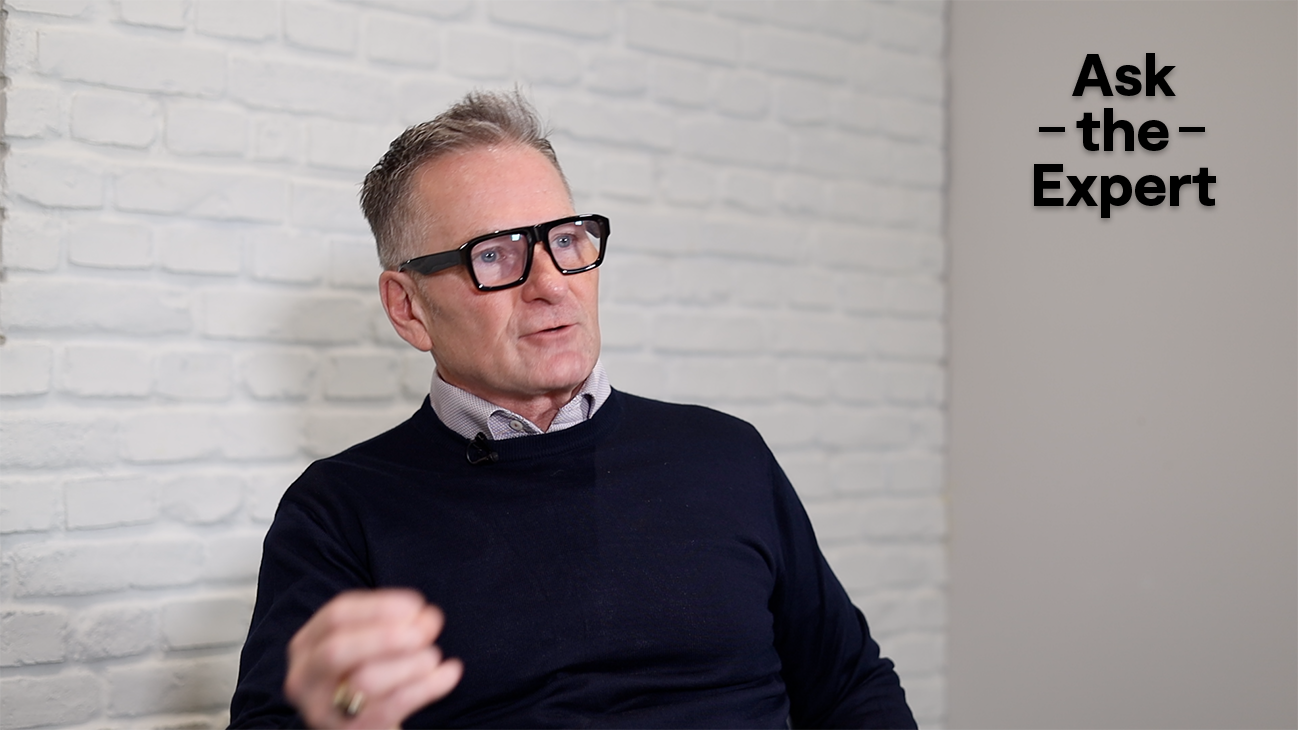
This week’s expert is Doug Stephens, one of the world’s foremost business futurists and the founder and CEO of Retail Prophet. Stephens has been called “the futurist that futurists follow” — and for good reason. He’s the go-to authority for global brands like Nike, IKEA, Coca-Cola, and Louis Vuitton, an internationally bestselling author of three books on the future of consumerism, and a regular voice in The New York Times, The Wall Street Journal, and Fast Company.
We asked him — what do leaders need to understand about AI before bringing it into their organization? Here’s what he had to say.
Answers have been edited for length and clarity.
Bringing AI Into Your Organization? Here’s What You Need to Know

What you want to first address and come to terms with is that in virtually every single technological revolution, there are two sets of consequences: the intended and the unintended.
The intended speak for themselves. For example, smartphone technology made us vastly more efficient, more productive. It allowed us to compress the time in our day. We aren’t just sitting in a restaurant staring at the walls, we now have a media device that we’re constantly connected to.
The unintended consequences are a different story. There’s pretty good evidence now that smartphones have significantly reduced our attention spans and our ability to concentrate on a task. There was one study that found that even if your smartphone isn’t in your hand or even turned on, but happens to be in the same room, it’s a psychological distraction.
So these are unintended consequences, things we never thought of that are not only harming our ability to concentrate but actually harming our IQs and the IQ’s of young people coming through the education system.
Understand the Intended and Unintended Consequences of AI
When it comes to AI, we have to first address that there will be intended outcomes — greater productivity, efficiency, and the ability to analyze and report on data we didn’t have the capacity to handle before. There will also be unintended consequences.
As an example, Jack Dorsey’s new company, Block, recently laid off 50% of their workforce. They said that it was because of AI efficiency and that they were reformulating the company. Dorsey said he believes that other companies are going to follow suit within the next one to two years.
If we extrapolate that out, that the vast majority of companies are going to come to the same conclusion that we can lay off these significant chunks of the workforce, that AI is going to make companies vastly more productive, the question becomes for who? Because these people aren’t just workers. They’re not just employees. They’re presumably consumers in the market as well.
If we do the math: according to a Microsoft study, the top 40 professions most exposed to AI disruption account for 9 million workers in the United States. If you unemploy those nine million people, all of a sudden you’ll find that unemployment in the United States rockets to 10%. And that’s just on the 40 most exposed positions.
What happens if it’s 400 positions that are now all of a sudden being swallowed up by AI? We could find ourselves in a position where we have incredibly productive companies and no market to sell into. So, we have to be extremely careful as we go forward.
What to Do Before You Implement AI
So, back to your question, what if I’m the person in the organization that’s charged with leading us into the fog of AI? Here’s my advice:
Establish an Ethics Committee
You should in advance begin to research what the red lines are for your company. Where will you go? Where will you not go? We just saw an example of this in the market when Anthropic got into a conflict with the US Department of Defense because they had set red lines. They had set guard rails for their technology which they were now being asked to violate. Companies are going to face these moments, and it’s good to map that out right away.
Educate Your Organization
There’s a presumption that people understand what AI is and what their relationship is going to be with AI within the organization, but most don’t. You’re going to have midlevel managers and directors that are going to have to understand how AI is being used upstream and downstream of their functions and how the technology that they’re using is interplaying with that. And then you’re going to have executives that are going to need to understand AI on a completely different strategic plane.
Manage Your Expectations Around Competitive Advantage
If I were to go into the average company today and ask them whether or not Microsoft Office had proven to be a competitive advantage for their business, most would say, “Of course not.” If I were to say, “Well, tell me about social media. I’m sure that your business triumphed over your competitors because you had a Facebook page.” They’d say, “Of course not. Everybody has a Facebook page.”
Technology is very rarely a long-term advantage, so right off the top, you have to dispel any illusion that you’re going to secure a long-term advantage from it. What you need to understand is what are the likely table stakes, right? What are we going to need to invest to at least maintain parody with our competitors? As long as you can do that, you know that you’re not losing ground.
The Human Skills That Will Set You Apart
The next question becomes, where can we truly win? I believe that the human operating system is going to prove to be profoundly more powerful than the synthetic operating system.
AI is a tool, and it is a tool no different than any other tool. Fire is a tool, it can be used to heat your home or it can be used to burn your home down, depending on how you use it. So the companies that will ultimately prevail with AI are going to be those that have three things in my opinion.
Critical Thinking
The ability to ask right questions of AI and properly evaluate its outputs. Critical thinking today is in short supply today. It’s not something our school systems are manufacturing anymore according to research.
Communication
The ability to fully and inspirationally communicate within the organization. To write a cogent brief for your teammates. To debate an idea or concept and come down to the best solution. That’s going to be an invaluable skill.
Creativity
Again, creativity is not something that our school systems are producing. When we look at the creativity levels of young kids today compared to those even 10, 15 years ago, there’s a vast difference. A lot of it is attributed to the use of passive media — smartphone use and time spent on screens. So creativity is in short supply and you’re going to have to go out and look for it. You’re going to have to hire it. You’re going to have to nurture it. In some cases, we’re even seeing companies that are wading into the educational realm and beginning to grow these skills themselves.
The Bottom Line
So to recap, if you can identify and limit the unintended consequences up front, set up an internal committee to define how you are prepared to use this technology and minimize exposure to those ugly headlines that a lot of companies are going to suffer; and build this educational ecosystem and talent pipeline, you can use this tool in a much more effective and efficient way. If you can do those three things, you’re way ahead of the game.
Book Doug Stephens for Your Next Event
If you want your organization thinking differently about the future, Doug Stephens delivers. As one of the world’s most sought-after business speakers, he offers dynamic keynotes that don’t just explore business transformation — they reveal the competitive advantages waiting for organizations bold enough to reimagine their future. Contact us to learn more about Doug and how to book him for your next event.
Hear More From Doug
AI is just one piece of the puzzle. Doug also shared his thoughts on what companies are missing when it comes to competitive advantage, whether business roadmaps still hold up in an age of uncertainty, and how trust has fundamentally shifted across the retail landscape.