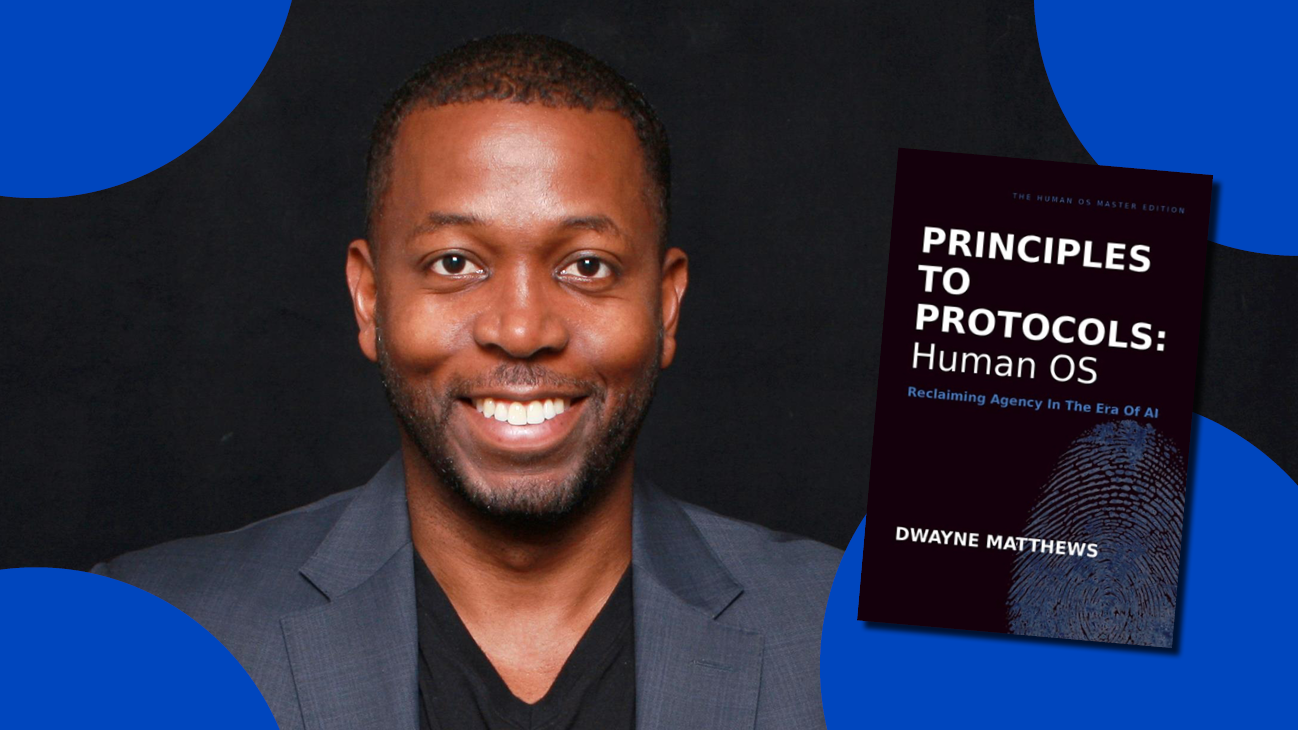
In an era where the skills necessary for the future of work are constantly evolving, how can we ensure our workforce is future-ready? This is the question future strategist Dwayne Matthews aims to solve with the release of his new book, Principles to Protocols: Human OS — his roadmap for creating a skilled and adaptable workforce to drive continued innovation, productivity, and economic prosperity.
Principles to Protocols: Human OS is built around one idea: most high performers are running on an outdated human operating system. Default habits, reactive patterns, and borrowed beliefs installed for a linear world, not an exponential one accelerated by AI. Dwayne’s book gives leaders the tools to upgrade that system deliberately.
We recently spoke with Dwayne about his new book, exploring the outdated mental models holding leaders back, the four-step Mode Protocol for shifting behaviour under pressure, and what it really means to lead with composure, judgment, and purpose in an AI-accelerated world.
The Outdated Operating System
Speakers Spotlight: You describe leaders as running on an “outdated human operating system.” What does that look like in practice?
Dwayne Matthews: To understand why the operating system is outdated, you have to understand where it was installed. Most of today’s leaders were trained for a linear world. Change was gradual and skills aged well. A degree, a credential, a certification — these were the currencies of a linear world and the information model matched. Knowledge was built and distributed at a linear cadence. A textbook was updated every few years, professors taught that same book for years, and this worked because the environment was predictable enough for that pace to hold.
Underneath this was a deep assumption that cognitive intelligence was scarce. It could only be held by the individual and certain individuals did a better job at it than others. The entire value chain of education and work was organized around this premise.
That world is gone. AI has changed the equation. Cognitive intelligence is no longer scarce. It is abundant and becoming exponential. Meanwhile, information has also become exponential. It arrives faster than the human mind can process and integrate it. Our old learning model, where you stockpile knowledge and deploy it over a career, cannot keep pace in an exponential world.
So, what does an outdated operating system look like? It looks like a leader trained to accumulate knowledge as a signal. Someone rewarded for having answers in a world that now rewards the quality of your questions and your ability to stack them into sequences. Someone whose focus is fractured by an exponential information environment they were never equipped to navigate.
It shows up through what I call Default Modes. Under pressure, leaders drop into patterns rehearsed for years without awareness. Control Mode, where anxiety disguises itself as micromanagement. Optimization Mode, where you over-engineer every decision to the point of paralysis. Withdrawal Mode, checking out emotionally while still showing up physically. And Defensiveness Mode, where protecting the ego matters more than learning.
These are not character flaws. They are the residue of a linear operating system running inside an exponential environment.
The Four-Step Mode Protocol
SpSp: Your book introduces a four-step “mode protocol” to shift from default modes to productive ones. How do these steps work together to help leaders shift their mindset and actions?
DM: The Mode Protocol exists because awareness alone around default modes is not enough. You can know you are reacting poorly and still not be able to stop it. Under pressure we need structure.
Leaders trained in a linear world had more recovery time between stimulus and response. In an exponential environment, that margin has disappeared. Decisions compound faster. Consequences cascade further. The cost of operating in a default mode has increased because the environment amplifies everything.
The four steps are Interrupt, Reorient, Stabilize, and Enter:
- Interrupt breaks the automatic pattern. Default modes persist because they run uninterrupted. The Interrupt creates a pause large enough for agency to re-enter, breaking momentum before our reactions become identity.
- Reorient shifts attention from internal reactivity to external requirement. Instead of “What is happening to me?” the question becomes “What is needed right now?” This aligns our attention with responsibility.
- Stabilize grounds our identity before we act. Under pressure, our identity collapses to its weakest version unless it has been rehearsed. Stabilization anchors you in your principles and character.
- Enter is the deliberate step into the productive mode the moment requires. Leadership mode when the team needs direction. Composure mode when emotions are high. Learning mode when you do not have the answer. Confidence mode when overthinking has replaced forward motion.
Each step builds on the one before it, so that by the time you “enter”, you are acting from clarity. Over time, this becomes a practiced capacity. In an exponential world, the leaders who thrive will not be the ones with the most knowledge. They will be the ones who can shift how they operate in real time.
Building Habits That Stick
SpSp: The book includes a 52-week practice companion. How can structured, long-term engagement with these protocols help leaders build habits that actually stick, instead of falling back into old patterns?
DM: In an exponential environment, learning has to become a rhythm, not an event. The Practice Companion is not a workbook you complete. It is a system you use. It operates on four rhythms. Daily, five minutes to choose your focus and one action. Weekly, 15 minutes to reflect and run one protocol. Quarterly, 60 minutes to review what is compounding and what is decaying. Yearly, three hours to re-orient to purpose.
Each of the 20 principles is paired with a protocol and practiced one week at a time. After 20 weeks, you repeat. After 40, you see which principles have become part of your operating system and which still need work.
This structure works because the old learning model is breaking down. You cannot stockpile enough knowledge to cover what is coming. What you need is a rhythm that keeps you adaptive, built on better questions, deliberate practice, and consistent reflection.
People do not fail to change because they do not want to. They fail because their systems collapse under pressure. The Practice Companion is the structure that builds mental muscles for those moments.
The Mental Models That Matter
SpSp: Of the 10 mental models in your book, which do you find most powerful for leaders navigating fast-changing, AI-driven environments?
DM: These mental models are essential:
First Principles Thinking goes beneath the assumptions. You break a problem down to what is irreducible and actually true, then rebuild from the ground up. Most leaders are still operating on inherited assumptions from the linear world. They assume credentials signal value the way they used to. First Principles asks: What is actually true in this new environment?
Second-Order Thinking looks past the immediate result and asks what happens next, then what, then what. In a linear world, second-order effects show up slowly enough to adjust. In an exponential world, they compound fast. A decision to automate a department has first-order efficiency gains, but the second-order effects on institutional knowledge and team trust can be devastating if no one asks, “And then what?”
The Map Is Not the Territory matters because in an algorithmic world, your map is constantly being curated for you. AI-generated summaries give you confidence and eventually will do so without comprehension. Most leaders will soon find themselves navigating with maps they never verified, built by systems they don’t fully understand. Remembering that reality is more than the map is important for discernment and cognitive sovereignty.
In a world where cognitive intelligence is abundant, the premium shifts to judgment, sense-making, and the quality of your questions. These models are how you sharpen those capacities.
Becoming a Future-Ready Leader
SpSp: By fully implementing the Human OS framework, what kind of leader or decision-maker, does it shape someone into?
DM: It shapes someone into a leader built for an exponential world. This leader has stopped competing on knowledge alone and started competing on judgment, sense-making, and cognitive sovereignty. They know focus has become a form of wealth and they protect it accordingly. They have changed their relationship with information. They no longer learn “just in case.” They have reduced their learning loops and gotten better at asking questions and stacking them into sequences that lead somewhere useful.
They can recognize their Default Modes in real time and override them deliberately. They have built and are aware of their human signature, that unique intersection of curiosity, lived experience, and perspective that cannot be replicated by a machine. They govern their defaults instead of being governed by them. And they have a rhythm: daily focus, weekly protocols, quarterly resets, yearly redesign.
Most importantly, this leader has accepted that the credential-driven, stage-gate operating system of the linear world is no longer sufficient. They have simply updated and led their teams and peers to do the same. And because they have updated, they can navigate exponential change with composure instead of panic, lead through uncertainty without pretending to have all the answers, and remain coherent when everything around them is accelerating.
Coherence. Agency. Presence. Purpose. Those are the assets that compound when information and content become a commodity, unlocking stranded brilliance within individuals and teams. That is the promise of this framework.
Bring Dwayne Matthews to Your Next Event
If your organization is navigating the pressures of AI, rapid change, and workforce transformation, Dwayne Matthews delivers more than a keynote — he delivers a new operating system for your leaders.
A trusted advisor to global organizations, former heads of state, and innovation foundations, Dwayne combines world-class research with practical frameworks your teams can apply immediately.
Contact us to learn more about Dwayne and to book him for your next conference, leadership summit, or corporate event.