
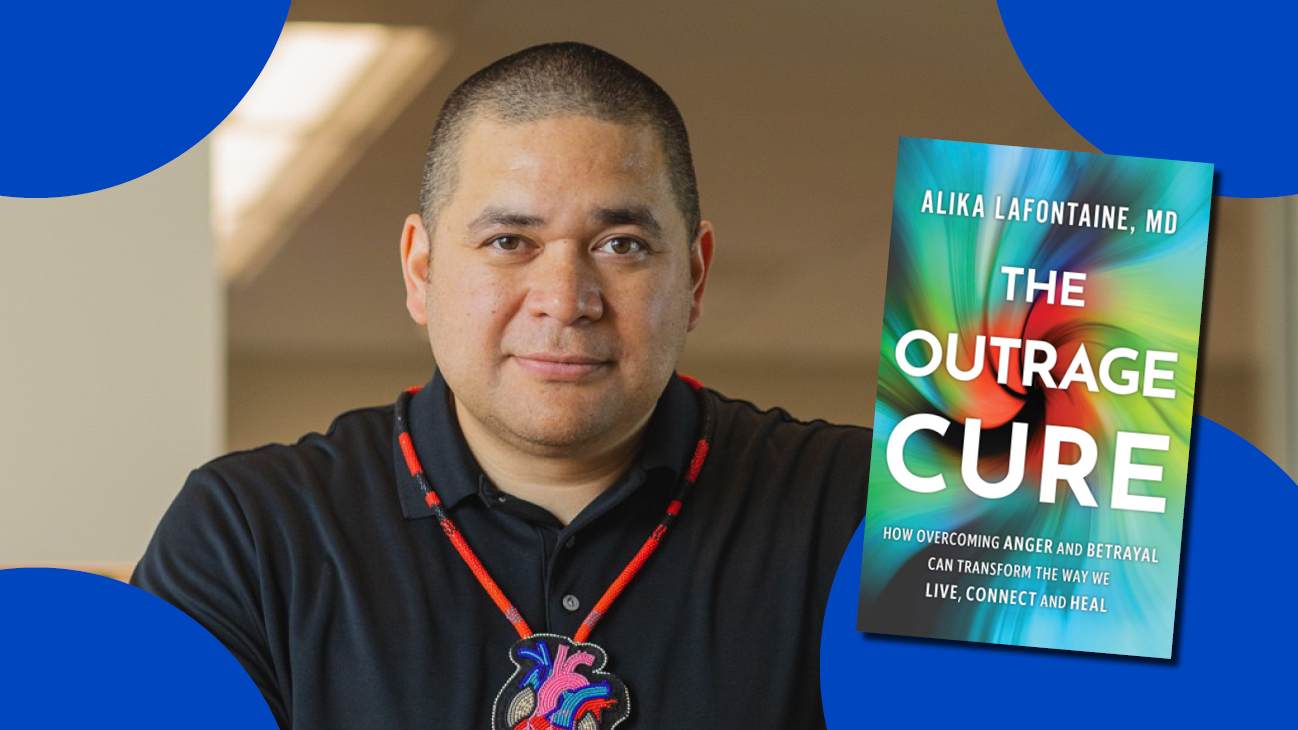
We live in an age of outrage. Dr. Alika Lafontaine wants to show us the way through it.
An award-winning physician, health innovator, and the first Indigenous doctor to lead the Canadian Medical Association, Alika’s new book, The Outrage Cure, explores how anger, left unanswered, deepens into outrage — and how outrage, once a response to harm, can become the harm itself. It draws on decades of his personal and professional experiences to trace the emotional arc from loss to anger to betrayal to indifference, and offers a guide to finding our way back, individually and together.
The Outrage Cure doesn’t ask you to stop caring — it asks what we lose when outrage becomes the only language we have left. We sat down with Alika to find out more.
Living in the Age of Outrage
Speakers Spotlight: What inspired you to write The Outrage Cure and explore the role of outrage and anger in our lives?
Dr. Alika Lafontaine: I’ve been thinking about writing a book for awhile and had been approached to provide thoughts around health systems or health leadership. But underneath everything I’ve been seeing and experiencing lately, I was recognizing that there was a building momentum around people being very upset and angry about how health systems were working, and even more broadly how society is working. I couldn’t have anticipated that we’d be here today, but it was predictable that some form of this future was going to happen.
We live in an age of outrage. It’s in our politics, our workplaces, and even in our closest relationships. My book is about what happens when anger, which I argue comes before outrage, goes unanswered.
Why Anger Isn’t the Enemy
SpSp: A key idea in the book is that anger isn’t the problem but what it turns into. How can we better understand this emotional tension and when it’s a signal for something deeper, rather than something to suppress?
AL: It starts with understanding our biology. Our bodies are set up to help us adapt to the circumstances we face, and historically we’ve evolved through many generations to have a limbic system, part of our brain, that is tailored to help us respond to threats.
The emotions I talk about in this book — anger, outrage, and indifference — they’re all emotional triggers for this limbic system. Each is proceeded by a type of stimulus similar to when you prick your finger and a pain response is triggered. When you experience some sort of loss you end up feeling anger, which is really a way for us to signal to others that we need help.
When we talk about navigating the emotional landscape that we’re in right now, what’s important for us, as individuals or as those trying to fix or lead institutions, is to recognize that these emotions are natural human expressions of what we’ve experienced over generations. When viewed that way, it can become clear how these emotions can assist us in seeing the human experience.
This is contrary to what we’re taught in mainstream media. Often anger is something to be dismissed or supressed. For example, in the health facilities where I work, there’s a zero-tolerance policy for anger. But often, especially in my area of healthcare, you’re seeing people at the lowest part of their lives. There should be the full expectation that people are going to be angry and going through these other churning emotions.
It’s interesting to see how we’ve grown to adapt as a biological system. We have these emotions that push us towards certain behaviours so we can become more adaptive, but we live in a society where we’ve become less and less able to deal with these emotions even though they’re a central part of the human experience. I think that’s one of our primary challenges today.
How Outrage Is Quietly Reshaping Workplace Culture
SpSp: Where do you see outrage quietly influencing workplace culture in ways leaders might be missing?
AL: One of the easiest ways to understand these emotional waves is through recent events that have affected all of us. The memory of the pandemic may be slowly waning, but I’m sure if you sat down and talked with someone about their experience, they remember. They know what it felt like.
It’s interesting to see how it manifested in the workplace. When we experience shared loss, whether it’s from something like a pandemic or natural disaster or even a lot of the economic up and downs we’re seeing now, people are very willing to help solve the problem early on. That’s something we saw with the pandemic. At the very beginning, everyone was on board, but as it continued and we had to keep adjusting our lives to this new reality, people experienced incredible loss — loss of connection, loss of jobs, loss of security. And with each subsequent wave of loss, people’s anger and outrage continued to grow because they felt like they weren’t being responded to in the way they needed.
When problems don’t get fixed over a long period of time, when people continue to experience ongoing loss, it’s inevitable that they start to feel a sense of betrayal, that the people who are supposed to solve the problems aren’t. When that transition happens, everything gets a lot more intense. People start to shift from not simply wanting the problem to be solved but also wanting those people that let them down to be removed or for these systems to be reformed. I think that’s where we are today.
One of the challenges workplaces have today is how do you get people to be part of a shared culture again? How do you make sure the problems that we’ve been encouraged for years to bring to work as part of our social circle, how do we make sure that those problems don’t interfere with what the workplace is supposed to do? How do we have people feel like they’re a part of something again? Those are challenges that will not go away quickly and will only get more intense in the short term because of this shared loss and sense of betrayal. We often direct those feelings of anger and outrage towards the wrong people. We may experience betrayal at work and direct it at family members, we may experience betrayal in our day to day lives and redirect it to people at work. The breaking down of those barriers and lines between the different people we are and the different places that we live make solving that even more challenging.
How to Lead Through Outrage
SpSp: The Outrage Cure offers guidance on transforming distress into trust, accountability, and collective well-being. Can you share a practical approach from the book that individuals or leaders can start applying immediately?
AL: This book is rooted in a personal experience I had with someone whose extremely close to me, who I felt really understood me, and a fracture that happened as a result of something that, for the most part, didn’t really involve us. It happened thousands of kilometres away. I draw on the experiences I’ve had personally and professionally to try and figure out how we bring ourselves back together after these kinds of fractures. The solution comes down to really understanding where we’re at within this continuum of anger to indifference.
In the book, I talk about how loss precedes anger and how when anger starts to feel like betrayal, that leads us into outrage. And as we start to work harder and harder to change the systems we’re a part of and get hurt in the process, we fall into indifference. If you’re trying to fix those things, it’s about responding to what those emotions are trying to tell you. When people are angry, we just have to fix problems but when people are outraged, we have to respond to their sense of betrayal. How do you regain their trust? The biggest challenge in workplaces right now is counteracting the shift into indifference. This feeling from people that no matter what they do, they’re never going to improve things or have an impact.
As a leader, it starts with themselves. They need to go through that journey to understand what about their lives led to loss, what about their lives has led to feelings of betrayal, and where do they feel like they can’t have an impact no matter what they do. Starting there helps ground us in these emotions. In understanding yourself, you can start understanding other people.
Then, there are definitely signs that leaders can observe to understand where people are in the continuum. Look at how your people are behaving, is the feedback you’re getting from your teams focused on problem solving, are people constantly second guessing your decisions, are people shutting down or withdrawing? Those are the types of things leaders can map out to understand where they and their teams stand.
The Cost of Indifference: Why Confronting Outrage Is Urgent
SpSp: What do you hope readers take away from this book?
AL: When I wrote the book, I really was trying to figure out how to fix this fracture between me and someone who was deeply important to me. What I hope is that people will read the book and walk through their own journey. We can’t shortcut biology or emotion. We’ve been taught through mainstream media that there is somehow a hack or a shortcut to fix these very deeply human experiences. In reality, we just have to walk through them.
I’m really hoping the book is a way for me to contribute to people at all stages of life to walk through these emotions and gain a more adaptive way to react to them. It’s through this that we can hopefully return to what I think a lot people miss about the past, that we can reach out and really connect to people again.
One last thing I’ll add, if we don’t confront these powerful emotions that we have going through society right now, we’ll inevitably inch more and more towards that terminal end of indifference. These unaddressed emotions are very dangerous for society. They’re also an enormous opportunity for people with ill intentions to come in and steal value from systems that they aren’t really interested in building up. I hope people recognize the urgency of this problem and are paying attention to it. I think things will get worse before they get better, but they’ll only get better if people pay attention to what’s going on.
Hire Dr. Alika Lafontaine to Speak at Your Event
In his keynote, The Outrage Cure: Understanding Anger to Heal Relationships, Systems, and Self, Dr. Alika Lafontaine brings these insights directly to your organization — helping leaders and teams interpret emotional tension not as a threat, but as a pathway to alignment.
Through lived experience, practical frameworks, and real-world examples, audiences leave with the tools to navigate conflict with clarity, foster emotionally intelligent cultures, and rebuild trust from the inside out.
Contact us to learn more about Alika and what he can bring to your next event.