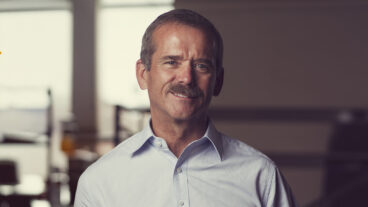

For 10 days, the world was captivated by Artemis II, watching four astronauts circle the moon for the first time in half a century. While the mission lasted less than two weeks, the preparation behind it took decades. That gap — between what the world saw and what actually made it possible — was what Dan Riskin was covering as CTV’s science and technology specialist, from the earliest tests of the Orion spacecraft right through to splashdown.
That vantage point gave Dan a rare perspective — one that went beyond the spectacle to a masterclass in how great teams are built.
The New Space Age
Dan is an evolutionary biologist turned award-winning science broadcaster, who has been making science accessible, engaging, and fun for more than a decade. He’s best known as the former co-host of Discovery Canada’s flagship science program Daily Planet and as host of Animal Planet’s docu-horror show, Monsters Inside Me.
As CTV’s point man, Dan had a front row seat to the inner workings of Artemis and why it marked such a historic moment for human history.
“The big thing that sets the Artemis era apart from the Apollo era of the 1960s and ’70s is that the purpose of Apollo was for the USA to get to the moon first, plant their flag, thumb their noses at the Soviets, and go home. Once it was done, it was done,” Dan said. Artemis is something else entirely — the beginning of a permanent human presence on the moon.
“What blew my mind was the way everyone came together to watch the Artemis mission,” Dan continued. “There’s so much division in the world right now, but everyone seemed to feel united and happy about this little tin can going around the moon.”
The Team Behind the Mission
That unity extended to the crew itself. The four astronauts “left as friends and came back best friends”, Dan says, a testament to how intentionally the team was constructed.
“A huge part of astronaut selection is about finding people who will get along in a confined space when things get stressful,” Dan says. Beyond selection, the crew underwent mental health training before the mission — giving them practical tools to navigate conflict and other problems under pressure.
For most people, the Artemis story began at launch. For Dan, it started more than a decade earlier, reporting on the Orion capsule during testing. “The hard parts of Artemis all happened before launch — all the planning, all the training,” he says. “Astronauts spend just a tiny portion of their lives in space. What makes them great is all the work they do to build a successful mission beforehand.”
The Diversity Advantage
For Dan, a highlight of watching the team in action was seeing how deliberately NASA built diversity of thought and perspective into the mission itself. Rather than designating one astronaut to make observations on the far side of the moon, the crew took turns — each bringing a different eye to what they saw.
“Different people with different backgrounds experience the world differently, see art differently, and make scientific discoveries differently,” Dan explains. “If NASA had just trained one astronaut to make all the careful observations of the moon, they would have missed out on the advantages of that diversity.”
The results spoke for themselves. Where one astronaut tracked shifting contrast across a crater’s surface, another spotted variations in colour, while others caught details that might otherwise have gone unrecorded. All of it useful. None of it accidental.
Lessons From the Launchpad
What the Artemis II crew demonstrated, Dan says, is a blueprint any team can follow, especially when working towards ambitious goals. He shared four simple rules to help teams thrive in the age of Artemis.
1. Acknowledge Individual Goals Within a Shared Mission
The best team strategies don’t override individual ambition — they harness it.
2. Leverage Diversity
For complex tasks, build a diverse team. Diverse teams perform better together on complex tasks than homogenous teams do, even when those homogenous teams are made of all-stars.
3. Train For Resilience, Not Just Success
The goal is to avoid problems — but the best teams are built to handle them when they arrive. That capacity has to be developed before it’s needed, not improvised in the moment.
4. Bring Your Community Along
If you shoot for the metaphorical stars or the literal moon, share the significance, the story, and the inspiration with your community. That can build trust and provide benefits well beyond the moonshot itself.
The Work Behind the Wonder
For Dan, the most important part of the Artemis story is the part nobody watched — the decades of planning, training, and learning from everything that didn’t go according to plan. That’s where the real lessons live, he says.
It’s also what Dan unpacks for audiences in his keynote, “Thriving in the Age of Artemis: Moonshots Through Teamwork”. He explores what it actually took to pull off one of the most ambitious missions in human history, and what any team with big goals can take from it.
For those looking to build teams that perform under pressure, embrace diversity, and rise to the moment when it counts, Dan Riskin makes a compelling case that the moon has more to teach us than we might think.
Contact us to learn more about Dan and how to book him for you next event.