
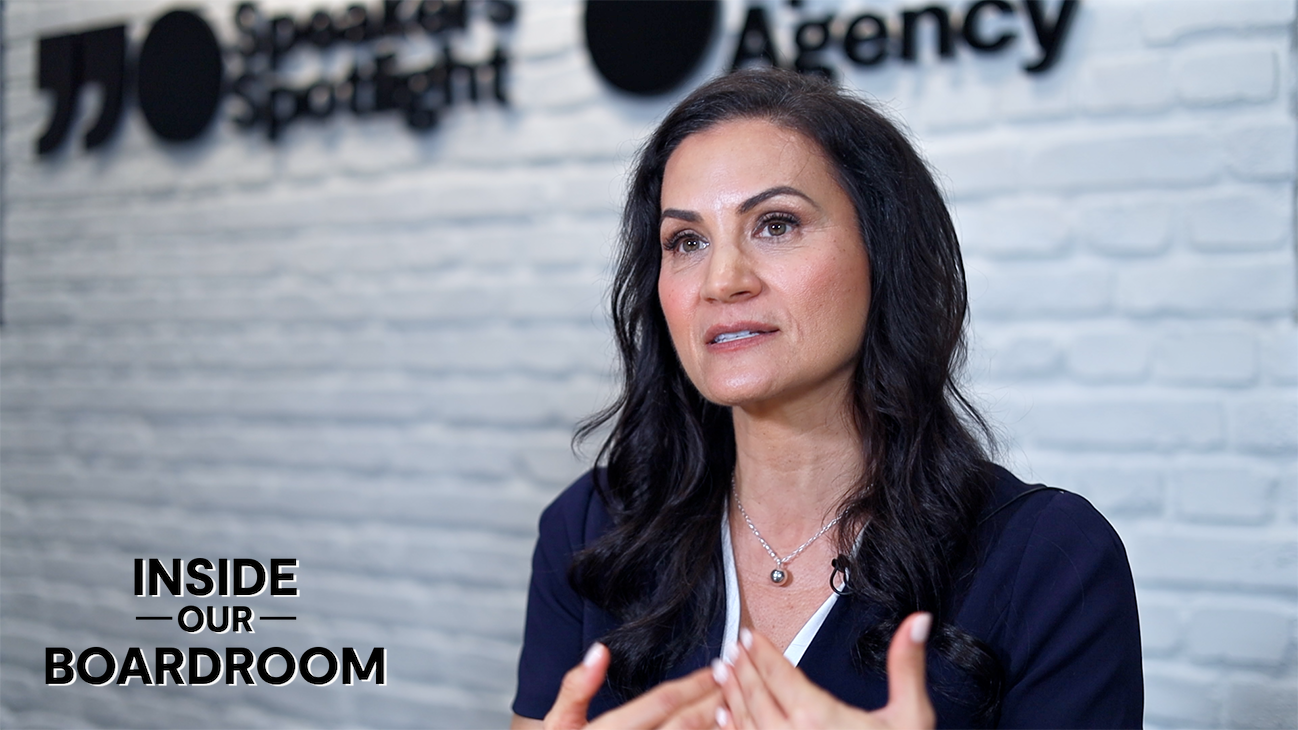
Fueled by her own experience with burnout and depression, award-winning medical doctor and renowned stress resilience expert Dr. Susan Biali equips leaders and their teams with neuroscience-backed strategies to strengthen their resilience and perform effectively under pressure.
Susan began her medical career as one of a select few women chosen for Royal College training in Emergency Medicine. After her personal burnout crisis, she left the ER and gained two decades of frontline experience in fast-paced urban medical clinics. Today, Susan is an executive coach, combining her unique medical and lived expertise to help senior leaders better navigate high-stakes environments.
In this “Inside Our Boardroom” conversation, Susan dives deep into burnout, its prevalence in the workplace, and how leaders can harness stress as a catalyst for high performance.
Answers have been edited for length and clarity.
The Three Signs of Burnout
Speakers Spotlight: What is burnout and how can we identify it correctly?
Dr. Susan Biali: It is very important to clinically define burnout because it is a word that gets thrown around so much these days, and it’s easy for people to misdiagnose themselves or others. As an example, I have a friend who had every reason to suspect that the fatigue and cognitive challenges that she was experiencing were burnout related. But I always tell people if you are unusually tired or negative, any big significant change like that, the first thing you should do is see your doctor because there are multiple things that can masquerade as burnout.
In the case of my friend, it turned out that she actually had iron deficiency anemia. There’s no way that a stress leave or a vacation or even changing jobs would’ve fixed that.
When it comes to burnout, the majority of experts in the field agree on three fundamental components, all of which need to be present. One is exhaustion, that’s usually the first symptom to show up. Then the second is a personality change towards the negative, so people may find themselves becoming more cynical or resentful about work and their colleagues. The third component, not surprisingly, is if our productivity or effectiveness at our job declines. A really fascinating element of that is people will also start to lose confidence in their ability to do their jobs.
Learn more about the signs of burnout and how it alters the brain in the video below:
Building Stress Resilience
SpSp: In your book, The Resilient Life, you share practical tools for managing stress. What’s one simple strategy people can use right away?
SB: We’re all going to encounter hardship and challenges. In fact, we need that to be at our best and to even perform at our highest. Stress is actually really important, but what we want is to be able to ride out and flex with the disasters and crises that come about, and this comes down to our baseline level of mental, physical, and neurological resilience.
I’m fascinated with how we can, through very simple steps, help the baseline of our nervous system run from a balanced enough foundation so that when we get bad news or have to pivot quickly, we’re minimally impacted by it and able to think clearly through it. That is so essential. Being able to stay in your prefrontal cortex versus going limbic and just spinning. Much of that depends on your physical, mental, and neurological baseline.
From research, we know that the most resilient people on the entire planet are those who are well resourced and who use those resources. For example, people who have a good benefit plan with psychological support and counseling and actually use it. They don’t try to be a lone ranger and white-knuckle things. That is a disaster for resilience. The strongest people know when they need help and they reach out to people in their networks for support.
So, in terms of a simple strategy, it’s two-part. It’s about intentionally cultivating that resilience within yourself and also making sure that you have resources and are not being too proud to use them.
Dive deeper into stress management techniques below:
Harnessing Stress for High Performance
SpSp: You say stress isn’t always the enemy. How can we learn to harness it as a positive force?
SB: It is so important to have an accurate, balanced understanding of stress. There was one study for example that put two groups of people into severely stressful circumstances. One group had attended a workshop prior to that which had told them, based on scientific evidence, that stress is good for the body. How when you’re under a certain kind of stress, your mind is sharper than ever, your immune system thrives, and, in fact, our cells can sometimes even age backwards. That’s called stress rejuveness. This group, when put in the stressful situation, thrived.
The other group attended a workshop that taught them all the negative impacts of stress on the mind and our physiology. When they were subjected to that same stress, that group had all these terrible markers even though they were in exactly the same circumstances. So, what we believe about stress is very important.
It’s also important to discern when stress brings out the best in humans — we come together, we’re charged, we come up with solutions — and to not always negativize it. There’s been so much stress lately that we’re in this stress doom loop where we start to be anxious about distress versus seeing how it actually strengthens us.
That being said, there is also a toxic kind of stress. Say that we have a really toxic leader or working within a toxic work culture or we’re experiencing poverty or discrimination, those are specific kind of stresses that are much harder for people to thrive within unless, for example, they rally because of it. Again, those situations bring out our best.
Learn more about the fascinating impact of stress on human performance in the video below:
Limiting Daily Stressors
SpSp: How does one manage burnout and anxiety from outside the workplace?
SB: We want to be so careful and so intentional about how we allow ourselves to be exposed to our world today. We know, for example, that in the case of the Boston Marathon bombing, when they compared the impact of that trauma over the long term, the people who were present at the bombing were significantly less impacted than the people who had doomscrolled it on social media, exposing themselves over and over to images and news about it.
That for me is such a profound illustration of how not only are we making things harder for ourselves but that we actually have control over how much it impacts us. So, this feels a bit cliché, but it’s true. Limit your exposure to the news.
Learn how Susan protects herself from outside stress in the video below:
Brain Health and High Performance
SpSp: What role does brain health play in resilience and high performance, what are some of the daily choices we can make to protect it?
Brain health based on evidence-based neuroscience is the most exciting frontier imaginable for me. I’ve been doing this work for a really long time, I’m going on 25 years now, and what I love about it so much is the amount of power, agency, and intentionality it can give us in a world that feels so out of control. This is of course so important for leaders because leaders need to be able to think fast, innovate, stay calm, pivot, be flexible, and perform at an extremely high level even when under extreme duress.
So, I love giving people tools in terms of the specific levers they can pull on a day-to-day basis when it’s necessary. For example, sleep and exercise are absolutely foundational — the two biggest levers that we can pull for emotional stability, mental health, and high performance. I always tell people if you’re not sleeping well, you’re not waking up rested, get that addressed. If you can fix your sleep, it will improve your quality of life, mental health, focus, attention, and you’ll even lose weight.
In terms of exercise, I recently heard Dr. Peter Attia say that he considers exercise even more important for brain health than sleep. Even a brisk walk can have an incredible impact on the brain. It can help you grow new brain cells. It can strengthen the prefrontal cortex, which is all your executive function. It can completely change your ability to manage stress and even the way you perceive stress. Next is nutrition. We know that if people shift from a standard North American diet to more of a Mediterranean or plant-based diet with lots of fibre, antioxidants, fish, olive oil, legumes, etc., and eat that way for months, their brain age can actually decrease by nine years.
And then one of the biggest hacks, which only takes minutes a day, is mind-body practices. There’s specifically one that I use on a daily basis called non-sleep deep rest. It’s a science-based protocol that significantly amps up your cognitive performance, your ability to learn things, sleep well, and regulate the emotional impact of stress. I could talk about this forever, but those are probably the main ones, and they’re things that we have control over.
Hire Dr. Susan Biali to Speak at Your Event
Recognized worldwide as an expert in stress, resilience, and performance, Dr. Susan Biali has delivered keynotes and workshops for such esteemed organizations as the US Navy, Google, MIT, McKinsey & Company, The Coca-Cola Company, AT&T, and Deloitte. In 2024, she was invited to join the faculty of Harvard Medical School Continuing Education’s Herbert Benson MD Course in Mind-Body Medicine, where she lectured on reducing clinician burnout and fostering resilience.
Susan doesn’t just teach resilience — she’s lived it, making her insights uniquely powerful for those seeking to unlock their full potential and sustain healthy high performance both at home and work.
Contact us to learn more about Susan and how she can help your organization thrive through change and excel without sacrificing well-being.