
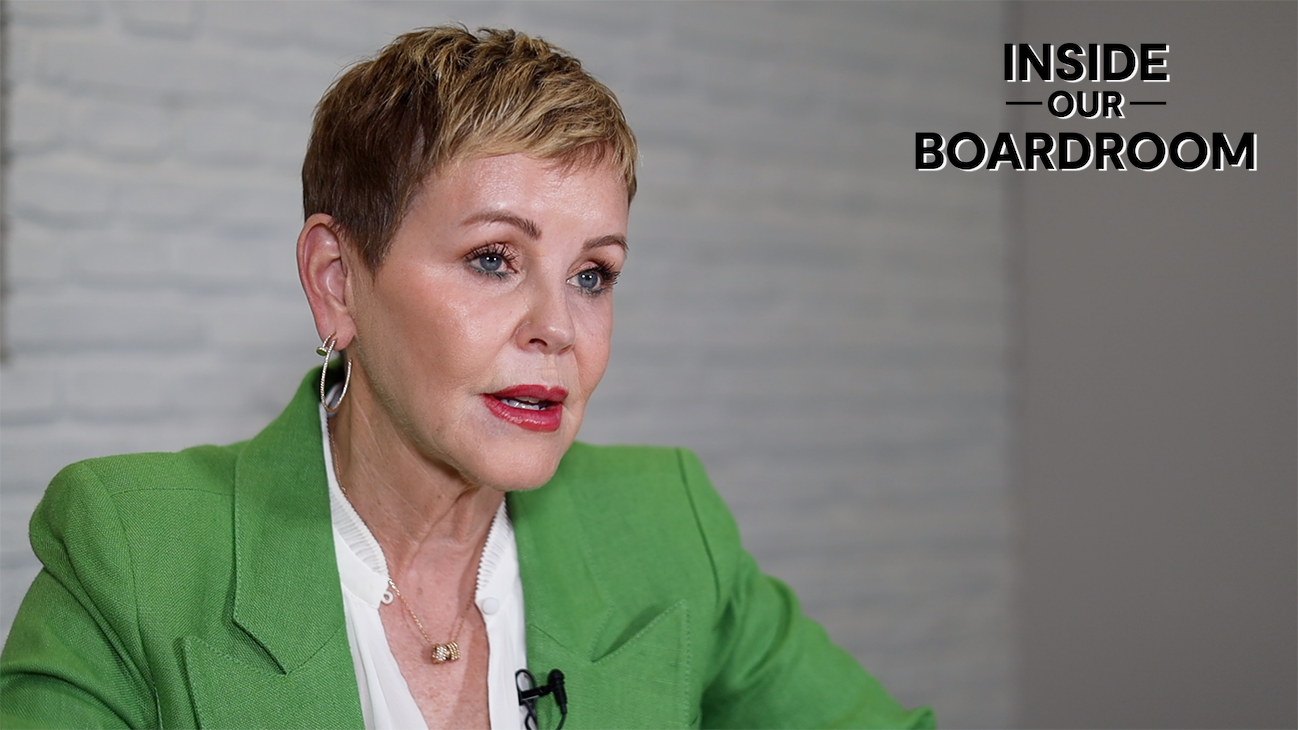
Pattie Lovett-Reid is one of Canada’s most trusted financial voices. The former Chief Financial Commentator for CTV News and the current Chief Financial Commentator at HomeEquity Bank, she has spent decades making personal finance more accessible and empowering for Canadians, guiding them through multiple economic crises — from the dotcom bust to today’s inflation and interest rate volatility.
Able to provide up-to-date market insights, an overview of current economic conditions, and practical financial guidance tailored to today’s climate, Pattie recently joined us “Inside Our Boardroom” to explore why you need a financial plan B, how to start investing on any income, Canada’s financial report card, and why financial resilience is strategy, not luck.
Answers have been edited for length and clarity.
Preparing for “What If”
Speakers Spotlight: What’s one finance thing Canadians aren’t doing in today’s financial climate that they should be?
Pattie Lovett-Reid: You have to prepare for the “what if” scenario. People don’t worry about losing their job until it hits their household. And the reality is really good people will lose their jobs. What I suggest is that people prepare themselves for a plan B. Even if they’re doing plan A and it’s all working out fine. We all hit financial speed bumps, and you need to have a plan B in place.
I think there is an emotional element to it. I can remember in my relatively early days as an executive at TD, they came to me and said, “Patty, we’re going to have to let you go.” I wasn’t prepared for that. Then they said, “we’re not sure we’re going to let you go right now, but we’re just not sure how you add value to our organization.” I remember thinking, okay, I need to find out why I’m not adding value or what they need from me to appreciate that I’m adding value. Then I moved on to the next step, what am I going to do differently financially to prepare myself? So, we sat down and did our net worth statement. I wanted to know where we were financially and where some of the costs were that we could cut immediately.
I never thought for a heartbeat that I wouldn’t find something else. But I also wanted to get through a difficult situation by having a plan in place that I already started to execute.
Ultimately, I was never let go, but I learned a very valuable lesson. Just because you’re busy and doing things in an organization, it may not be what they want you to do and what they value. So, it’s one of the first questions I always ask now. If I’m doing a presentation, what is it that you want me to do for you? What is the overriding message here? And then we’ll re-engineer from there.
Canada’s Financial Report Card
SpSp: If you were marking Canadian financial literacy, what mark would you give?
PLR: I don’t think we give Canadians enough credit for the financial savviness that they have. It’s a better story saying people are living beyond their means, that they don’t know how much money they have coming in, or what they’re spending their money on. But based on the Canadians that I’ve spoken to, they’re worried about inflation, about interest rate volatility, trade tensions, but they know where they stand. They know what they have to do.
Where I saw this most starkly was during COVID and government bailout, which some called it. Households all of a sudden, because they couldn’t spend and had money coming in, felt very flush for the first time and they said, this feels good. I’m not going to go back to old behaviours.
Unfortunately, there’s fear of missing out. There’s social media and people get back, in some cases, to where they were and they do spend. But this day of reckoning where it’s all doom and gloom, I don’t think so. You can’t control the environment, but you can control how you respond to it. And that’s what I try to encourage. So, I give can Canadians more credit than sometimes they give themselves.
Building Financial Resilience
SpSp: What is the importance of resiliency when it comes to financial success?
PLR: Reflecting on myself, I recently came up with a concept. When people introduce me, they go, “Patty has been around for decades and decades and decades and decades.” Okay, they can shave one of those decades off, but the reality is I have been around a while. I have been through economic challenges like we’re going through right now. I went through the dotcom bust of 2000. I used to think there’s a new asset class. You’ve got cash, you’ve got bonds, you’ve got stocks, and you’ve got technology. No, that’s not really how it works.
The 2008 financial crisis, when a big bank like Lehman Brothers was allowed to collapse, everything dried up on Bay Street and Wall Street because no one knew who was going to be next. You had a European debt crisis. You had the Asian currency crisis. Then when COVID hit, it was a health crisis that turned into a financial crisis. And then of course we’ve got trade, interest rates, trade again, and we’ve gotten through it all.
So, as I was thinking about life’s next steps, I thought, okay, what is resiliency? What does it really mean? Maybe it’s agility. I don’t know, but resiliency to me is about having a plan and sticking to it, but tweaking the plan because it’s not carved in stone. So, when you have a certain element of resiliency, it’s not luck that some people get through, it’s strategy because they stuck with it. When you are resilient, this leads to reinvention and that can happen fairly quickly when you know your numbers. That’s sort of the power of the pivot. You have to have the courage to change. If you don’t, you will lose your way, and it’s really hard to gain that traction back.
The Financial Flywheel Effect
SpSp: How do you reply when people say, “I don’t earn enough to think about investing”?
PLR: Yes, you do. Every single person, even if it’s a back-of-the-envelope type of calculation, deserves to have a financial plan. And when I say financial plan, it’s about having a goal. I don’t know anyone who doesn’t have some sort of goal.
I think about it like a giant flywheel. You’re in the middle and your first spoke on that bicycle is to set a goal. Understanding how much money you have coming in is another spoke, where you are spending it is another, and here’s what happens. If you did one thing each month on your financial situation, the flywheel starts to gain momentum and rather than you grinding forward, it pulls you forward. It’s very satisfying to actually achieve a financial goal that you’ve established for yourself.
I can remember when my daughter got her first job, I said, “Oh my, I’m so excited. Here’s what you should do with your money.” And she looked at me and said, “That excites you. It doesn’t excite me.” It was a very powerful lesson because when people impose their goals on you and you’re expected to change behaviours to achieve those goals, it’ll never happen. It has to be your goals. You have to own it. You have to get excited about it.
Navigating Unexpected Market Performance
SpSp: How do you navigate a market that doesn’t perform how we expect it to?
PLR: Right now, I think the markets are shocking and surprising a lot of investors because they have continued to do exceptionally well. Tech has done phenomenally. A lot of this has to do with the fact that yes, there is trade tension, but we seem to have, so far, muddled our way through it. At the core, company earnings are meeting expectations or in some cases exceeding, so there hasn’t been a catalyst for a sell-off, but that doesn’t mean there won’t be.
My word of caution is what makes your portfolio work is your asset allocation. How much are you going to have in cash, in bonds, and in the stock market? Stay true to that. So, when the stock market takes off like it’s been doing, you need to rebalance on a regular basis.
Are we in a bubble? Some would say we are, others would say we’re not. So just make sure that when you get to a certain point and your asset allocation gets out of whack, bring it back and stay true to who you are as an investor.
Hire Pattie Lovett-Reid to Speak at Your Event
As a keynote speaker, Pattie Lovett-Reid helps audiences build wealth, navigate economic uncertainty, and take control of their financial futures with confidences by revealing how making small, intentional shifts in your approach to money — and life — can lead to big results over time.
Contact us to learn more about Pattie and how she can equips audiences with the tools needed to thrive financially.