Captain David Marquet transformed one of the Navy’s worst-performing submarines into its best by abandoning traditional command-and-control leadership. After taking command of the USS Santa Fe — then ranked dead last in retention and operational standing — David discovered that barking orders wouldn’t work. Instead, he “turned the ship around” by treating his crew as leaders, not followers, creating an environment where everyone contributed their full intellectual capacity.
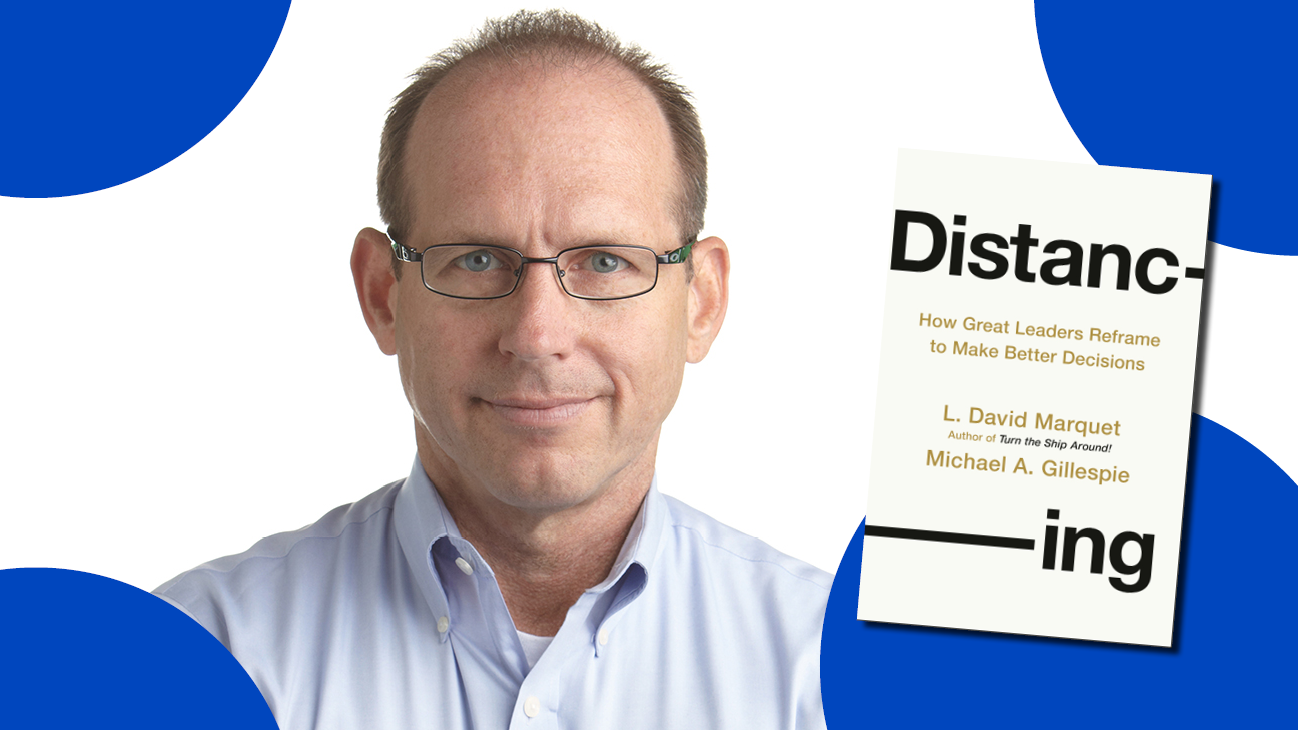
This revolutionary approach took the Santa Fe from “worst to first” and created more subsequent leaders than any other submarine. The bestselling author of Turn the Ship Around and Leadership is Language, David has spent over a decade helping organizations create empowering work environments. His latest book, Distancing: How Great Leaders Reframe to Make Better Decisions, explores a critical but often overlooked leadership skill — the ability to step outside the “me-here-and-now” perspective to make wiser, more objective decisions.
We recently sat down with David to explore his new book and the impact of psychological distancing on leadership capability, especially when leading under pressure.
Distancing as a Leadership Tool
Speakers Spotlight: What inspired you to explore the concept of “distancing” as a leadership tool, and why is the ability to coach yourself this way such a critical skill for leaders?
David Marquet: The inspiration for exploring distancing came from my time commanding the nuclear-powered submarine USS Santa Fe. Early on, I learned that getting officers and crew to speak up and propose actions was only half the battle — the real breakthrough was helping them make sound, wise decisions under pressure. Certain questions, like “What would you do if you were me?” or “What would your six-month future self want you to do?” seemed to unlock clearer thinking. At the time, I didn’t know why these worked so well, but later research revealed they triggered a shift from the “me-here-and-now” perspective to a more objective, distanced viewpoint.
Distancing is critical because leaders often face emotionally charged, high-stakes situations where ego, bias, and immediacy can cloud judgment. By intentionally creating psychological distance, leaders can coach themselves into making better decisions — without relying solely on external advisors.
The “Me-Here-and-Now” Trap
SpSp: You call the “me-here-and-now” self a major obstacle to good decision-making. Can you explain what this means and why it’s such a challenge for leaders?
DM: The “me-here-and-now” self is our default mental state: we see the world from behind our own eyes, centered on our immediate concerns, feelings, and self-image. While natural, this perspective is predictably biased — it cherry-picks evidence that flatters us, defends past actions, and maintains our self-concept. Under stress, it intensifies, creating tunnel vision and narrowing our thinking to the present moment. Leaders in this state are more likely to miss critical cues, dismiss valuable feedback, and make reactive decisions. The challenge is that this immersion feels normal, so we rarely recognize when it’s distorting our judgment.
Three Types of Psychological Distancing
SpSp: In your book description, you mention three types of psychological distancing for leaders — self, spatial, and temporal. Can you share a quick example of self, spatial, or temporal distancing in action?
DM: Self-distancing: Intel’s Gordon Moore and Andy Grove imagined being replaced by new executives and asked, “What would our successors do?” — leading them to pivot from memory chips to microprocessors.
Spatial distancing: Negotiator William Ury uses the mental image of stepping onto a “balcony” during tense talks, giving him a calmer, broader perspective.
Temporal distancing: Jeff Bezos, deciding whether to leave a lucrative Wall Street job to start Amazon, imagined himself at 80 looking back — realizing he’d regret not trying more than failing.
Staying Calm Under Pressure
SpSp: Many leaders feel pressure to respond immediately. How can they use distancing techniques without slowing down decision-making in fast-paced environments?
DM: Distancing doesn’t have to mean long delays. In fast-paced settings, leaders can use “micro-distancing” — brief mental pauses to shift perspective before responding. This might mean silently asking, “If I were advising a colleague, what would I tell them to do?” or quickly picturing the situation from a balcony view. Calling a short pause — seconds or minutes — can prevent reactive mistakes while still meeting operational tempo. You can also get your mind right in anticipation of an event, like a critical retrospective, a feedback session, or a performance review.
SpSp: What role does distancing play in reducing anxiety and emotional reactivity when making high-stakes choices?
DM: Distancing helps leaders regulate emotions by shifting attention away from the self-threat of the moment. When leaders imagine themselves as a future version, an outside observer, or in a different location, they disengage from defensive patterns and see events more objectively. This reduces the fight-or-flight response, enabling calmer, more rational thinking — even in high-pressure, high-visibility situations.
Building Your Distancing Habit
SpSp: If a leader could start practicing only one distancing habit tomorrow, which would you recommend for the biggest immediate impact?
DM: Start with the “future self” exercise. When faced with a decision, picture yourself at the end of your career — or even at the end of your life — looking back. Ask, “What choice will I be proud of then?” This reframes the decision in terms of long-term values, not short-term comfort or fear, and often brings instant clarity.
Ready to Transform Your Leadership?
Captain David Marquet brings his proven “give control, create leaders” framework to audiences worldwide through powerful keynotes on distancing, intent-based leadership, safety culture transformation, and modernizing workplace language.
Named one of the top 100 leadership speakers by Inc. magazine, David delivers compelling presentations that show how to unlock the passion, initiative, and intellect of every team member.
Contact us to book David as your next keynote speaker and discover how he can transform your organization’s leadership and culture.