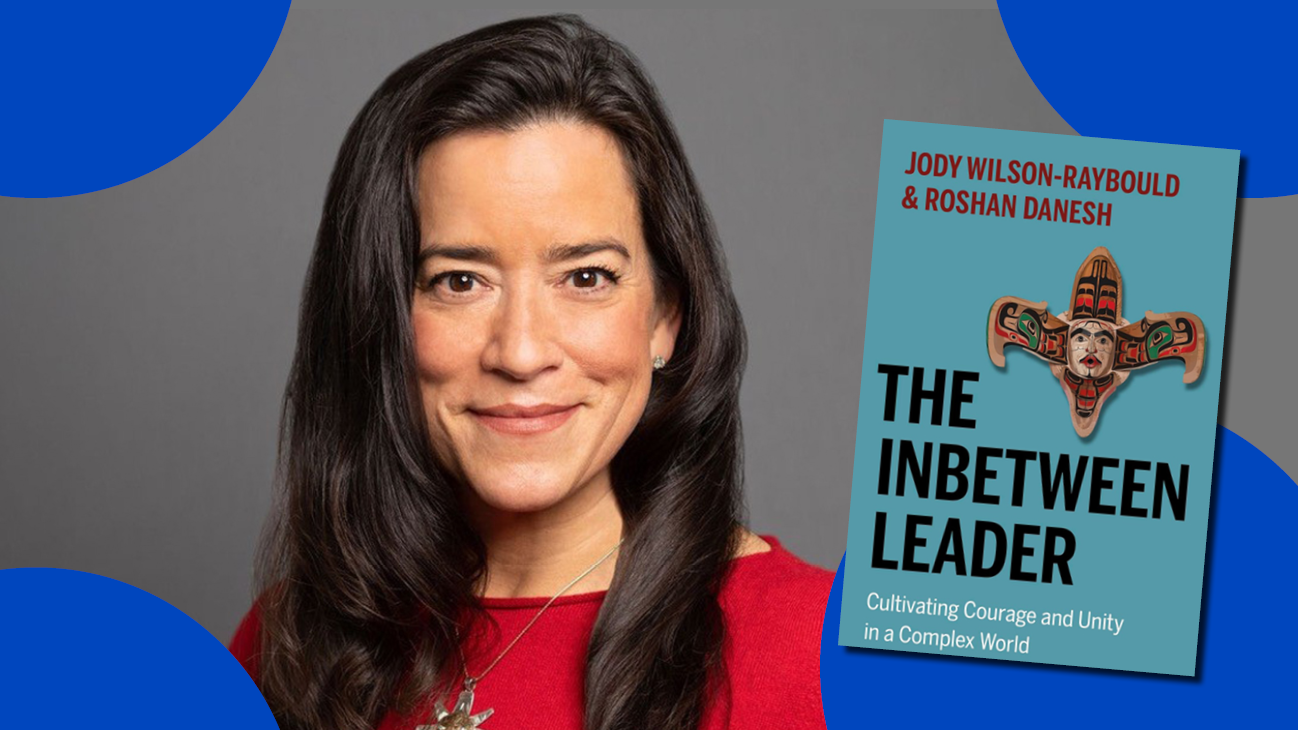
In this era of extreme polarization, traditional leadership models rooted in competition and hierarchy are falling short. In her new book, The Inbetween Leader: Cultivating Courage and Unity in a Complex World, The Hon. Jody Wilson-Raybould offers an alternative — one that fosters interconnectedness, empowers diverse teams, and maintains unity without erasing difference.
The bestselling author of True Reconciliation, Jody’s new book, co-authored with Roshan Danesh, draws on Indigenous governance traditions and worldviews as well as her own leadership journey to show how leaders at every level, from boardrooms to kitchen tables, can put unity into practice and build spaces where people feel genuinely valued and heard.
Jody is a former MP and Minister of Justice and Attorney General of Canada, as well as the daughter of a hereditary chief, who has built a strong reputation as a bridge builder and champion of good governance and accountability. We recently sat down with her to explore her new book and what it means to lead from the inbetween.
A New Type of Leadership
Speakers Spotlight: What is an “inbetween leader,” and what does this kind of leadership look like in practice?
The Hon. Jody Wilson-Raybould: The idea of an inbetween leader came about as a response to a lot of different things that have happened throughout my life. The framing behind it is in response to where I found myself in mainstream politics and some of the realities and challenges I faced there. It’s also a response to travelling and speaking to groups of people from all walks of life about leadership today, and increasingly seeing a decline in how people view leadership in public life.
In the book, I say that leadership is both in time and out of time. What I mean by that is there are various aspects of leadership that are constant across time, but there is also an aspect of leadership that has to be in response to the particular moment we’re in. The moment we’re in now is somewhat paradoxical, in that we seem to be pulling apart while also pulling together. The inbetween leader can stand in between those forces and harness their dynamics, with the goal of breaking down the silos and the divisions that exist between and among us.
The book is not a step-by-step formula, but it does explore the various attributes and practices of an inbetween leaders. I like to think of it as a mirror people can use to self reflect on their own leadership style and those around them, enabling them to rise up.
An Inbetweener in Politics
SpSp: Can you share an experience that changed how you think about what it means to lead from the “inbetween”?
JWR: People like to hear about my time in politics. I found myself elected as an MP and then in the position of Minister of Justice and Attorney General. That experience is one of the emphases behind this book. I’ve always talked about being an inbetweener, even before I had the concept in my head. But the reality I faced, and the experiences I had sitting around the cabinet table or in other meetings with ministers and prime ministers, was that when it came to issues around the relationship between Indigenous and non-Indigenous peoples, and reconciliation between them, we were sitting around the same table but speaking different languages. When I spoke about those issues, no one seemed to understand what I was talking about.
This was true on various issues, not just Indigenous ones, and I found myself trying to be a bridge between these different realities and worldviews, thinking politics could be done in a different way. But the reality of politics, particularly with political parties, is polarization, different worldviews, and competitive models of leadership. That led to many challenges for me, which ultimately led to me resigning and being kicked out.
Where Traditional Leadership Falls Short
SpSp: Where do traditional leadership models fall short when leaders are navigating today’s polarization and competing perspectives?
JWR: We have a chapter in the book that speaks to different models of leadership and worldviews. There are three models we look at in particular: authoritative and controlling, a competitive model where the winner takes all, and then a unity-based worldview, which is what I believe in and what I think an inbetween leader is. I’m not faulting models of leadership and traditions throughout history, they served their purpose at times, but I spend a lot of the book talking about my reality and leadership.
In terms of where leadership falls short today, I think we need to ask ourselves different questions about this moment in time and what this moment demands. We don’t need more leaders like we see south of the border. If we look at the challenges and complexities we have right now, the leaders we need are not ones who lead through force and fear, or wanting to win at all costs, the leader we need are those that build unity, that pull people together, and utilize the best within all of us to tackle the challenges we have in front of us. You can’t build unity or partnership through force or competition.
Where leaders fall short right with this right now is that that they talk about unity, but their means do not match their words. There is no consistency of a values-based approach. The actions they take don’t reflect that unity-based reality or principles.
Consensus Over Competition
SpSp: Your book draws on Indigenous governance traditions and integrative worldviews. What principles do you explore that challenge conventional approaches to leadership and decision-making?
JWR: I was raised within the customs and traditions of my people. I was raised by my grandmother and parents who taught me how to be a leader and what my responsibility is within our nation. I come from a potlatchian people. We have a big house where decisions are made, people are married, wealth is redistributed, people atone for their so-called sins, etc. In mainstream politics, I was surprised about the realities of political parties where winner takes all. In a potlatch, there are no political parties or partisanship. This is where I think mainstream politics can learn form Indigenous ways of being, where you function by consensus and the role of a leader is to seek that consensus. That doesn’t mean everyone agrees, there is debate as we seek a general consensus on the issues.
My approach is to seek out consensus as much as possible. Leadership is deeply personal, and in the book, I speak about what I was taught, my responsibility to myself and my community and the values I grew up with of accountability and restoration. I was taught to understand and ensure balance, and when that balance is off, how to restore it. There is a lot that non-Indigenous people in politics can learn from a culture that has existed for thousands of years.
Leadership Starts Within
SpSp: What do you hope readers take away from The Inbetween Leader and put into practice in their own organizations and communities?
JWR: One of the things that I hope this book encourages is the ability to be self reflective as an individual and as a leader. It explores attributes that we see as being present in an inbetween leader and a unity-based worldview, such as being constant and coherent and constructively resilient, and we share practices to go with them. This book is not intended to be a blueprint as I think leadership is very personal, but it does provide signposts to help people reflect on themselves and their interactions with others.
What I want people to take away is a sense of hope that we are not destined to remain in this place. I hope they can see that their actions have value and have ripples that they may not notice in the moment. What we do as individuals matter, and what seems to be lacking in public leadership can be found within ourselves.
Hire Jody Wilson-Raybould to Speak at Your Event
Canada’s first Indigenous Minister of Justice and Attorney General, the Hon. Jody Wilson-Raybould brings a rare perspective as both a community and political leader. She speaks powerfully on leadership, Indigenous rights and reconciliation, democracy and governance, and justice.
Contact us to learn more about Jody and how to bring her to your next event.