
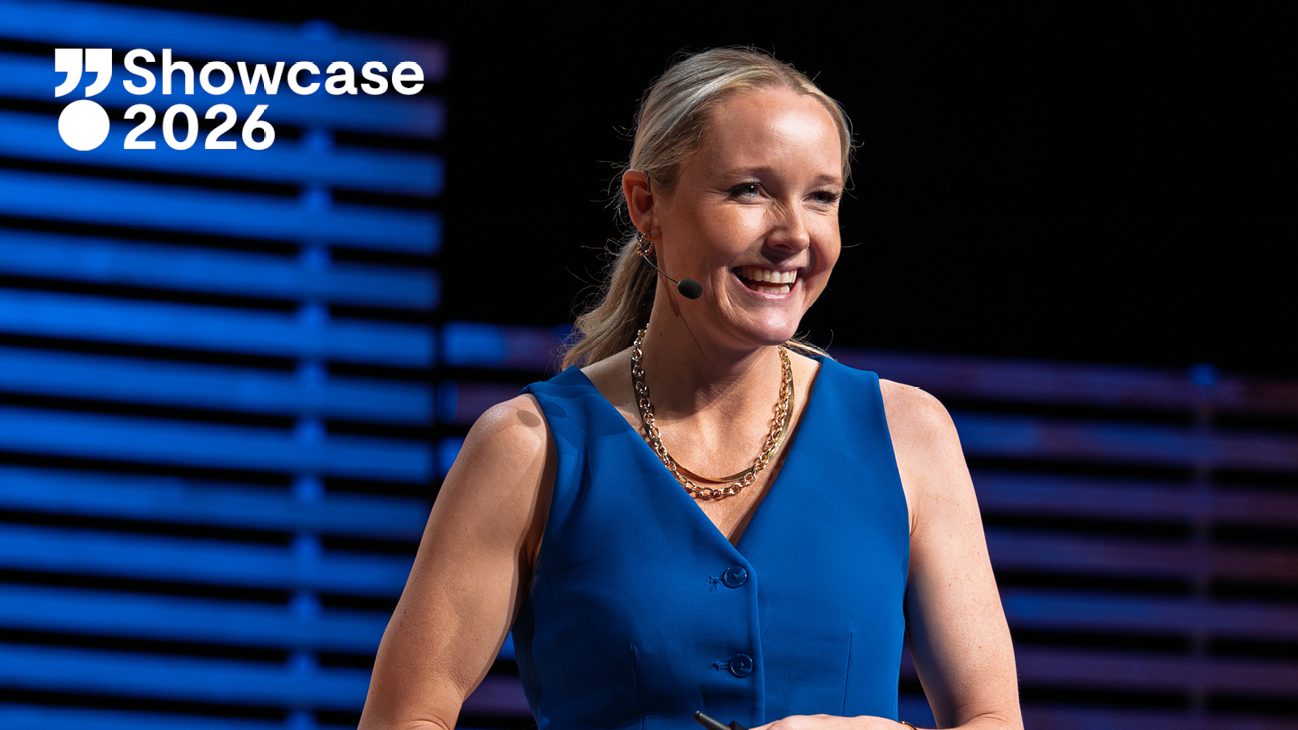
We celebrate the win, the podium, the success — and we call it excellence. But Olympian Sarah Wells would tell you that’s the highlight reel, not the story. True excellence is built in the preparation, the setbacks, and the moments nobody sees.
As our closing keynote at Showcase 2026, Speakers Spotlight’s annual client-exclusive, TED-style event, Sarah ended the day on a high note. Known for her “cell phone charging energy”, she shared her remarkable Olympic journey to break down the three pillars of true excellence — proving that it isn’t reserved for a select few, but a mindset anyone can adopt, no matter who you are or where you begin.
Sarah Wells is charismatic, energetic, and well prepared. She did a good job of connecting experiences as an athlete to what success looks like for individuals who put in the time and effort and persevere.
Showcase 2026 attendee
From the Track to the Stage
Sarah spent 14 years training for a 55-second race. That’s 90 percent of her time preparing for something that lasts less than one minute. In the world of high-performance sport, that ratio is accepted without question because everyone understands that excellence lives in the preparation, Sarah said. But the ratio is completely flipped in the business world. Most of us spend just 10 percent of our time learning and preparing, and 90 percent in the race. That is backwards because “true growth,” Sarah said, “happens when we embrace the training mindset.”
An Olympic hurdler for Team Canada, Sarah made her Olympic debut at the London 2012 Games. She had remarkably qualified after being sidelined for nine months with a stress fracture in her left femur. It’s what happened during those nine months that shaped everything she now teaches about excellence.
The Three Pillars of Excellence
Sarah’s philosophy centres on the idea that excellence isn’t about perfection — it’s about breaking free from limiting beliefs and constantly striving to outperform who you were yesterday. This is something she learned firsthand through broken bones, torn muscles, and moments that tested everything she had. It’s from those moments that she draws her three pillars of excellence.
1. Go All In
After her stress fracture diagnosis, Sarah’s doctor told her she’d need three months off. This was devastating for her. One year out from the Olympics, she had yet to hit the qualifying standard. She needed 55 seconds; her best was 56. Her coach gave her a choice. She could walk away, and everyone would understand. Or she could keep showing up — not to sprint or hurdle, but to do the foundational work. “It’s not gonna be flashy. It’s not going to be fun. But it will be foundational. And that is still progress,” he told her. Those three months became nine — but she kept showing up anyways.
That reframe — from what success looks like to what success is built on — fuelled her comeback, and became the challenge she put to the room. “Your success won’t be built on your best days,” she said. “It’ll be built on the days you show up anyways.”
2. Break the Blueprint
Elite hurdlers, Sarah explained, run 15 strides between hurdles, clearing each one with the same lead leg. But, coming back from injury, Sarah had lost muscle on one side so 15 strides kept landing her short. Her coach suggested changing it up — taking 16 strides and alternating legs, something no one at a world-class level does. Her instinct was to push back. His response changed everything. He asked, “Are we trying to make the Olympics the way everyone else is — or are we trying to make the Olympics?” They broke the blueprint and she qualified.
Every person in the room, Sarah said, has their own 16-stride advantage. “When we’re met with change or a challenge, look to your strengths. It just might be the path through.”
3. Find Strength in Setbacks
Fresh off the London Olympics, Sarah already had her eye on Rio 2016. She won a silver medal at the 2013 Summer Universiade and a pair of medals at the 2015 Pan Am Games in Toronto. Her sponsors, the media, and everyone around her agreed: she was ready.
Six weeks before the 2016 Olympic trials, Sarah woke up with a tight hamstring. She knew she probably shouldn’t train but did it anyways. Mid-sprint, it tore. In that moment, she realized her highest level of success had quietly become her baseline expectation, and in protecting it, she had pushed through a warning sign she knew she shouldn’t have ignored.
Over the next six weeks, Sarah did everything she could to recover. On race day, she knew she didn’t need her best performance — she just needed to finish top three to make the Olympics. At the halfway mark, she was winning. Then one girl came into her vision, then another, then a third at the final hurdle. Shoulder to shoulder at the finish line, she gave everything she had — and finished fourth, missing the Olympic team by a fraction of a second.
“Success is not a ledge,” Sarah said. “It’s a roller coaster — good days and bad quarters. It doesn’t mean you’re falling off. It just means you’re on the ride.” But what struck her most wasn’t the loss, it was what she discovered in the wreckage of it. She had shown up on a torn hamstring, in the biggest race of her career, and left everything on the track. That, she said, revealed a belief in herself far stronger than any medal could. “It showed me a strength I didn’t even know I had.”
Book Sarah Wells for Your Next Event
Excellence isn’t built in the spotlight — it’s built in the moments before it. That was Sarah’s message from start to finish. “No matter success or setback,” she said, “it is never an endpoint. It is simply a stepping stone.”
With more than a decade of competition at the highest level, along with a master’s degree in leadership and innovation from the Smith School of Business, Sarah delivers powerful, research-backed insights that unlock the mindset and practical tools to cultivate excellence in everything we do.
Contact us to learn more about Sarah Wells and how to book her for your next event.