Trust is in crisis. Confidence in governments, media, and institutions has been declining for decades. Yet, one organization has somehow done the opposite: Wikipedia. What began as a punchline has become one of the most trusted sources of information in the world. So how did they do it?
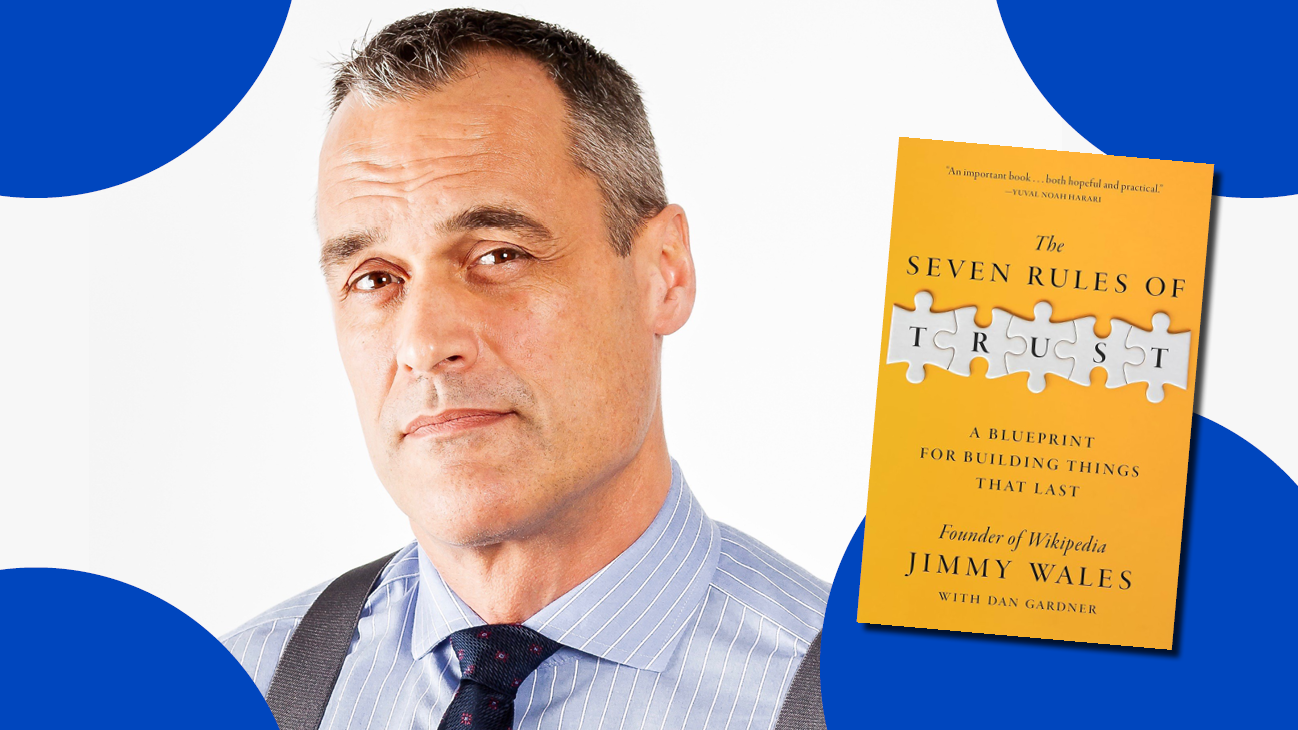
Award-winning journalist and New York Times bestselling author Dan Gardner set out to answer that question alongside co-author and Wikipedia founder Jimmy Wales. The result is The Seven Rules of Trust: A Blueprint for Building Things That Last — a research-backed guide to cultivating the one thing every team, organization, and community can’t function without.
We recently sat down with Dan to dig into what Wikipedia got right, what most leaders get wrong, and why the oldest instincts in human nature might be your greatest asset in an age of AI.
On Working with Wikipedia Founder, Jimmy Wales
Speakers Spotlight: What brought you and Jimmy Wales together for this project — and why did you decide that trust would be the central theme of the book?
Dan Gardner: Jimmy is the founder of Wikipedia and after 25 years — in which Wikipedia went from an unworkable joke to one of the most important websites in the world — he wanted to write a book about the experience and what academic research says about trust and cooperation. Because trust and cooperation were what built Wikipedia. It couldn’t exist without it.
But Jimmy had never written a book before. I specialize in books about how people think, judge, plan, and execute. Fingers, meet glove.
From a Punchline to a Trusted Information Hub
SpSp: Early critics called Wikipedia naïve for assuming strangers could collaborate honestly online. What were some of the key moments or decisions that turned that “naïve” vision into a sustainable culture of trust?
DG: The key is social norms that promote trust and cooperation. To create those norms, the very first steps are by far the most important. It’s a matter of path-dependency. Get on the right path early and you’re golden. Get on the wrong path and you will have to struggle mightily to get back to the right path. Course-correction isn’t impossible, as we show in the book. But it’s harder than getting it right in the first place.
The Power of Trust
SpSp: Your book outlines seven rules of trust. Were there any that surprised you — insights that only became clear through studying Wikipedia’s evolution?
DG: Wikipedia has a rule for its editors: “assume good faith.” That means assume the other person is being honest. The other person doesn’t have a hidden agenda. The other person won’t screw you over at the first opportunity.
Before I researched trust, I would have thought, “yeah, that sets a positive tone. That’s good. But not all that important.” But what I may have missed is that people are naturally inclined to reciprocate: When someone sends something your way, you want to send the same thing their way. If someone is friendly and helpful, you want to be friendly and helpful; if someone is insulting and nasty, you want to paste them, right? That is an impulse hard-wired by evolution. And it is powerful.
Now, if you “assume good faith,” you are, in effect, giving trust to that person. That triggers the instinct for reciprocity: “You gave me your trust? Okay, I’ll give you my trust.”
It’s not a perfect mechanism. Some people will abuse the trust you give. But as a general rule, giving trust is a remarkably powerful way to get trust.
Why Transparency Wins Every Time
SpSp: Which rule do you think is most often neglected or misunderstood in today’s organizations?
DG: Transparency. Hands down. Executives commonly think that to earn trust they must show their organization will always deliver as expected. And they’re right to think that’s important! But they take it too far. They think this means they must hide mistakes and embarrassments. They fear transparency.
But being transparent — openly admitting those mistakes and embarrassments — can be a superb way to cultivate trust. Yes, it does mean admitting things that may put a dent in your perceived competence. But people know that no one, and no organization is perfect. And more importantly, when you are transparent about faults and failings, you show that you are a person — or an organization — of integrity. You show that you believe in honesty. You show that you will tell people the truth, even when it hurts. And integrity is one of the three pillars of trust, along with competence.
Confession is good for the soul. And trust, too.
The Evolution of Trust in an AI-Driven World
SpSp: In an age of AI-generated content and misinformation, how do you see the concept of trust evolving?
DG: Only two things are certain about the effects of AI on society given the current pace and scale of adoption. One, they will be widespread; two, they will largely be unpredictable. So I will suggest with some confidence that AI will contribute to trust being further disrupted, shifting, and evolving, but I think any attempt to say precisely how is a fool’s errand.
So what can an executive do to preserve and promote trust in a world in flux? Focus on what is not changing. Make that your baseline for responding as the environment evolves.
What’s not changing? Human nature. It’s the product of hundreds of thousands of years, and in all that time, judging the trustworthiness of others was an essential task for our ancestors. That’s where our cognitive hardwiring for judging trust comes from. And that’s not going to change anytime soon. (And by “anytime soon,” I’m talking centuries and millennia.)
You must understand that ancient hardwiring. It’s the critical first step in preparing yourself to respond swiftly and effectively in a rapidly shifting environment disrupted by the very newest technology.
How to Build Trust
SpSp: What’s one practical first step anyone — a manager, a teacher, or a community organizer — can take to begin building a “positive loop of trust” in their own context?
DG: The first of our seven rules is: “keep it personal.” That’s the essential first step. It can get you surprisingly far. And it’s easy to implement because it’s what people naturally do.
How do you decide to trust this person but not that person? You sense it intuitively. Maybe you haven’t explicitly thought about why you feel the way you do. But you feel it. Well, that intuitive sense, teased out with good research, and made explicit, is your best guide at every level from one person judging one person to millions of people judging an international organization.
Or to put that more simply: What works face-to-face is what works at every scale.
Hire Dan Gardner to Speak at Your Organization
Drawing from his bestselling books, Dan Gardner is one of the world’s most sought-after voices on trust, risk management, forecasting, and decision-making. His keynote Winning Trust in an Untrusting Time draws on economics, evolutionary psychology, and the unlikely story of Wikipedia to give leaders a practical, research-backed model for earning — and keeping — trust.
Contact us to learn more about Dan and how to book him to speak at your next event.