
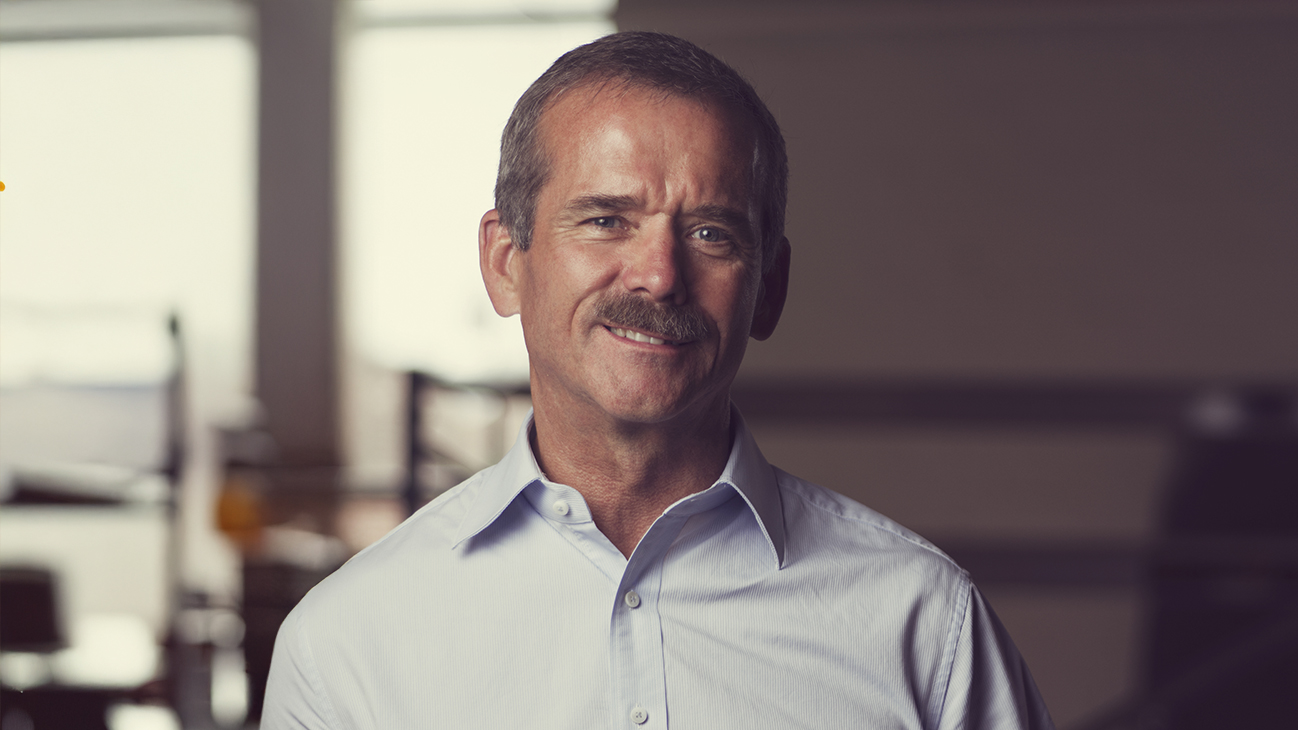
In 1995, Colonel Chris Hadfield met a new student at the Royal Military College of Canada, striking up a mentorship that would last for decades and see this young freshman, Jeremy Hansen, make a historic trip around the moon.
Jeremy was one of four astronauts aboard Artemis II, which embarked on a historic 10-day mission on April 1, 2026 — NASA’s first crewed deep space mission in over 50 years. As of April 6, the crew reached the moon for their scheduled lunar flyby making Jeremy the first Canadian to ever venture to the moon.
“What is going on right now is what this crew has been living for. It’s what they’ve been training for for the last decade,” Chris said in an interview with Bloomberg. A celebrated astronaut himself and the first Canadian to command the International Space Station, he joined them to discuss the impact of the Artemis II mission and what it means for the future of space exploration.
“They have managed to successfully fly a rocket that no one ever flew before,” Chris continued, “fly a spaceship that no one has ever flown before, and successfully travel all the way from the earth to the moon.”
A Leap Forward in Science and Technology
Artemis II, Chris said, presents a scientific opportunity unlike anything that has come before. The crew photographed and observed the lunar surface in extraordinary detail, capturing data at a scale the Apollo missions 50 years before it could never have managed.
“One of the big advantages right now is we have digital photography,” Chris said. “They can take thousands and thousands of pictures that film wouldn’t capture because of the radiation up there. So the detail of science they’re bringing back, that’s an unprecedented advance in technology. “
The ship itself tells the same story. This is NASA’s first crewed flight test of the Space Launch System rocket and Orion spacecraft. “The way it navigates, the way we communicate with it, the monitoring systems on board. This is the first time we’ve flown it with people, and we got it all the way to the moon and back,” Chris said.
The Next Phase of Space Exploration
But for Chris, the mission is bigger than the technology itself. He sees Artemis II as the first chapter of the next phase in space exploration. “We’re transitioning from the exploration 50 years ago to the very first flight of the settlement phase of the moon,” he said. “It’s really easy to ignore that amongst all the hubbub, but that’s where we are in human history.”
With settlement of the moon being the ultimate goal, Artemis II gave NASA a rare chance to document the far side of the moon — gathering the kind of close-up detail that will help shape where and how we put people there permanently.
The Apollo missions saw astronauts land near the equator of the moon. Since then, Chris said, we’ve discovered that the north and south pole of the moon have craters full of ice. “Best guess, about 100 billion gallons of water,” he added. Also the poles always have sun on the horizon, which would provide consistent solar power.
“So one of the things this crew is observing is not just the amazing geology of the moon but also what the conditions are going to be like at the poles and the first landing site. The first place that we’re going to live will be near the South Pole where we have naturally occurring water and power from the sun.”
Chris estimates that it could be within two or three years that we’ll have astronauts at the south pole, once enough robotic infrastructure is in place.
Building a Framework for the Moon
While momentum in space travel has historically been vulnerable to shifting political landscapes, Chris sees the Artemis program differently — built to last beyond any single administration.
“A good example is Antarctica,” he said. “No one had ever been there until the late 1800s. People were dying all the time trying to get there. But then we decided collectively, with multiple countries, that we should settle Antarctica differently. We should do it cooperatively and we should do it for the long term. That, I think, with any luck at all, will be the future of the moon.”
It’s a conviction he’s putting into practice. Chris is currently working alongside King Charles III through the Open Lunar Foundation to build the governance frameworks that will shape how humanity actually settles the moon — how nations share access, resolve disputes, and maintain the will to keep moving forward.
“The International Space Station, despite its complications, has endured and succeeded for over 30 years… We need to take those ideas to the moon and find a way to make it part of the human experience.”
A Legacy of Exploration
For Chris, Jeremy and his crewmates are the start of that story. The pathfinders, he calls them — and he would know one when he sees one.
Throughout his distinguished career, Chris has been a fighter/test pilot, flown three space missions, built two space stations, performed two spacewalks, crewed the Shuttle and Soyuz, and, of course, commanded the International Space Station. His many awards include the NASA Exceptional Service Medal, the Meritorious Service Cross (twice), and the Order of Canada.
Chris also served as NASA’s Director of Operations in Russia and led NEEMO 14 — a 14-day mission in the Aquarius underwater laboratory on the ocean floor, testing the skills and systems needed for future space exploration.
Today, Chris serves as a director and advisor to multiple tech companies, including SpaceX and Virgin Galactic. He is also an adjunct professor at the University of Waterloo, chair of the Open Lunar Foundation, and is assisting King Charles III with space business practices for the Sustainable Markets Initiative.
Book Chris Hadfield as Your Next Speaker
As a keynote speaker, Chris Hadfield’s presentation celebrates the marvels and wonders of science and spaceflight while exploring the parallels between space exploration, leadership, and the strategic integration of emerging technologies. They have been called “an astonishing display of visual storytelling” by Harvard Business Review, and his TED talk, “What I Learned from Going Blind in Space”, has been viewed over 20 million times.
Contact us to learn more about Chris and how to book him for your next event.