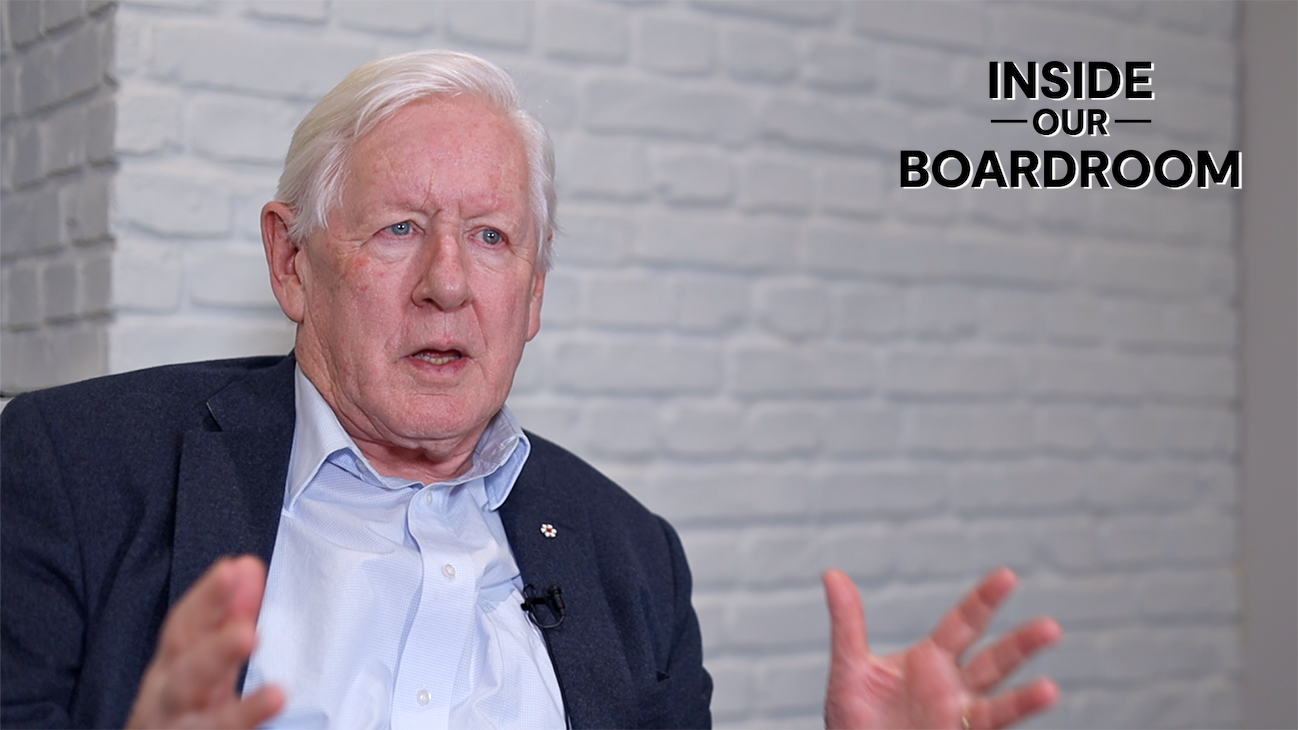
With over five decades of leadership spanning international diplomacy, national politics, and public policy, the Honourable Bob Rae has navigated some of the most consequential moments in modern Canadian and global history — from the halls of Queen’s Park to the floor of the United Nations.
Bob has served as the Premier of Ontario and the interim Leader of the Liberal Party of Canada, and was elected to federal and provincial parliaments 11 times over four decades. Most recently, he served as Canada’s Ambassador, where he led discussions on some of the world’s most pressing humanitarian challenges.
Few voices carry the breadth of real-world experience that Bob brings to questions of leadership, resilience, and navigating uncertainty. He recently joined us “Inside Our Boardroom” to reflect on what true leadership looks like in turbulent times, the short- and long-term challenges ahead for Canada, and how leaders can best prepare themselves and their teams for what’s coming.
Answers have been edited for length and clarity.
Leading Through Adversity
Speakers Spotlight: How would you define true leadership in a challenging time?
The Hon. Bob Rae: I think leadership is about having a vision of what you want to do and where you think things need to go and then finding the ability within yourself to say yes, this is something I really believe needs to happen. Leadership in a sense starts with yourself. If you can’t convince yourself of something, if you don’t have the self-confidence to take your message or your idea, whether in business or government, where it needs to go, then you’re going to have a hard time persuading anybody else.
Then you come to the next phase, which is about listening. It’s about sharing your idea and then listening to what others think about it. I always remind people that a good leader needs followers, otherwise, you’re either just managing things or you’re a prophet off in another direction, telling people where to go but not necessarily having anybody come with you. Then it’s a process of give and take. Learning how to listen, learning how to persuade, making sure you know what you’re doing.
The final stage is action. We often forget that one. Leadership without execution is problematic and very quickly you lose your ability to persuade. There’s always a gap between the word and the deed, and it’s really important to keep that gap as narrow as you can because what builds credible leadership is confidence, and what builds confidence is people knowing that you’re telling the truth, doing what you said you would do, and delivering on what you said. So that’s true leadership in a nutshell.
Canada’s Challenges Ahead
SpSp: What are Canada’s greatest challenges in the near and long term?
BR: I think in the longer term we have to be prepared for real technological change and rapid change affecting how we live and work. Everybody needs to be prepared for change of some kind and that change is not necessarily going to be easy. In the immediate term, I think the challenge we face is the economics and politics of Canada due to the unpredictability of our neighbour, and I’m putting it as mildly as I can.
We have to recognize we’re living in a very difficult moment for the country, which requires us to work together more effectively than we have for a long time. We don’t have the luxury of just sitting around and criticizing. We have to figure out how we can make this better and how we can fix it. One of the immediate challenges that we’re going to face is, can we stay the course with our leadership, whether in the country or as a company. Can we find a way to improve that and work better together more effectively? And can we help everyone become more resilient to the forces that are coming at us?
Staying Focused Through Challenging Times
SpSp: How do you stay focused when international challenges keep shifting?
BR: Well, I think you have to avoid the temptation to be impulsive in your reaction. One of the things about social media is it looks for instant reaction. Like or don’t like, comment or don’t comment. There’s an enormous temptation for people to think that they don’t have time to step back and question, “How is this going to work through?” The immediacy of the reaction that’s required by today’s media means that you have to have the courage to take your time and reflect.
We are always tempted to think and act impulsively, and we need to think much more consequentially and act much more consequentially. What will happen if we do X? What’s the likely reaction if I do this? It’s more like chess. You’re thinking about the next move, but your opponent may be thinking about three or four moves down the way. So, you’ve got to be aware of that and thinking in that broader way. But in order to see the whole board, you have to be able to see the bigger picture. That isn’t going to happen if you respond impulsively to what you’re facing.
Navigating Shifting Canada-US Relations
SpSp: What advice do you have for businesses dealing with today’s US administration?
BR: The key to everything is gathering as much information as you can about exactly what you’re facing as quickly as you can, then having the ability as a leader to share where you think this takes you. Then it’s about listening to others, especially those who may have a different view, and then trying to figure out where does this all come together, and you don’t necessarily have endless amounts of time to do that.
I also think it’s really important for leaders to provide people with a sense of hope and a sense that there’s room for things to be done better. If you’re in the arena, as Teddy Roosevelt once famously said, you’re making decisions. You don’t have the luxury of thinking critically or negatively about what you’re trying to do. Sometimes journalists and media commentators or critics don’t really get the difference between what they’re doing and what you are doing because if you’re in the arena, you simply have to move in a direction that’s positive and thoughtful and wait for the criticism afterwards. You’ll just have to do whatever it is you have to do. It’s important to remember that.
Building Resilient Teams
SpSp: How do we stay on track in a world that’s taking a greater toll on mental health?
BR: There’s so much more recognition today, from the prevalence or the extent to which there’s a serious mental health issue out there and its need to be addressed and then the willingness of people to come forward and help others.
Particularly, I found this during COVID. I was in New York when it was the epicentre of COVID in the earlier days, and I had to spend a lot of time, as a leader, thinking about how people were doing and how we could help to make it better. As in most things, the first point that has to be made is that there are no thoughts that can’t be expressed, that you can’t get yourself in a situation where you’re not allowed to talk about something or that you can’t find a place where you can talk about it.
The second thing is for all of us to admit that it’s a problem that everybody faces in one way, shape, or form. I can remember when I had a serious experience with my own mental health. I was in my early 20s, and it was first met with disbelief. People said, “You’re doing so well, so you haven’t got any objective reason why.” The first thing we learn about mental health is that you don’t necessarily know the reasons for it, maybe you tried to be too much of a perfectionist, you drove yourself too hard, you had an issue with addiction, etc. Whatever it might be, we have to ask ourselves how do we deal with those problems and how do we provide people with the means to deal with it?
As a leader, you have a responsibility to create a space of positivity. You don’t have the luxury of simply being negative or critical. We all know people in the workplace who can be toxic. I think it’s one of the most critical jobs of a leader to be able to recognize that this is a big deal. That this is a big problem in our society, and it affects every workplace. Creating the programs to show that you’re prepared to take it seriously as a company is hugely important. It makes all the difference in the world, and I think it’s time that we really championed how to get this.
Hire Bob Rae to Speak at Your Next Event
The Honourable Bob Rae offers audiences rare insight into navigating complex global challenges, building consensus across divides, and leading through transformation. His keynotes draw on firsthand experience with humanitarian crises, negotiations with world leaders, and critical issues — delivered with the wisdom of a statesman and the accessibility of a natural storyteller.
Contact us to learn more about Bob and how to book him for your next event.