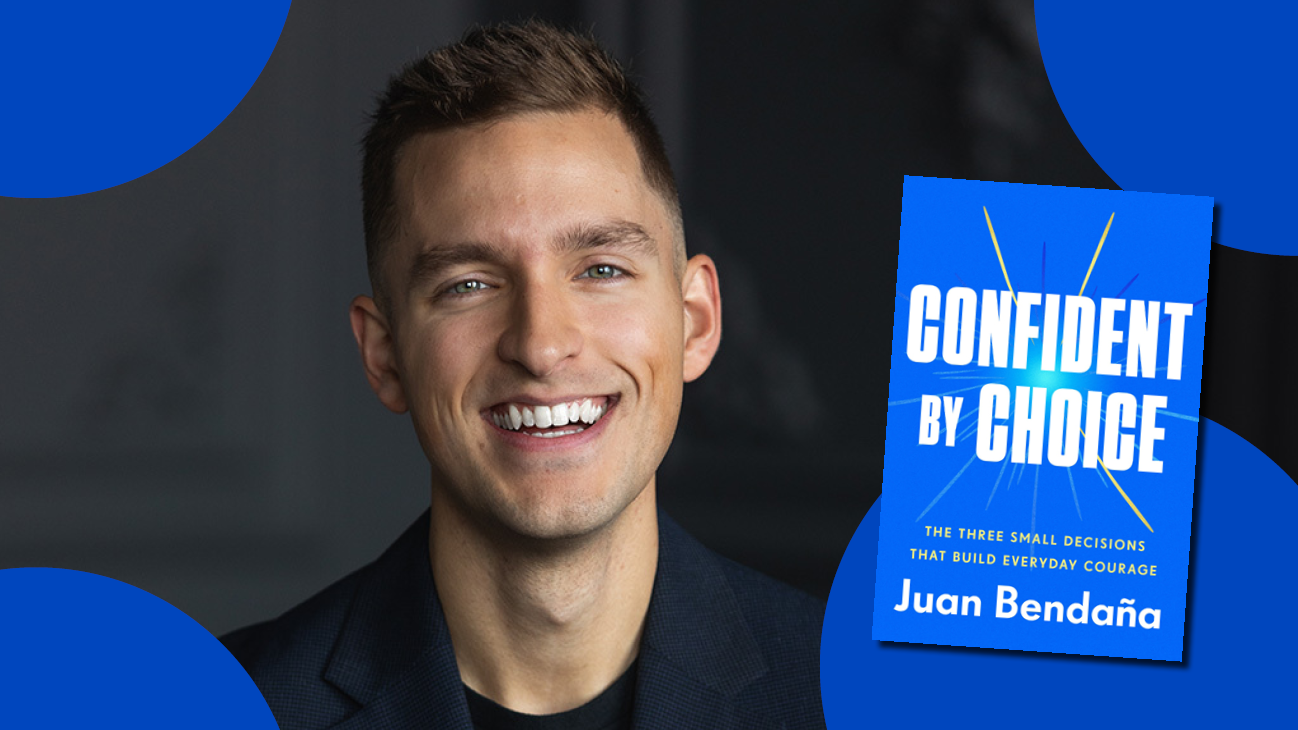
Confidence is the foundation to success. In his new book, Juan Bendaña helps readers activate the confidence mindset to live boldly, thrive through change, and ignite extraordinary growth.
After years of research and working with over 250,000 individuals, Juan uncovered the four myths about confidence that actually cause and reinforce self-doubt. To combat these, he developed the Confidence Cycle — a repeatable flywheel that helps people gain and sustain confidence in every aspect of their life through three key decisions: micro-energy, micro-courage, and micro-action. The result? Micro-proof and boost of confidence.
Featured in Harvard Business Review and Rolling Stone, Confident by Choice shares Juan’s practical, research-backed framework that will jumpstart your confidence and help build lasting courage to be your best self and face life’s inevitable challenges. We recently spoke with Juan about his new book to learn more about the Confidence Cycle and the steps we can take today to start building our more confident self.
Becoming a Confident Expert
Speakers Spotlight: How did you become a confidence expert and focus on it as a key factor to performance, leadership, wellness, etc.?
Juan Bendaña: It was sparked out of a desire to figure it out for myself. I wasn’t born with confidence, but over time I was able to develop it in certain areas by doing certain things that led me to feel more confident.
Once I dove into the world of leadership and performance, I realized it was the missing piece, and one day, I developed a system — a framework called the Confidence Cycle. I wanted to know the answer to building confidence and the current research wasn’t cutting it. So, I drew out this system and put it to practice, using myself as a guinea pig, and it changed how I saw myself, my work, and the world. I decided to go all in on that system and 2.5 years later, it’s a book.
Busting the Biggest Confidence Myths
SpSp: Your new book busts myths about confidence. What are some of the most damaging myths about confidence you’ve seen people hold onto?
JB: One of the most prevalent myths is that confident people have zero insecurities. That couldn’t be further from the truth. Confident people have just as much insecurities and doubt as the rest of us, they just have a different relationship with them. They don’t see self-doubt as a sign to stop, but as a signal to get better — to retool and grow.
A second myth is that confident people are extroverted. That’s often an association we make because extroverted people put themselves out there, they’re not afraid to raise their hand. Confident people do put themselves out there, they engage with the world, but sometimes they are reserved and introverted. Oftentimes, extroversion is a sign of insecurity — they are overcompensating, trying to validate an idea or their perspective, show that what they say matters, that they are valuable. So that correlation is pretty misguided.
The Power of Micro Steps in Building Confidence
SpSp: You’ve created a repeatable framework to build and sustain confidence that’s centred around micro steps. How do these small steps lead to big transformations?
JB: Most of the work on confidence right now focuses on the confident-competence loop — the better you become, the more confident you will feel. But too often people don’t even get to the action step — the process of building their skills — because they are tired and afraid.
That’s where micro steps come in, the first focusing on generating energy. Energy is the ignition that starts the engine, that sparks the process. Developing that energy creates a catalytic effect to build micro-courage, which is needed to put yourself in a moment of fear and discomfort. Most people don’t take this step because they are too tired to fight the fear of failure and rejection, but it’s important to step into a moment of discomfort to expand and grow. That’s when we get to the third micro step, which is micro-action — actually taking the leap, raising your hand and saying, “yes, I’m going to volunteer.”
Those three steps then lead to micro-proof. You start seeing evidence that you are what you say you are, that you are the person you say you want to be. Enough reinforcement leads to a new identity and a new confident version of yourself.
The Confidence Cycle in Action
SpSp: Can you share a story of your framework in action?
JB: I’ll share a personal story. About 7-8 years ago, before I had this model, I saw it play out in real time. I was always someone who struggled with their weight. After a relationship suddenly ended, I fell apart and turned to food as a coping mechanism. I was 75lbs overweight, binge eating, and it felt like life was spiraling.
I needed to do something. I put my last $600 down on a flight to California after my friend suggested I needed to change something, a fresh start. In those six weeks, I was practicing the confidence cycle without knowing it. I invested energy into an area of my life I wanted to improve, not only weight loss, but changing how I showed up in the world. This gave me the courage to make the uncomfortable decision to go somewhere I’ve never been, which facilitated my ability to take micro-action, the daily steps needed to create this transformation. This then gave me proof I was on the right track. Every failure, rejection, and goal reached started to reinforce that identity, which reinforced the confidence I was building, which gave me more energy, and the evolutions kept happening. I lost 75lbs and reinvented the way I saw myself within six months.
How to Break Free from Self-Doubt
SpSp: For someone who feels stuck in self-doubt, what’s something they can do today to start building momentum?
JB: Find the excitement in your life. Sometimes when people feel defeated, discouraged, etc., it can feel like the energy of our lives is being taken away. We need to find that excitement again.
When we are in a state of excitement, it creates anticipation, which generates energy. It’s anticipation psychology — our brain’s way of preparing for something to come. For example, we feel better before a vacation vs. on the trip. So, my recommendation is to tap into the excitement of life, even if it’s just being excited to see friends this weekend, to take your dog for a walk, or that your favourite show released a new season. Latch on to that excitement, because excitement releases energy. We can leverage it to bring energy to the now and use that energy on the goals we want to work towards.
So, if you’re feeling discouraged or out of options, excitement is the first place to start because that will give you energy to spark the process of growth, transformation, and of moving forward.
Bouncing back from Setbacks
SpSp: How do you prevent confidence from fading over time, especially after a setback?
JB: We need to spend more time in the process of growth than dwelling on what has happened. It’s easier to dwell on failure, rejection, adversity, etc., but all of that is thinking about the past as opposed to setting your sights forward on what can happen.
Most worrying is just the anticipation of a negative outcome that hasn’t happened, while excitement is the anticipation of something positive. Most thoughts of failure and rejection are bared on something that has already happened, something set in stone, so instead, think about what hasn’t and have a vision for the kind of future you want to create.
Hire Juan Bendaña to Speak at Your Event
Through inspiring stories, humour, practical insights, and audience interaction, Juan Bendaña prepares leaders and their teams to break through barriers of self-doubt, cultivate motivation, and ignite excitement for the future. His dynamic delivery leaves audiences inspired, engaged, and ready to tackle their biggest goals with renewed energy and optimism — no matter what the future holds.
Contact us to learn more about Juan and why audiences call him a “walking shot of espresso.”